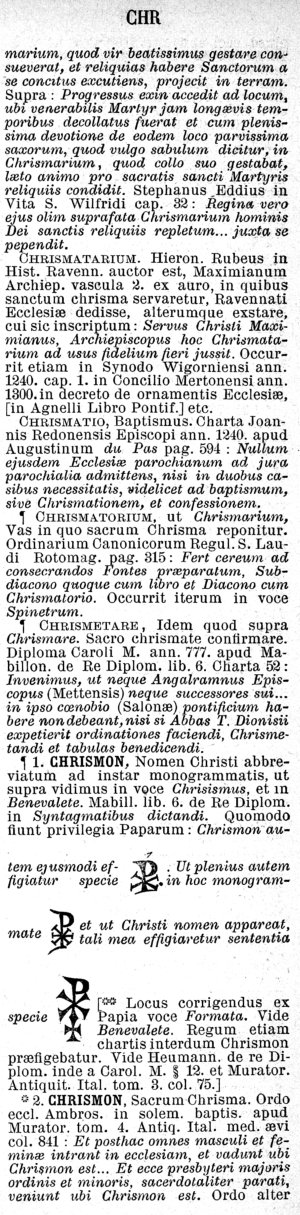
One of the oldest Christograms is the Chi-Rho (☧). It consists of the superimposed Greek letters chiScript error: No such module "Lang". and rhoScript error: No such module "Lang"., which are the first two letters of the Greek Script error: No such module "Lang"., 'Christ'. It was displayed on the Script error: No such module "Lang". military standard used by Constantine I in 312 AD. The IX monogram (File:Christliche Symbolik (Menzel) I 193 4.jpg) is a similar form, using the initials of the name Script error: No such module "Lang"., 'Jesus (the) Christ', as is the ΙΗ monogram (File:IH Monogram with iota and eta superimposed.svg), using the first two letters of the name Script error: No such module "Lang"., 'JESUS' in uppercase.
There were a very considerable number of variants of "Christograms" or monograms of Christ in use during the medieval period, with the boundary between specific monograms and mere scribal abbreviations somewhat fluid.
The name Jesus, spelled Script error: No such module "Lang". in Greek capitals, has the abbreviations IHS (also written JHS, IHC, or ΙΗΣ). The name Christus , spelt Script error: No such module "Lang"., has XP (and inflectional variants such as IX, XPO, XPS, XPI, XPM). In Eastern Christian tradition, the monogram ΙϹΧϹ (with Overline indicating scribal abbreviation) is used for Script error: No such module "Lang". in both Greek and Cyrillic tradition.
A Middle Latin term for abbreviations of the name of Christ is Script error: No such module "Lang"..[1] Similarly, the Middle Latin Script error: No such module "Lang"., Script error: No such module "Lang". refers to the Chi-Rho monogram specifically.[2]
Script error: No such module "labelled list hatnote".
In antiquity, the cross, i.e. the instrument of Christ's crucifixion (Script error: No such module "Lang"., Script error: No such module "lang".), was taken to be T-shaped, while the X-shape ("chiasmus") had different connotations. There has been scholarly speculation on the development of the Christian cross, the letter Chi used to abbreviate the name of Christ, and the various pre-Christian symbolism associated with the chiasmus interpreted in terms of "the mystery of the pre-existent Christ".[3]
In Plato's Script error: No such module "Lang"., it is explained that the two bands which form the "world soul" (Script error: No such module "Lang".) cross each other like the letter Chi, possibly referring to the ecliptic crossing the celestial equator:
And thus the whole mixture out of which he cut these portions was all exhausted by him. This entire compound divided lengthways into two parts, which he joined to one another at the centre like the letter X, and bent them into a circular form, connecting them with themselves and each other at the point opposite to their original meeting-point; and, comprehending them in a uniform revolution upon the same axis, he made the one the outer and the other the inner circle.
— Plato, Script error: No such module "Lang"., 8.36b and 8.36c[4]
The two great circles of the heavens, the equator and the ecliptic, which, by intersecting each other form a sort of recumbent chi and about which the whole dome of the starry heavens swings in a wondrous rhythm, became for the Christian eye a heavenly cross.
— Lua error in package.lua at line 80: module 'Module:Footnotes/anchor_id_list' not found.. See also Lua error in package.lua at line 80: module 'Module:Footnotes/anchor_id_list' not found.
Justin Martyr in the 2nd century makes explicit reference to Plato's image in Script error: No such module "Lang". in terms of a prefiguration of the Holy Cross.[5] An early statement may be the phrase in Didache, "sign of extension in heaven" (Script error: No such module "lang".).[3]
An alternative explanation of the intersecting celestial symbol has been advanced by George Latura, claiming that Plato's "visible god" in Script error: No such module "Lang". is the intersection of the Milky Way and the Zodiacal Light, a rare apparition important to pagan beliefs. He said that Christian bishops reframed this as a Christian symbol.[6]
The most commonly encountered Christogram in English-speaking countries in modern times is the Χ (or more accurately, Chi), representing the first letter of the word Christ, in such abbreviations as Xmas (for "Christmas") and Xian or Xtian (for "Christian").
Iota Chi (IX)
Script error: No such module "Labelled list hatnote".
An early form of the monogram of Christ, found in early Christian ossuaries in Palestine, was formed by superimposing the first (capital) letters of the Greek words for Jesus and Christ, i.e. iotaΙ and chiΧ, so that this monogram means "Jesus Christ".[7]Template:Rp
Chi Rho (ΧΡ)
Script error: No such module "Labelled list hatnote".
The Alpha and Omega symbols may at times accompany the Chi-Rho monogram.[11] Since the 17th century, Script error: No such module "Lang". (Script error: No such module "Lang".; also Script error: No such module "Lang".) has been used as a Neo-Latin term for the Chi Rho monogram.
Because the Script error: No such module "Lang". was used as a kind of "invocation" at the beginning of documents of the Merovingian period, the term also came to be used of the "cross-signatures" in early medieval charters.[c]Script error: No such module "Lang". in this context may refer to the Merovingian period abbreviation I. C. N. for Script error: No such module "Lang"., later (in the Carolingian period) also I. C. for Script error: No such module "Lang"., and still later (in the high medieval period) just C. for Script error: No such module "Lang"..[13]
St Cuthbert's coffin (late 7th century) has an exceptional realisation of the Christogram written in Anglo-Saxon runes, as ᛁᚻᛋ ᛉᛈᛋ, transliterated to the Latin alphabet as 'IHS XPS', with the chi rendered as the eolh rune (the old z or algiz rune) and the rho rendered as the p-rune.
IHS
IHS Christogram embossed on an 1864 leather-bound King James Bible
In the Latin-speaking Christianity of medieval Western Europe (and so among Catholics and many Protestants today), the most common Christogram became "IHS" or "IHC", denoting the first three letters of the Greek name of Jesus, Script error: No such module "Lang"., iota-eta-sigma, or Script error: No such module "Lang"..[14][15][16]
The Greek letter iota is represented by 'I', and the eta by 'H', while the Greek letter sigma is either in its lunate form, represented by 'C', or its final form, represented by 'S'. Because the Latin-alphabet letters I and J were not systematically distinguished until the 17th century, "JHS" and "JHC" are equivalent to "IHS" and "IHC".
"IHS" is sometimes interpreted as meaning Template:Langx or in Latin Script error: No such module "Lang". (or Script error: No such module "Lang".) Script error: No such module "Lang"., ('Jesus, Saviour of men [or: of Jerusalem]' in Latin)[17] or connected with Script error: No such module "Lang".. English-language interpretations of "IHS" have included "In His Service"[18] or "In His Steps." Such interpretations are known as backformed acronyms.
Used in Latin since the seventh century, the first use of IHS in an English document dates from the fourteenth century, in Piers Plowman.[19] In the 15th century, Saint Bernardino of Siena popularized the use of the three letters on the background of a blazing sun to displace both popular pagan symbols and seals of political factions like the Guelphs and Ghibellines in public spaces (see Feast of the Holy Name of Jesus).
The IHS monogram with the H surmounted by a cross above three nails and surrounded by a Sun is the emblem of the Jesuits, according to tradition introduced by Ignatius of Loyola in 1541.[17]
IHS has been known to appear on gravestones, especially among Irish Catholics.[20][21][22]
In Eastern Christianity, the most widely used Christogram is a four-letter abbreviation, ΙϹ ΧϹ—a traditional abbreviation of the Greek words for 'Jesus Christ' (i.e., the first and last letters of each of the words Script error: No such module "Lang"., with the lunate sigma 'Ϲ' common in medieval Greek),[23] and written with titlo (diacritic) denoting scribal abbreviation (Page Template:Script/styles slavonic.css has no content.І︮С︯ Х︮С︯).
On icons, this Christogram may be split: 'ΙϹ' on the left of the image and 'ΧϹ' on the right. It is sometimes rendered as 'ΙϹ ΧϹ ΝΙΚΑ' (Script error: No such module "Lang".), meaning 'Jesus Christ Conquers'. 'ΙϹΧϹ' may also be seen inscribed on the Ichthys.
Script error: No such module "Labelled list hatnote".
Lhq-inscription on a Japanese lantern
After Francis Xavier landed in Kagoshima, Japan, in 1549, his missionary work grew and became widely distributed throughout Japan under the patronage of the Script error: No such module "lang".. However, during the Edo period (1603–1867), Christians were persecuted and forced to hide. Because they were forbidden to openly reverence the images of Christ or Mary, it is believed that they transferred their worship to other carved images and marked them with secret symbols understood only by the initiates. Certain Japanese lanterns, notably the Script error: No such module "lang". (Script error: No such module "Lang"., 'Christian lanterns'), did bear the "Lhq" monogram, which, a quarter turned, was engraved on the shaft (Script error: No such module "lang".), which was buried directly into the soil without basal platform (Script error: No such module "Lang".). The 'Lhq' monogram corresponds to the distorted letters 'IHS'.[24]
Archaeology
In 2016, a 1,300-year-old corpse, was found in a cemetery near a medieval monastery in Ghazali, Sudan, whose right foot bore a tattoo from medieval Nubia, a region that covered parts of modern-day Egypt and Sudan, depicting a Chi Rho and an Alpha Omega. The person, most likely male, lived sometime between 667 and 774.[25]
^The portmanteau of Christo- and -gramma is modern, first introduced in German as Script error: No such module "Lang". in the mid-18th century. Its adoption into English as Christogram dates to c. 1900.
^The symbol was moved to storage for the refurbishments under Pellegrino Tibaldi and re-instated in the choir on 6 September 1669.[8] Use of the name Script error: No such module "Lang". is apparently based on the term Script error: No such module "Lang". as used by Landulf of Milan;[9] Landulf's mention of a crismon of Saint Ambrose clearly refers to chrism, i.e. holy oil, not a symbol.[10]
^While in English literature of the 19th to mid 20th century, Script error: No such module "Lang". refers to the Chi Rho monogram exclusively, the German-language usage has also come to be adopted in some cases in the specific context of medieval sigla, especially in works translated from German into English, e.g.
Hans Belting, Edmund Jephcott (trans.), Likeness and Presence: A History of the Image Before the Era of Art (1997), pp. 107–109.[12]
^Chrisimus (par les Bénédictins de St. Maur, 1733–1736), in: du Cange, et al., Glossarium mediae et infimae latinitatis, ed. augm., Niort : L. Favre, 1883‑1887, t. 2, col. 317b. "CHRISIMUS, Nomen Christi abbreviatum in antiquis instrumentis secundum diversos casus sic XPS. XPI. XPO. XPM. ubi media littera P. Græcum. Vox Chrisimus legitur in Annal. Benedict. tom. 5. pag. 7."
^Crismon (par les Bénédictins de St. Maur, 1733–1736), in: du Cange, et al., Glossarium mediae et infimae latinitatis, ed. augm., Niort : L. Favre, 1883‑1887, t. 2, col. 621b.
"CRISMON, Nota quæ in libro ex voluntate uniuscujusque ad aliquid notandum ponitur. Papias in MS. Bituric. Crismon vel Chrismon proprie est Monogramma Christi sic expressum ☧"
1 chrismon (par les Bénédictins de St. Maur, 1733–1736), in: du Cange, et al., Glossarium mediae et infimae latinitatis, ed. augm., Niort : L. Favre, 1883‑1887, t. 2, col. 318c, citing Heumann. de re Diplom. inde a Carol. M. § 12; Murator. Antiquit. Ital. tom. 3. col. 75.
^ abPage Module:Citation/CS1/styles.css has no content.Grigg, Robert (1977). ""Symphōnian Aeidō tēs Basileias": An Image of Imperial Harmony on the Base of the Column of Arcadius". The Art Bulletin. 59 (4): 477, 469–482. doi:10.2307/3049702. JSTOR3049702.
^Page Module:Citation/CS1/styles.css has no content.Bagatti, Bellarmino (1984). The Church from the Circumcision: History and Archaeology of the Judaeo-Christians. Studium Biblicum Franciscanum, Collectio Minor, n.2. Jerusalem: Franciscan Print. Press. OCLC17529706.
^I. A. Ferrai, "I Fonti di Landolfo Seniore", Bullettino dell'Istituto storico italiano 14 (1895), p. 29.
^Allegory of the Church by Calvin Kendall 1998 Template:ISBN page 137
^For German usage, see Ersch et al., Volume 1, Issue 29 of Allgemeine Encyklopädie der Wissenschaften und Künste, 1837, p. 303Template:In lang.
Johann Christoph Gatterer, Elementa artis diplomaticae universalis (1765), p. 145 ( Abriß der Diplomatik 1798,
p. 64).
^Johann Christoph Gatterer, Abriß der Diplomatik (1798),
p. 64f.
Carl Ernst Bohn, Allgemeine deutsche Bibliothek vol. 111 (1792), p. 521.
^Christian sacrament and devotion by Servus Gieben 1997 Template:ISBN page 18
^The Continuum encyclopedia of symbols by Udo Becker 2000 Template:ISBN page 54
^ abMaere, René. "IHS." The Catholic Encyclopedia. Vol. 7. New York: Robert Appleton Company, 1910.
^Page Module:Citation/CS1/styles.css has no content.Bush, Brian Paige; (NA), Bush (1 March 2004). His Blueprint In The Bible: A Study Of The Number Three In Scripture. Dorrance Publishing Co. p. 9. ISBN9780805963823.
^Page Module:Citation/CS1/styles.css has no content.Romano, Ron. Portland's Historic Eastern Cemetery: A Field of Ancient Graves. Arcadia Publishing. p. 87.
^Page Module:Citation/CS1/styles.css has no content.New Jersey Cemeteries and Tombstones: History in the Landscape. Rutgers University Press. 2008. p. 179.
^Page Module:Citation/CS1/styles.css has no content.Irish South Australia: New histories and insights. Wakefield Press. 2019. p. 81.
^Symbols of the Christian faith by Alva William Steffler 2002 Template:ISBN page 67
Lua error in package.lua at line 80: module 'Module:Navbox/configuration' not found.Lua error in package.lua at line 80: module 'Module:Navbox/configuration' not found.





_I_193_4.jpg)


.jpg)