Endoderm
Page Module:Infobox/styles.css has no content.
| Endoderm | |
|---|---|
| Lua error in package.lua at line 80: module 'Module:InfoboxImage/data' not found. Tissues derived from endoderm. | |
| Details | |
| Days | 16 |
| Precursor | Epiblast |
| Identifiers | |
| MeSH | Template:Wikidata |
| NeuroNames | Template:Wikidata |
| NeuroLex ID | Template:Wikidata |
| TA98 | Lua error in Module:Wikidata at line 746: attempt to index field 'wikibase' (a nil value). |
| TA2 | Template:Wikidata |
| TH | {{#property:P1694}} |
| TE | {{#property:P1693}} |
| FMA | Template:FMA |
| Anatomical terminology [[[d:Lua error in Module:Wikidata at line 865: attempt to index field 'wikibase' (a nil value).|edit on Wikidata]]] | |
Script error: No such module "Check for conflicting parameters".

Endoderm is the innermost of the three primary germ layers in the very early embryo. The other two layers are the ectoderm (outside layer) and mesoderm (middle layer).[1] Cells migrating inward along the archenteron form the inner layer of the gastrula, which develops into the endoderm.[2]
The endoderm consists at first of flattened cells, which subsequently become columnar. It forms the epithelial lining of multiple systems. The endoderm epithelium forms the respiratory and gastrointestinal tracts through nodal signaling.[3]
In plant biology, endoderm corresponds to the innermost part of the cortex (bark) in young shoots and young roots often consisting of a single cell layer. As the plant becomes older, more endoderm will lignify.
Formation of the Endoderm Layer
The endoderm is formed through the nodal signaling pathway.[3] In all vertebrate species, it has been found that the development of the endoderm is at a high concentration of the nodal signaling gradient, whereas mesoderm development is at the side of low concentration of nodal signaling.[3]
In humans, the endoderm can differentiate into distinguishable organs after 5 weeks of embryonic development.
Production of Tissues
The following chart shows the tissues produced by the endoderm. The embryonic endoderm develops into the interior linings of two tubes in the body, the digestive and respiratory tube.[4] Pattern formation allows the initial endoderm cells to form the organs involved in each of these systems.[3] By forming these organs, the ability to absorb nutrients in the digestive tract and to exchange gases in the respiratory tract follows.[3]
| Layer | Category | System | |
|---|---|---|---|
| General[5] | Gastrointestinal tract | the entire alimentary canal except part of the mouth, pharynx and the terminal part of the rectum (which are lined by involutions of the ectoderm), the lining cells of all the glands which open into the digestive tube, including those of the liver and pancreas | |
| General | Respiratory tract | the trachea, bronchi, and alveoli of the lungs | |
| General | Endocrine glands and organs | the lining of the follicles of the thyroid gland and the epithelial component of the thymus (i.e. thymic epithelial cells). | |
| Auditory system | the epithelium of the auditory tube and tympanic cavity | ||
| Urinary system | the urinary bladder and part of the urethra |
Liver and pancreas cells are believed to derive from a common precursor.[6]
Additional images
-
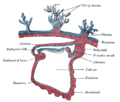 Section through the embryo.
 -
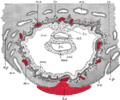 Section through ovum imbedded in the uterine decidua
 -
 Signaling pathway to inducing endoderm


See also
Page Template:Div col/styles.css has no content.
References
 This article incorporates text in the public domain from Template:Wikidatathe 20th edition of Gray's Anatomy (1918)
Page Template:Reflist/styles.css has no content.
- ^ Langman's Medical Embryology, 11th edition. 2010.
- ^ Page Module:Citation/CS1/styles.css has no content.Fukuda, Kimiko; Kikuchi, Yutaka (August 2005). "Endoderm development in vertebrates: fate mapping, induction and regional specification". Development, Growth and Differentiation. 47 (6): 343–355. doi:10.1111/j.1440-169X.2005.00815.x. ISSN 0012-1592. PMID 16109032. S2CID 26241717. Retrieved 10 March 2023.
- ^ a b c d e Page Module:Citation/CS1/styles.css has no content.Zorn, Aaron M.; Wells, James M. (2009). "Vertebrate endoderm development and organ formation". Annual Review of Cell and Developmental Biology. 25: 221–251. doi:10.1146/annurev.cellbio.042308.113344. ISSN 1530-8995. PMC 2861293. PMID 19575677.
- ^ Page Module:Citation/CS1/styles.css has no content.Gilbert, SF. "Endoderm". Sinauer Associates. Retrieved 14 March 2013.
- ^ The General category denotes that all or most of the animals containing this layer produce the adjacent product.
- ^ Page Module:Citation/CS1/styles.css has no content.Zaret KS (October 2001). "Hepatocyte differentiation: from the endoderm and beyond". Curr. Opin. Genet. Dev. 11 (5): 568–74. doi:10.1016/S0959-437X(00)00234-3. PMID 11532400.
Page Module:Side box/styles.css has no content.Page Template:Sister project/styles.css has no content.
Lua error in package.lua at line 80: module 'Module:Navbox/configuration' not found.
Lua error in mw.title.lua at line 404: bad argument #2 to 'title.new' (unrecognized namespace name 'Portal').


