EMS VCS 3
Page Module:Message box/ambox.css has no content.
 | This article needs additional citations for verification. (August 2024) |

Note: it has printed logo: "V.C.S. 3".
The VCS 3 (or VCS3; an initialism for Voltage Controlled Studio, version #3) is a portable analogue synthesizer with a flexible modular voice architecture introduced by Electronic Music Studios (EMS) in 1969.[# 1]
EMS released the product under various names. Logos printed at the console's front left (see photos) say "V.C.S. 3" on the most widely sold version; "The Putney (VCS 3)" on the earlier version; and "The Synthi (VCS 3) II" on the later version "Synthi VCS 3 II".[# 2]
History
Page Template:Multiple image/styles.css has no content.

"The Putney (VCS 3)"

"The Synthi (VCS 3) II"
The VCS 3 was created in 1969 by Peter Zinovieff's EMS company. The electronics were designed largely by David Cockerell, and its distinctive appearance was the work of composer Tristram Cary. It was one of the first portable commercially available synthesizers, in the sense that it was housed entirely in a small wooden case, unlike synths from American manufacturers such as Moog Music, ARP and Buchla, which had large cabinets and could take up entire rooms.
The VCS 3 cost just under £330 in 1969. Some people found it unsatisfactory as a melodic instrument due to its inherent tuning instability.[1] This arose from the instrument's reliance on the then current method of exponential conversion of voltage to oscillator frequency—an approach that other companies also implemented with fewer tuning issues. However, the VCS 3 was renowned as an extremely powerful generator of electronic effects and processor of external sounds for its cost.[<span title="Script error: No such module "decodeEncode".">according to whom?]
The first album recorded using only the VCS 3 was The Unusual Classical Synthesizer on Westminster Gold.[2]
The VCS 3 was popular among progressive rock bands, and was used on recordings by artists including Franco Battiato, The Moody Blues, The Alan Parsons Project, Jean-Michel Jarre, Todd Rundgren, Hawkwind, Curved Air, Brian Eno (with Roxy Music and as a solo artist or collaborator), King Crimson, The Who, Gong, and Pink Floyd. Two VCS 3s and a Sequencer 256 were featured in the 1978 film The Shout.[3]

Description
The VCS 3 has three oscillators (the first two normal voltage-controlled oscillators; the third a low-frequency oscillator), a noise generator, two input amplifiers, a ring modulator, 24 dB/octave low-pass voltage-controlled filter,[citation needed] a trapezoid envelope generator, a joystick controller, a voltage-controlled spring reverb unit, and two voltage controlled output amplifiers. Unlike most modular synthesiser systems, which used cables to link components, the VCS 3 uses a distinctive patchboard matrix where pins are inserted to connect its components.
Keyboards controller
_%26_DK-1_keyboard_(1969),_Mus%C3%A9e_de_la_Musique_de_Paris.jpg)
connected to VCS 3 (rear)
Although the VCS 3 is often used for generating sound effects due to lack of a built-in keyboard, external keyboard controllers were available for melodic play. The DK1, produced in 1969, is an early velocity-sensitive monophonic keyboard for VCS 3 with an extra VCO and VCA.[# 3] In 1972 it was extended for duophonic play as DK2.[# 4] Also in 1972, the Synthi AKS was released, as well as a digital sequencer with a touch-sensitive flat keyboard, the KS sequencer,[# 5] and its mechanical keyboard version, DKS.[# 6]
Related models
The VCS 3's basic design was reused by EMS in many other of their own products,[citation needed] most notably the EMS Synthi 100 (1971),[# 7] the Synthi A (1971),[# 8] and AKS (1972, essentially a VCS 3 in a plastic briefcase). The AKS also has a sequencer built into the keyboard's lid.[# 9]
A former agent of EMS in the United States, Ionic Industries, released a portable-keyboard VCS 3 clone in 1973. The Ionic Performer, whose circuitry is based on the VCS 3's, replaced the patchboard matrix with over 100 push-buttons, and added a built-in keyboard and effects units.[4]
-
![EMS Synthi A (1971), also called Portabella[# 8]](https://upload.wikimedia.org/wikipedia/commons/thumb/d/dc/EMS_A.jpg/120px-EMS_A.jpg?utm_source=commons.wikimedia.org&utm_campaign=imageinfo&utm_content=thumbnail)
-
![EMS Synthi AKS (1972)[# 9]](https://upload.wikimedia.org/wikipedia/commons/thumb/9/96/EMS_Synthi_AKS.jpg/120px-EMS_Synthi_AKS.jpg?utm_source=commons.wikimedia.org&utm_campaign=imageinfo&utm_content=thumbnail) EMS Synthi AKS (1972)[# 9]
EMS Synthi AKS (1972)[# 9] -
![EMS Synthi 100 (1971), formerly Digitana, also called The Delaware[# 7]](https://upload.wikimedia.org/wikipedia/commons/thumb/e/ec/EMS_Synthi_100.jpg/120px-EMS_Synthi_100.jpg?utm_source=commons.wikimedia.org&utm_campaign=imageinfo&utm_content=thumbnail)
![EMS Synthi A (1971), also called Portabella[# 8]](/index.php/File:EMS_A.jpg)
![EMS Synthi AKS (1972)[# 9]](/index.php/File:EMS_Synthi_AKS.jpg)
![EMS Synthi 100 (1971), formerly Digitana, also called The Delaware[# 7]](/index.php/File:EMS_Synthi_100.jpg)
Synthi A


Script error: No such module "Labelled list hatnote".
The EMS Synthi A has the same electronics as the VCS 3, but was rehoused in a Spartanite briefcase. Instead of routing signals using patch cables, like Moog products, it uses a patch matrix with resistive pins. The 2700 ohm resistors soldered inside each pin vary in tolerance, indicated by different colours: red pins have 1% tolerance, white have 5%, and green pins are attenuating pins with a resistance of 68,000 ohms.
The later Synthi AKS incorporated an early digital 256 event KS (Keyboard Sequencer) sequencer in the lid, with input provided by a capacitance-sensitive Buchla-style keyboard.
Perhaps its most prominent use is in the introduction to The Alan Parsons Project's I Robot. (1977). VCS 3 synthesisers were also used alongside a traditional chamber music ensemble for the soundtrack to the BBC's Life On Earth nature documentary series, composed by Edward Williams.[5]
Along with Klaus Schulze and Tangerine Dream, other frequent users of the instrument include Cabaret Voltaire, Tim Blake & Miquette Giraudy of Gong, Richard Pinhas of Heldon, Merzbow, Thomas Lehn, Cor Fuhler and Alva Noto.
Development
The original VCS No.1 was a hand-built rack-mount unit with two oscillators, one filter and one envelope, designed by Cockerell before the formation of EMS. When a benefactor, Don Banks, asked Zinovieff for a synthesiser, Zinovieff and Cockerell decided to work together on an instrument that was small and portable but powerful and flexible.
Notable users
- BBC Radiophonic Workshop[6]
- Brian Eno[7]
- Howie B on U2's Pop[8]
- Jean-Michel Jarre[9]
- Merzbow on Door Open at 8 AM[10][11][12][13]
- Pete Townshend[14][15]
- Pink Floyd on Obscured by Clouds (1972), The Dark Side of the Moon (1973), and Wish You Were Here (1975)[16]
- King Crimson on Lizard (1970) and Earthbound (1972)[17][18]
- Todd Rundgren[19][20]
- Tangerine Dream[21]
References
Page Template:Reflist/styles.css has no content.
- ^ Page Module:Citation/CS1/styles.css has no content.Reid, Gordon (November 2000). "All About EMS, Part 1". Sound on Sound. Archived from the original on 2016-03-03.
- ^ Page Module:Citation/CS1/styles.css has no content."unusualstuff - krakatack". Sites.google.com. Retrieved 2020-04-12.
- ^ Page Module:Citation/CS1/styles.css has no content."EMS VCS 3 "The Shout" 1978 | Pin Electronics".
- ^ Page Module:Citation/CS1/styles.css has no content.Dennis Bathory-Kitsz. "Killer – My Ionic "Performer" Synth (from Ionic Industories, made by Alfred Mayer)".
- ^ Power, Mike. 'Release of Life On Earth soundtrack delivers music as pioneering as the show', in The Guardian, 2 November 2009
- ^ Page Module:Citation/CS1/styles.css has no content.Rawlins, Sarah (31 March 2021). "The Birth of the Radiophonic Workshop". National Science and Media Museum blog. National Science and Media Museum. Retrieved 2024-08-12.
- ^ Page Module:Citation/CS1/styles.css has no content."How Brian Eno Created "Discreet Music" | Reverb Machine". reverbmachine.com. 3 September 2019. Retrieved 2022-10-09.
- ^ Page Module:Citation/CS1/styles.css has no content."Flood & Howie B: Producing U2's Pop". Sound On Sound. July 1997. Archived from the original on 2015-06-07.
- ^ Page Module:Citation/CS1/styles.css has no content."Three Questions With Jean-Michel Jarre". Synth History. 20 October 2022. Retrieved 2024-08-12.
EMS VCS 3, my first synth ever, still working and present on each of my albums as a ritual.
- ^ Page Module:Citation/CS1/styles.css has no content.Door Open at 8 AM. Bandcamp (Media notes). Retrieved 2024-10-02.
- ^ Page Module:Citation/CS1/styles.css has no content."EMS Synthesizers: Brits en eigenzinnig". interface.nl (in Nederlands). Archived from the original on 2024-10-04. Retrieved 2024-10-04.
- ^ Page Module:Citation/CS1/styles.css has no content."Silent Modular Wars!!". merzbow.net (in 日本語). Archived from the original on 2024-10-04. Retrieved 2024-10-04.
- ^ Page Module:Citation/CS1/styles.css has no content.Miron Ghiu (26 February 2018). "A short conversation with the legendary noise artist, Merzbow". blackrhinoradio.com. Archived from the original on 2024-10-04. Retrieved 2024-10-04.
- ^ Page Module:Citation/CS1/styles.css has no content."Three Questions With Pete Townshend". Synth History. 27 April 2020. Retrieved 2024-08-12.
- ^ Page Module:Citation/CS1/styles.css has no content.Marks, Ben (1 October 2015). "Rise of the Synthesizer: How an Electronics Whiz Kid Gave the 1980s Its Signature Sound". Collectors Weekly. Retrieved 2024-08-12.
- ^ Page Module:Citation/CS1/styles.css has no content.The, Pink Floyd (1973). The Dark Side Of The Moon (Media notes).: “DAVID GILMOUR Vocals, Guitars, VCS3 / NICK MASON Percussion, Tape Effects / RICHARD WRIGHT Keyboards, Vocals, VCS3 / ROGER WATERS Bass Guitar, Vocals, VCS3, Tape Effects”.
- ^ Page Module:Citation/CS1/styles.css has no content.Logan, Nick (6 June 1970). "KING CRIMSON — biggest one man band in business". New Musical Express. Retrieved 2024-08-12.
- ^ Sleeve notes for Earthbound.
- ^ Page Module:Citation/CS1/styles.css has no content."Todd Rundgren". Jazz Rock Soul. 30 March 2022.
- ^ Page Module:Citation/CS1/styles.css has no content.Zanca, Nick (23 November 2022). "The Wizard Speaks: An Interview With Todd Rundgren". Reverb.com. Retrieved 2024-08-12.
- ^ Page Module:Citation/CS1/styles.css has no content.The Cambridge Companion to Krautrock. Cambridge University Press. 27 October 2022. ISBN 9781009041591.
Bibliography
- Page Module:Citation/CS1/styles.css has no content.Hinton, Graham (December 2002). "EMS: The Inside Story". Electronic Music Studios (Cornwall). Archived from the original on 2013-05-21. Retrieved 2011-09-30.
- Page Module:Citation/CS1/styles.css has no content.Hinton, Graham (December 2002). "A Guide to the EMS Product Range - 1969 to 1979". Electronic Music Studios (Cornwall). Archived from the original on 2013-10-31.
- Page Module:Citation/CS1/styles.css has no content.Reid, Gordon (November 2000). "All About EMS, Part 1". Sound on Sound. Archived from the original on 2016-03-03.
- Page Module:Citation/CS1/styles.css has no content.Reid, Gordon (December 2000). "All About EMS, Part 2". Sound on Sound. Archived from the original on 2011-09-08.
- Models
Page Template:Reflist/styles.css has no content.
- ^ a b Page Module:Citation/CS1/styles.css has no content."VCS3 (aka The Putney) – The Products". Electronic Music Studios (Cornwall). Archived from the original on 2013-10-31.
- ^ Page Module:Citation/CS1/styles.css has no content."Synthi VCS3 II – The Products". Electronic Music Studios (Cornwall). Archived from the original on 2013-10-31.
- ^ Page Module:Citation/CS1/styles.css has no content."DK1 (aka The Cricklewood) – The Products". Electronic Music Studios (Cornwall). Archived from the original on 2013-10-31.
- ^ Page Module:Citation/CS1/styles.css has no content."DK2 – The Products". Electronic Music Studios (Cornwall). Archived from the original on 2013-10-31.
- ^ Page Module:Citation/CS1/styles.css has no content."KS – The Products". Electronic Music Studios (Cornwall). Archived from the original on 2013-10-31.
- ^ Page Module:Citation/CS1/styles.css has no content."DKS – The Products". Electronic Music Studios (Cornwall). Archived from the original on 2013-10-31.
- ^ a b Page Module:Citation/CS1/styles.css has no content."Synthi 100 (formerly Digitana, aka the Delaware) – The Products". Electronic Music Studios (Cornwall). Archived from the original on 2013-10-31. Retrieved 2011-09-30.
- ^ a b Page Module:Citation/CS1/styles.css has no content."Synthi A (formerly Portabella) – The Products". Electronic Music Studios (Cornwall). Archived from the original on 2013-10-31.
- ^ a b Page Module:Citation/CS1/styles.css has no content."Synthi AKS – The Products". Electronic Music Studios (Cornwall). Archived from the original on 2013-10-31.
Further reading
- Page Module:Citation/CS1/styles.css has no content."Retro: VCS3". Future Music. No. 63. Future Publishing. November 1997. p. 55. ISSN 0967-0378. OCLC 1032779031.
External links
Official
- http://emssynthesisers.co.uk/
- Page Module:Citation/CS1/styles.css has no content."An advertisement for the company, "every nun needs a Synthi"". Electronic Music Studios (London), Ltd. Archived from the original on 2012-07-17.
- Page Module:Citation/CS1/styles.css has no content."EMS Home". EMS Rehberg (Germany).
Articles
- Page Module:Citation/CS1/styles.css has no content."EMS VCS3 in the 1970s, part 1". The Music Aficionado. 2 September 2020. Retrieved 2024-08-13.
- Page Module:Citation/CS1/styles.css has no content."EMS VCS3 in the 1970s, part 2". The Music Aficionado. 14 October 2020. Retrieved 2024-08-13.
Modification and resources
- Page Module:Citation/CS1/styles.css has no content.Graham Hinton. "A Guide to EMS VCS3 & Synthi A/AKS Modifications & Servicing". Hinton Instruments.
- Page Module:Citation/CS1/styles.css has no content."Information on the EMS synthi A, KS and VCS3".
Software emulation
- Page Module:Citation/CS1/styles.css has no content."XILS 3, 4 and Vocoder 5000". — A VST simulation of a VCS3/VCS4 with Synthi Sequencer, and Vocoder 5000 by XILS-lab
- Page Module:Citation/CS1/styles.css has no content."Synthi Avs Plug-In". EMS Rehberg. — A (commercial) VST simulation of a VCS3/Synthi A by EMS Rehberg
- Page Module:Citation/CS1/styles.css has no content."Cynthia". — A free VST based on the architecture of VCS3/Synthi A by Ninecows
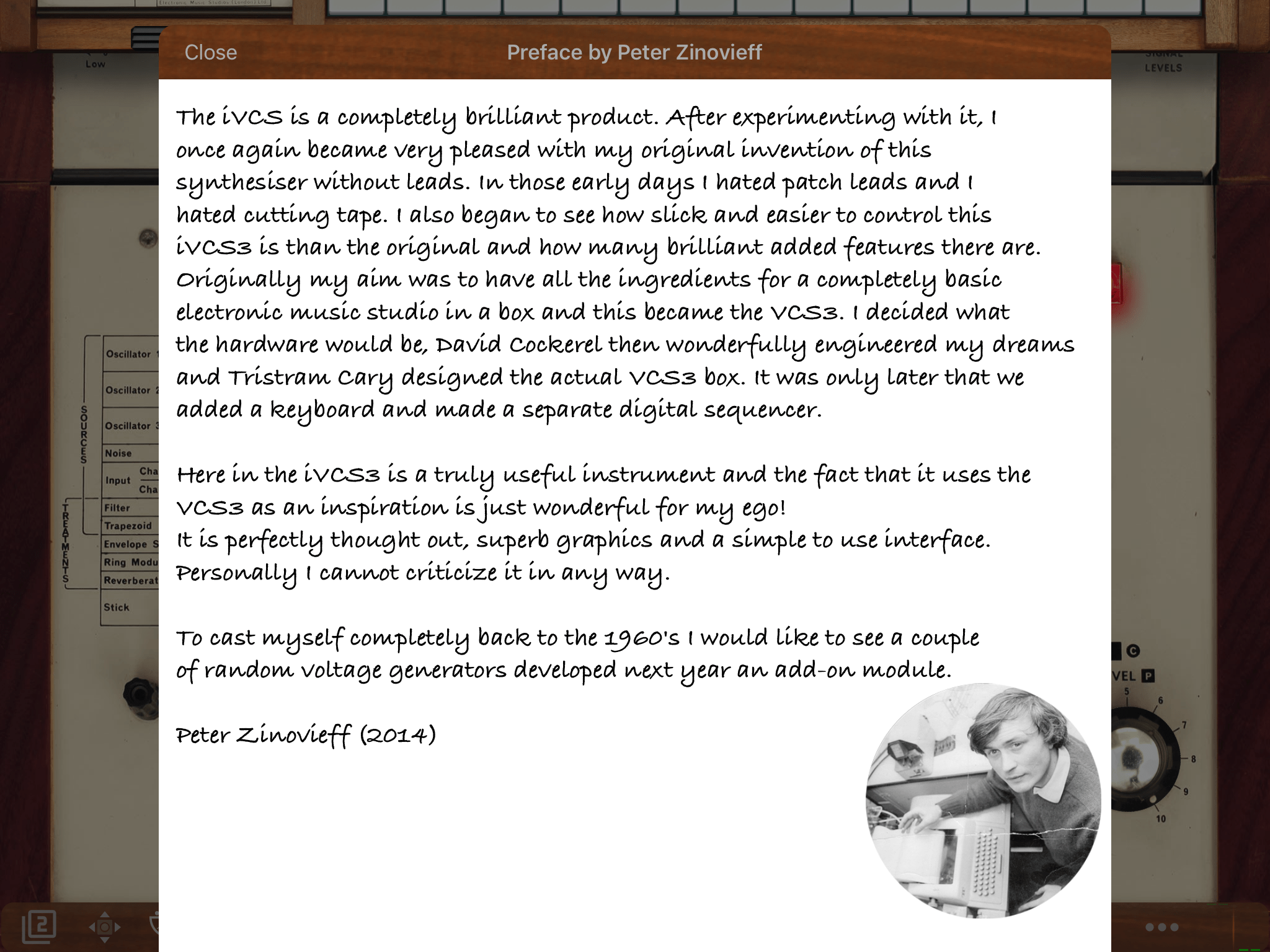
- Page Module:Citation/CS1/styles.css has no content."iVCS3". — Official EMS iOS emulator by apeSoft, with preface by Peter Zinovieff (screen shot)
EMS Synthi A
- Page Module:Citation/CS1/styles.css has no content."EMS' homepage (last updated August 1998)". Cornwall: Electronic Music Studios. Archived from the original on 2013-11-25.
- Page Module:Citation/CS1/styles.css has no content."Every Nun Needs a Synthi" (ad). Archived from the original on 2012-07-17.
- Page Module:Citation/CS1/styles.css has no content."VCS3 & Synthi A Modifications". Hinton Instruments. (last updated 2013-12-14)
- Page Module:Citation/CS1/styles.css has no content."Synthi A-VS plugin". Germany: EMS Rehberg. — A commercial VST simulation of a Synthi A by German EMS
- A freeware VST simulation of a Synthi A
- The EMS SYNTHI BLOG