Video Coding Engine
Video Code Engine (VCE; earlier referred to as Video Coding Engine,[1] Video Compression Engine[2] or Video Codec Engine[3] in official documentation) is AMD's video encoding application-specific integrated circuit implementing the video codec H.264/MPEG-4 AVC. Since 2012 it was integrated into all of their GPUs and APUs except Oland.
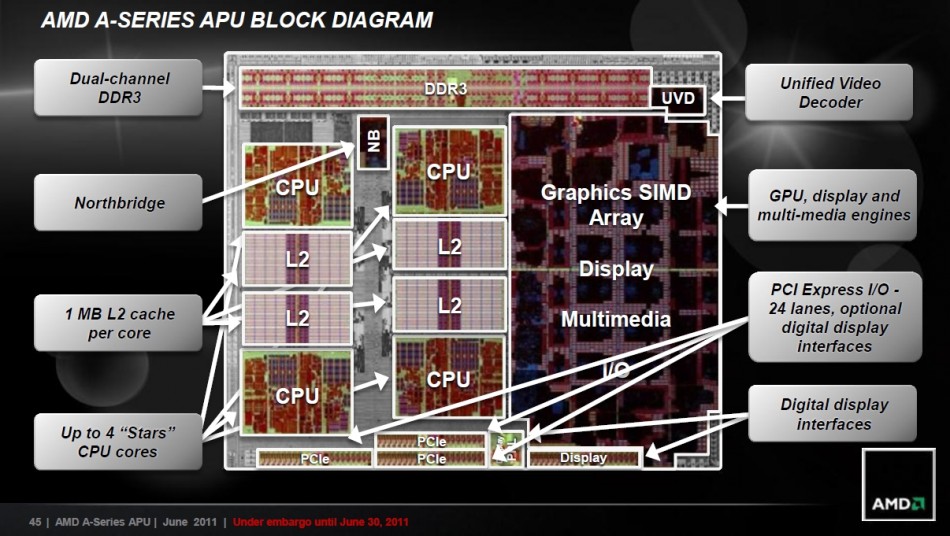
VCE was introduced with the Radeon HD 7000 series on 22 December 2011.[4][5][6] VCE occupies a considerable amount of the die surface at the time of its introduction[7] and is not to be confused with AMD's Unified Video Decoder (UVD).
As of AMD Raven Ridge (released January 2018), UVD and VCE were succeeded by Video Core Next (VCN).
Overview


The handling of video data involves computation of data compression algorithms and possibly of video processing algorithms. As the template compression methods shows, lossy video compression algorithms involve the steps: motion estimation (ME), discrete cosine transform (DCT), and entropy encoding (EC).
AMD Video Code Engine (VCE) is a full hardware implementation of the video codec H.264/MPEG-4 AVC. It is capable of delivering 1080p at 60 frames/sec. Because its entropy encoding block is also a separately accessible Video Codec Engine, it can be operated in two modes: full-fixed mode and hybrid mode.[8][9]
By employing AMD APP SDK, available for Linux and Microsoft Windows, developers can create hybrid encoders that pair custom motion estimation, inverse discrete cosine transform and motion compensation with the hardware entropy encoding to achieve faster than real-time encoding. In hybrid mode, only the entropy encoding block of the VCE unit is used, while the remaining computation is offloaded to the 3D engine of the GPU, so the computing scales with the number of available compute units (CUs).
VCE 1.0
VCE[1] Version 1.0 supports H.264 YUV420 (I & P frames), H.264 SVC Temporal Encode VCE, and Display Encode Mode (DEM).
It can be found on:
- Piledriver-based
- Trinity APUs (Ax-5xxx, e.g. A10-5800K)
- Richland APUs (Ax-6xxx, e.g. A10-6800K)
- GPUs of the Southern Islands generation (GCN1: CAYMAN, ARUBA (Trinity/Richland), CAPE VERDE, PITCAIRN, TAHITI). These are
- Radeon HD 7700 series (except HD 7790 with VCE 2.0)
- Radeon HD 7800 series
- Radeon HD 7900 series
- Radeon HD 8570 to 8990 (except HD 8770 with VCE 2.0)
- Radeon R7 250E, 250X, 265 / R9 270, 270X, 280, 280X
- Radeon R7 360, 370, 455 / R9 370, 370X
- Mobile Radeon HD 77x0M to HD 7970M
- Mobile Radeon HD 8000-Series
- Mobile Radeon Rx M2xx Series (except R9 M280X with VCE 2.0 and R9 M295X with VCE 3.0)
- Mobile Radeon R5 M330 to R9 M390
- FirePro cards with 1st Generation GCN (GCN1) (Except W2100, which is Oland XT)
VCE 2.0
Compared to the first version, VCE 2.0 adds H.264 YUV444 (I-Frames), B-frames for H.264 YUV420, and improvements to the DEM (Display Encode Mode), which results in a better encoding quality.
It can be found on:
- Steamroller-based
- Kaveri APUs (Ax-7xxx, e.g. A10-7850K)
- Godavari APUs (Ax-7xxx, e.g. A10-7890K)
- Jaguar-based
- Kabini APUs (e.g. Athlon 5350, Sempron 2650)
- Temash APUs (e.g. A6-1450, A4-1200)
- Puma-based
- Beema and Mullins
- GPUs of the Sea Islands generation as well Bonaire or Hawaii GPUs (2nd Generation Graphics Core Next), such as
- Radeon HD 7790, 8770
- Radeon R7 260, 260X / R9 290, 290X, 295X2
- Radeon R7 360 / R9 390, 390X
- Mobile Radeon R9 M280X
- Mobile Radeon R9 M385, M385X
- Mobile Radeon R9 M470, M470X
- FirePro W4300, W5100, W8100, W9100, S9100, S9150, S9170
- Mobile FirePro M6100, W6150M, W6170M
VCE 3.0
Video Code Engine 3.0 (VCE 3.0) technology features a new high-quality video scaling and - since version 3.4 - High Efficiency Video Coding (HEVC/H.265).[10][11]
It, together with UVD 6.0, can be found on 3rd generation of Graphics Core Next (GCN3) with "Tonga" and "Fiji" (VCE 3.0) based graphics controller hardware, which is now used AMD Radeon Rx 300 series (Pirate Islands GPU family) and VCE 3.4 by actual AMD Radeon Rx 400 series and AMD Radeon 500 series (both Polaris GPU family).
- Tonga: Radeon R9 285, 380, 380X; Mobile Radeon R9 M390X, M395, M395X, M485X
- Tonga XT: FirePro W7100, S7100X, S7150, S7150 X2
- Fiji: Radeon R9 Fury, Fury X, Nano; Radeon Pro Duo (2016); FirePro S9300, W7170M; Instinct MI8
- Polaris: RX 460, 470, 480; RX 550, 560, 570, 580; Radeon Pro Duo (2017)
AMD's Carrizo platform features VCE 3.1, retaining the same capabilities as the VCE found in "Fiji" and "Tonga".[12]
Stoney Ridge features a cut down version of VCE 3.4 without HEVC/H.265 encoding and is accompanied by a UVD 6.2 engine.[13]
VCE 3.0 removes support for H.264 B-frames.[14]
VCE 4.0
The Video Code Engine 4.0 encoder and UVD 7.0 decoder are included in the Vega-based GPUs.[15][16]
VCE 4.1
AMD's Vega20 GPU, present in the Instinct Mi50, Instinct Mi60 and Radeon VII cards, include VCE 4.1 and two UVD 7.2 instances.[17][18]
Feature overview
APUs
GPUs
The following table shows features of AMD/ATI's GPUs (see also: List of AMD graphics processing units). Template:Navbar-table
| Name of GPU series | Wonder | Mach | 3D Rage | Rage Pro | Rage 128 | R100 | R200 | R300 | R400 | R500 | R600 | RV670 | R700 | Evergreen | Northern Islands |
Southern Islands |
Sea Islands |
Volcanic Islands |
Arctic Islands/Polaris |
Vega | Navi 1x | Navi 2x | Navi 3x | Navi 4x | |||
|---|---|---|---|---|---|---|---|---|---|---|---|---|---|---|---|---|---|---|---|---|---|---|---|---|---|---|---|
| Released | 1986 | 1991 | Apr 1996 |
Mar 1997 |
Aug 1998 |
Apr 2000 |
Aug 2001 |
Sep 2002 |
May 2004 |
Oct 2005 |
May 2007 |
Nov 2007 |
Jun 2008 |
Sep 2009 |
Oct 2010 |
Dec 2010 |
Jan 2012 |
Sep 2013 |
Jun 2015 |
Jun 2016, Apr 2017, Aug 2019 | Jun 2017, Feb 2019 | Jul 2019 |
Nov 2020 |
Dec 2022 |
Feb 2025 | ||
| Marketing Name | Wonder | Mach | 3D Rage |
Rage Pro |
Rage 128 |
Radeon 7000 |
Radeon 8000 |
Radeon 9000 |
Radeon X700/X800 |
Radeon X1000 |
Radeon HD 2000 |
Radeon HD 3000 |
Radeon HD 4000 |
Radeon HD 5000 |
Radeon HD 6000 |
Radeon HD 7000 |
Radeon 200 |
Radeon 300 |
Radeon 400/500/600 |
Radeon RX Vega, Radeon VII |
Radeon RX 5000 |
Radeon RX 6000 |
Radeon RX 7000 |
Radeon RX 9000 | |||
| AMD support | 
|

| |||||||||||||||||||||||||
| Kind | 2D | 3D | |||||||||||||||||||||||||
| Instruction set architecture | Not publicly known | TeraScale instruction set | GCN instruction set | RDNA instruction set | |||||||||||||||||||||||
| Microarchitecture | Not publicly known | GFX1 | GFX2 | TeraScale 1 (VLIW5) (GFX3) |
TeraScale 2 (VLIW5) (GFX4) |
TeraScale 2 (VLIW5) up to 68xx (GFX4) |
TeraScale 3 (VLIW4) in 69xx [19][20] (GFX5) |
GCN 1st gen (GFX6) |
GCN 2nd gen (GFX7) |
GCN 3rd gen (GFX8) |
GCN 4th gen (GFX8) |
GCN 5th gen (GFX9) |
RDNA (GFX10.1) |
RDNA 2 (GFX10.3) |
RDNA 3 (GFX11) |
RDNA 4 (GFX12) | |||||||||||
| Type | Fixed pipeline[a] | Programmable pixel & vertex pipelines | Unified shader model | ||||||||||||||||||||||||
| Direct3D | Template:Screen reader-only | 5.0 | 6.0 | 7.0 | 8.1 | 9.0 11 (9_2) |
9.0b 11 (9_2) |
9.0c 11 (9_3) |
10.0 11 (10_0) |
10.1 11 (10_1) |
11 (11_0) | 11 (11_1) 12 (11_1) |
11 (12_0) 12 (12_0) |
11 (12_1) 12 (12_1) |
11 (12_1) 12 (12_2) | ||||||||||||
| Shader model | Template:Screen reader-only | 1.4 | 2.0+ | 2.0b | 3.0 | 4.0 | 4.1 | 5.0 | 5.1 | 5.1 6.5 |
6.7 | 6.8 | |||||||||||||||
| OpenGL | Template:Screen reader-only | 1.1 | 1.2 | 1.3 | 1.5[b][21] | 3.3 | 4.5 (Windows), 4.6 (Linux Mesa 25.2+)[22] | 4.6[23][c] | |||||||||||||||||||
| Vulkan | Template:Screen reader-only | 1.1[c][d] | 1.3[24][25][e] | 1.4[26] | |||||||||||||||||||||||
| OpenCL | Template:Screen reader-only | Close to Metal | 1.1 (not supported by Mesa) | 1.2+ (on Linux: 1.1+ (no Image support on Clover, with Rusticl) with Mesa, 1.2+ on GCN 1.Gen) | 2.0+ (Adrenalin driver on Win 7+) (on Linux ROCm, Mesa 1.2+ (no support in Clover, only Rusticl, Mesa, 2.0+ and 3.0 with AMD drivers or AMD ROCm), 5th gen: 2.2 win 10+ and Linux RocM 5.0+ |
2.2+ and 3.0 Windows 8.1+ and Linux ROCm 5.0+ (Mesa Rusticl 1.2+ and 3.0 (2.1+ and 2.2+))[27][28][29] | |||||||||||||||||||||
| HSA / ROCm | Template:Screen reader-only |
|
? | ||||||||||||||||||||||||
| Video decoding ASIC | Template:Screen reader-only | Avivo/UVD | UVD+ | UVD 2 | UVD 2.2 | UVD 3 | UVD 4 | UVD 4.2 | UVD 5.0 or 6.0 | UVD 6.3 | UVD 7 [15][f] | VCN 2.0 [15][f] | VCN 3.0 [30] | VCN 4.0 | VCN 5.0 | ||||||||||||
| Video encoding ASIC | Template:Screen reader-only | VCE 1.0 | VCE 2.0 | VCE 3.0 or 3.1 | VCE 3.4 | VCE 4.0 [15][f] | |||||||||||||||||||||
| Fluid Motion [g] |
|
|
|
? | |||||||||||||||||||||||
| Power saving | ? | PowerPlay | PowerTune | PowerTune & ZeroCore Power | ? | ||||||||||||||||||||||
| TrueAudio | Template:Screen reader-only | Via dedicated DSP | Via shaders | ||||||||||||||||||||||||
| FreeSync | Template:Screen reader-only | 1 2 | |||||||||||||||||||||||||
| HDCP[h] | Template:Screen reader-only | ? | 1.4 | 2.2 | 2.3 [31] | ||||||||||||||||||||||
| PlayReady[h] | Template:Screen reader-only | 3.0 |
|
3.0 | |||||||||||||||||||||||
| Supported displays[i] | 1–2 | 2 | 2–6 | ? | 4 | ||||||||||||||||||||||
| Max. resolution | ? | 2–6 × 2560×1600 |
2–6 × 4096×2160 @ 30 Hz |
2–6 × 5120×2880 @ 60 Hz |
3 × 7680×4320 @ 60 Hz [32] |
7680×4320 @ 60 Hz PowerColor |
7680x4320
@165 Hz |
7680x4320 | |||||||||||||||||||
/drm/radeon[j]
|
|
Template:Screen reader-only | |||||||||||||||||||||||||
/drm/amdgpu[j]
|
Template:Screen reader-only | Kernel 6.19+ [33]
|
| ||||||||||||||||||||||||
Page Template:Reflist/styles.css has no content.
- ^ The Radeon R100 Series has programmable pixel shaders, but do not fully comply with DirectX 8 or Pixel Shader 1.0. See article on R100's pixel shaders.
- ^ R300, R400 and R500 based cards do not fully comply with OpenGL 2+ as the hardware does not support all types of non-power of two (NPOT) textures.
- ^ a b OpenGL 4+ compliance requires supporting FP64 shaders and these are emulated on some TeraScale chips using 32-bit hardware.
- ^ Vulkan support is theoretically possible but has not been implemented in a stable driver.
- ^ Vulkan support in Linux relies on the AMDgpu kernel driver, the radeon driver does not support Vulkan.
- ^ a b c The UVD and VCE were replaced by the Video Core Next (VCN) ASIC in the Raven Ridge APU implementation of Vega.
- ^ Video processing for video frame rate interpolation technique. In Windows it works as a DirectShow filter in your player. In Linux, there is no support on the part of drivers and / or community.
- ^ a b To play protected video content, it also requires card, operating system, driver, and application support. A compatible HDCP display is also needed for this. HDCP is mandatory for the output of certain audio formats, placing additional constraints on the multimedia setup.
- ^ More displays may be supported with native DisplayPort connections, or splitting the maximum resolution between multiple monitors with active converters.
- ^ a b DRM (Direct Rendering Manager) is a component of the Linux kernel. AMDgpu is the Linux kernel module. Support in this table refers to the most current version.
Operating system support
The VCE SIP core needs to be supported by the device driver. The device driver provides one or multiple interfaces, e. g. OpenMAX IL. One of these interfaces is then used by end-user software, like GStreamer or HandBrake (HandBrake rejected VCE support in December 2016,[34] but added it in December 2018[35]), to access the VCE hardware and make use of it.
AMD's proprietary device driver AMD Catalyst is available for multiple operating systems and support for VCE was added to it[citation needed]. Additionally, a free device driver is available. This driver also supports the VCE hardware.
Linux
Script error: No such module "Labelled list hatnote".

- Initial VCE support was added on 4 February 2014 by Christian König of AMD to the free radeon driver.[36]
- Gallium3D state tracker for OpenMAX was added 24 October 2013 to Mesa 3D.[37]
- The free and open-source Radeon driver was adapted to use OpenMAX with the GStreamer OpenMAX (gst-omx) support for exposing the VCE video encode engine.[38]
- AMD employee Leo Liu implemented h264 level support into the Mesa 3D state tracker.[39]
Windows
The software "MediaShow Espresso Video Transcoding" seems to utilize VCE and UVD to the fullest extent possible.[40]
XSplit Broadcaster supports VCE from version 1.3.[41]
Open Broadcaster Software (OBS Studio) supports VCE for recording and streaming. The original Open Broadcaster Software (OBS) requires a fork build in order to enable VCE.[42]
AMD Radeon Software supports VCE with built in game capture ("Radeon ReLive") and use AMD AMF/VCE on APU or Radeon Graphics card to reduce FPS drop when capturing game or video content.[43]
HandBrake added Video Coding Engine support in version 1.2.0 in December 2018.[35]
Successor
Script error: No such module "Labelled list hatnote".
The VCE was succeeded by AMD Video Core Next in the Raven Ridge series of APUs released in October 2017. The VCN combines both encode (VCE) and decode (UVD).[44]
See also
Video hardware technologies
AMD
- Video Core Next - AMD
- Video Coding Engine - AMD
- Unified Video Decoder - AMD
- Video Shader - ATI
Others
- Intel Quick Sync Video – Intel's equivalent SIP core
- Nvidia NVENC – Nvidia's equivalent SIP core
- Qualcomm Hexagon - Qualcomm's equivalent SIP core
References
Page Template:Reflist/styles.css has no content.
- ^ a b Page Module:Citation/CS1/styles.css has no content."Introducing the Video Coding Engine (VCE) - AMD". developer.amd.com. Archived from the original on 4 June 2016. Retrieved 15 January 2022.
- ^ Page Module:Citation/CS1/styles.css has no content."Product brief". amd.com.
- ^ Page Module:Citation/CS1/styles.css has no content."Updates" (PDF). amd.com.
- ^ Page Module:Citation/CS1/styles.css has no content."White Paper AMD UnifiedVideoDecoder (UVD)" (PDF). 2012-06-15. Retrieved 2017-05-20.
- ^ Page Module:Citation/CS1/styles.css has no content."AnandTech Portal | AMD Radeon HD 7970 Review: 28nm And Graphics Core Next, Together As One". Anandtech.com. Archived from the original on January 7, 2012. Retrieved 2014-03-27.
- ^ Page Module:Citation/CS1/styles.css has no content."AMD's Radeon HD 7970 graphics processor - The Tech Report - Page 5". The Tech Report. 3 January 2012. Retrieved 2014-03-27.
- ^ Page Module:Citation/CS1/styles.css has no content."AMD A-Series APU block diagram". 2011-06-30. Retrieved 2015-01-22.[permanent dead link]
- ^ Page Module:Citation/CS1/styles.css has no content."Video & Movies: The Video Codec Engine, UVD3, & Steady Video 2.0". AnandTech. December 22, 2011. Archived from the original on January 7, 2012. Retrieved 2017-05-20.
- ^ Page Module:Citation/CS1/styles.css has no content."Radeon HD 8900 Specs". AMD. Retrieved 2016-07-18.
- ^ Page Module:Citation/CS1/styles.css has no content."Mailing Lists". lists.freedesktop.org. 4 June 2015. Retrieved 25 September 2023.
- ^ Page Module:Citation/CS1/styles.css has no content."VCEEnc". June 10, 2023 – via GitHub.
- ^ Page Module:Citation/CS1/styles.css has no content."AMDGPU (vi.c)". GitHub.
- ^ Page Module:Citation/CS1/styles.css has no content."AMDGPU (vi.c)". GitHub.
- ^ Page Module:Citation/CS1/styles.css has no content."Video Encode API: BFrames not supported on RX 4xx? · Issue #8 · GPUOpen-LibrariesAndSDKs/AMF". GitHub.
- ^ a b c d Page Module:Citation/CS1/styles.css has no content.Killian, Zak (March 22, 2017). "AMD publishes patches for Vega support on Linux". Tech Report. Retrieved March 23, 2017.
- ^ Page Module:Citation/CS1/styles.css has no content.Larabel, Michael (20 March 2017). "AMD Sends Out 100 Patches, Enabling Vega Support In AMDGPU DRM". Phoronix. Retrieved 25 August 2017.
- ^ Page Module:Citation/CS1/styles.css has no content.Deucher, Alex (15 May 2018). "[PATCH 50/57] drm/amdgpu/vg20:Enable the 2nd instance IRQ for uvd 7.2". Retrieved 2019-01-13.
- ^ Page Module:Citation/CS1/styles.css has no content.Deucher, Alex (15 May 2018). "[PATCH 42/57] drm/amd/include/vg20: adjust VCE_BASE to reuse vce 4.0 header files". Retrieved 2019-01-13.
- ^ Page Module:Citation/CS1/styles.css has no content."AMD Radeon HD 6900 (AMD Cayman) series graphics cards". HWlab. hw-lab.com. December 19, 2010. Archived from the original on August 23, 2022. Retrieved August 23, 2022.
New VLIW4 architecture of stream processors allowed to save area of each SIMD by 10%, while performing the same compared to previous VLIW5 architecture
- ^ Page Module:Citation/CS1/styles.css has no content."GPU Specs Database". TechPowerUp. Retrieved August 23, 2022.
- ^ Page Module:Citation/CS1/styles.css has no content."NPOT Texture (OpenGL Wiki)". Khronos Group. Retrieved February 10, 2021.
- ^ Page Module:Citation/CS1/styles.css has no content."OpenGL 4.6 Now Exposed For Old AMD Evergreen & Cayman GPUs On Linux Driver". Retrieved 2025-12-12.
- ^ Page Module:Citation/CS1/styles.css has no content."Mesamatrix". mesamatrix.net. Retrieved 2025-07-15.
- ^ Page Module:Citation/CS1/styles.css has no content."Conformant Products". Khronos Group. Retrieved 2024-12-02.
- ^ Page Module:Citation/CS1/styles.css has no content."RADV — The Mesa 3D Graphics Library latest documentation". Mesa3D. Retrieved 2026-05-27.
- ^ Page Module:Citation/CS1/styles.css has no content."radv: add Vulkan 1.4 support". Mesa. Retrieved 2024-12-02.
- ^ Page Module:Citation/CS1/styles.css has no content."AMD Radeon RX 6800 XT Specs". TechPowerUp. Retrieved January 1, 2021.
- ^ Page Module:Citation/CS1/styles.css has no content."AMD Launches The Radeon PRO W7500/W7600 RDNA3 GPUs". Phoronix. 3 August 2023. Retrieved 4 September 2023.
- ^ Page Module:Citation/CS1/styles.css has no content."AMD Radeon Pro 5600M Grafikkarte". TopCPU.net (in Deutsch). Retrieved 4 September 2023.
- ^ Page Module:Citation/CS1/styles.css has no content.Larabel, Michael (September 15, 2020). "AMD Radeon Navi 2 / VCN 3.0 Supports AV1 Video Decoding". Phoronix. Retrieved January 1, 2021.
- ^ Page Module:Citation/CS1/styles.css has no content.Edmonds, Rich (February 4, 2022). "ASUS Dual RX 6600 GPU review: Rock-solid 1080p gaming with impressive thermals". Windows Central. Retrieved November 1, 2022.
- ^ Page Module:Citation/CS1/styles.css has no content."Radeon's next-generation Vega architecture" (PDF). Radeon Technologies Group (AMD). Archived from the original (PDF) on September 6, 2018. Retrieved June 13, 2017.
- ^ Page Module:Citation/CS1/styles.css has no content."AMDGPU". Retrieved 2026-05-27.
- ^ Page Module:Citation/CS1/styles.css has no content."HandBrake rejected VCE pull request". GitHub. 2016-12-08. Retrieved 2017-08-15.
- ^ a b Page Module:Citation/CS1/styles.css has no content."HandBrake added VCE support in v1.2.0". 2018-12-22. Archived from the original on 2022-03-04. Retrieved 2018-12-31.
- ^ Page Module:Citation/CS1/styles.css has no content.König, Christian (4 February 2014). "initial VCE support". mesa-dev (Mailing list). Retrieved 28 November 2015.
- ^ Page Module:Citation/CS1/styles.css has no content.König, Christian (24 October 2013). "OpenMAX state tracker". mesa-dev (Mailing list). Retrieved 28 November 2015.
- ^ Page Module:Citation/CS1/styles.css has no content."AMD Open-Sources VCE Video Encode Engine Code". Phoronix. 2014-02-04. Retrieved 2017-05-20.
- ^ Page Module:Citation/CS1/styles.css has no content."st/omx/enc: implement h264 level support". 2014-06-12. Retrieved 2017-05-20.
- ^ Page Module:Citation/CS1/styles.css has no content."MediaShow Espresso Video Transcoding Benchmark". 2014-01-14. Archived from the original on 2022-03-04. Retrieved 2017-05-20.
- ^ Page Module:Citation/CS1/styles.css has no content."XSplit Broadcaster 1.3 maintenance update includes mainly performance enhancements and maintenance fixes including such noteworthy features such as support for AMD's VCE H.264 hardware encoder".
{{cite web}}: CS1 maint: deprecated archival service (link) - ^ Page Module:Citation/CS1/styles.css has no content."OBS branch with AMD VCE support". May 2, 2014. Retrieved 2017-05-20.
- ^ Page Module:Citation/CS1/styles.css has no content."Radeon Software Crimson ReLive Edition 16.12.1 Release Notes". Retrieved 2017-05-20.
- ^ Page Module:Citation/CS1/styles.css has no content.Larabel, Michael (17 November 2017). "Radeon VCN Encode Support Lands In Mesa 17.4 Git". Phoronix. Retrieved 20 November 2017.
Lua error in package.lua at line 80: module 'Module:Navbox/configuration' not found.