British Rail Classes 445 and 446
Template:Short description Template:DMCA Template:DMCA
Page Module:Message box/ambox.css has no content.
 | This article needs additional citations for verification. (December 2009) |
Page Module:Infobox/styles.css has no content.
| British Rail Class 445 and 446 | |
|---|---|
| Lua error in package.lua at line 80: module 'Module:InfoboxImage/data' not found. 4PEP unit No.4002 in the sidings at Wimbledon depot | |
| In service | 1971-1980 |
| ManufacturerTemplate:Pluralize from text | BREL |
| Order Template:Pluralize from text | Page Template:Plainlist/styles.css has no content.
|
| Built at | BREL York |
| Family name | 1972 design (PEP)[2] |
| Constructed | 1971 |
| Entered service | 1973[1] |
| Number built | Page Template:Plainlist/styles.css has no content.
|
| Number scrapped | All |
| Formation | 2/4 cars per trainset:Page Template:Plainlist/styles.css has no content.
|
| Diagram | Page Template:Plainlist/styles.css has no content.
|
| Design code | Page Template:Plainlist/styles.css has no content.
|
| Fleet numbers | Page Template:Plainlist/styles.css has no content.
|
| Capacity | Page Template:Plainlist/styles.css has no content.
|
| OperatorTemplate:Pluralize from text | British Rail |
| Specifications | |
| Train length | Page Template:Plainlist/styles.css has no content.
|
| Car length | Page Template:Plainlist/styles.css has no content.
|
| Width | 9 ft 3 in (2.82 m)[1] |
| Height | Page Template:Fraction/styles.css has no content.11 ft 6+1⁄2 in (3.518 m) |
| Doors | Bi-parting sliding |
| Maximum speed | 75 mph (121 km/h) |
| Weight | Page Template:Plainlist/styles.css has no content.
|
| Traction motors | 4 × GEC[1] (per car) |
| Power output | 4 x 100 hp (75 kW) (per car) Page Template:Plainlist/styles.css has no content.
|
| [[Railway electrification|Electric systemTemplate:Pluralize from text]] | 750 V DC third rail |
| Current collection | Contact shoe |
| Bogies | Page Template:Plainlist/styles.css has no content. |
| [[Railway brake|Braking systemTemplate:Pluralize from text]] | Page Template:Plainlist/styles.css has no content.
|
| Coupling system | Page Template:Plainlist/styles.css has no content.
|
| Multiple working | Within type only |
| Track gauge | 1,435 mm (Page Template:Fraction/styles.css has no content.4 ft 8+1⁄2 in) standard gauge |
Script error: No such module "Check for conflicting parameters".
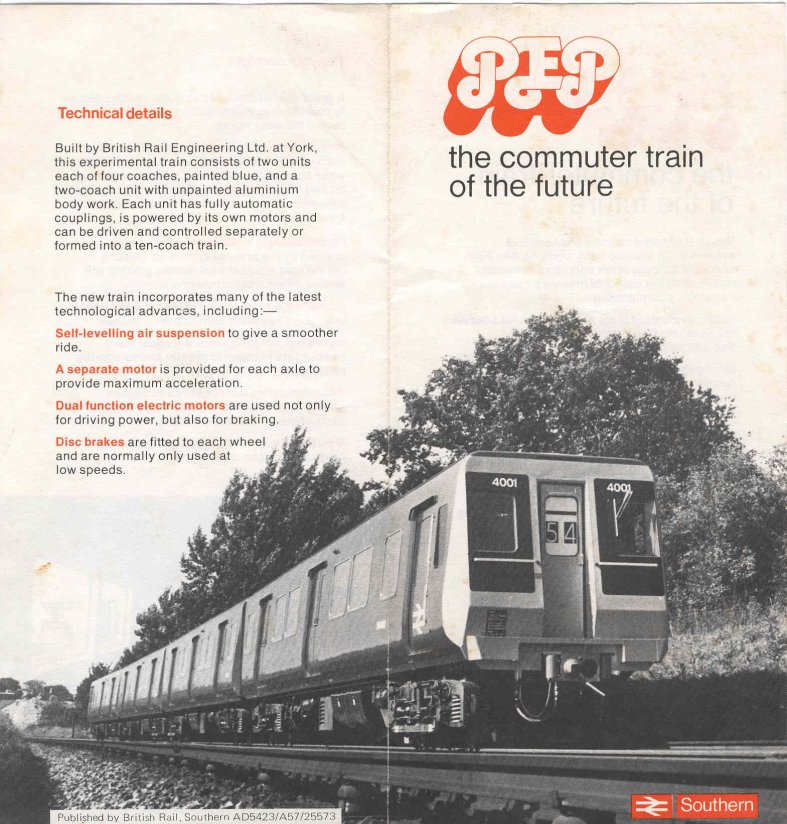
The PEP (Prototype Electro Pneumatic Train) Stock were prototype electric multiple units used on British Rail's Southern and Scottish Regions during the 1970s and early 1980s. They were forerunners of the British Rail Second Generation electric multiple unit fleet. Three units were built, one two-car unit (2001), and two four-car units (4001/4002). Under TOPS, the driving cars were originally classified as Class 461 with the non-driving motor cars as Class 462.[1] They were later reclassified as Class 445 (4PEP) and Class 446 (2PEP).
Internal layout was for commuter services; low-backed, bus-style 2+2 seating in open saloons, wide gangways with hanging straps, and no lavatory facilities. They were the first electric multiple units designed by British Rail with electric sliding doors,[4] outside the Scottish Region. They were unable to operate with any other stock due to their new coupling system.[5] Externally, 2001 was finished in unpainted aluminium, while 4001/4002 were painted in all-over Rail Blue.[6] In passenger use, they normally operated together as a ten-car formation.
Design
On the 4-PEP units the non-driving cars were powered, similar to London Underground practice at the time, but a departure from previous British Railways designs where there had not been any 4-car units with all axles powered.[7] Also introduced for the first time was rheostatic braking with cam-controlled analogue logic, and fluorescent lighting working at 50 Hz. Interior design was open saloons with 2+2 seating, although this was not considered to be finalised until after trial running, and also included communicating doors between coaches and between units, with the driving cars having 2 pairs of sliding doors each and 3 pairs on the non-driving coaches.[7]
Passenger use
All three units were initially assigned to the South Western Division of the Southern Region, based at Wimbledon Park and Strawberry Hill. Upon arrival, they were used under an extensive testing programme prior to entering full passenger service in June 1973, on services from Waterloo to Chessington South, Hampton Court and Shepperton. In August 1973, all three units were moved to the South Eastern Division, where they worked services from Cannon Street/Charing Cross to Bromley North, Dartford and Sevenoaks. Although capable of being used as a single 10-car formation on the SED, a number of failures saw them returned to the SWD after a month.
Departmental use
After the units were withdrawn from passenger service, they continued to be used by the Research department for further tests.[8] For this purpose, the units and individual carriages were all renumbered into the departmental series. The two Class 446 power cars were teamed with a newly built pantograph trailer and became TOPS Class 920, number 920001.[5] This was then used for the development of Classes 313–315.[9] The two Class 445 four car sets became TOPS Class 935, numbered 056 and 057 in the Southern Region departmental (non-revenue earning) unit series. 056 saw little use, being stored at Wimbledon Park until June 1980, when it was transferred to the Railway Technical Centre at Derby.
Production classes
The production-run classes which are most visibly similar to the prototype Stock are the dual voltage 750 V DC / 25 kV AC Class 313, the 25 kV AC Classes 314 and 315, and the 750 V DC Classes 507 and 508. It was also planned that the rolling stock for the services through the proposed Picc-Vic tunnel, intended as Class 316, would have formed part of the PEP family.[10] However, subsequent builds have also drawn heavily on the experience gained by this stock.
The PEP units had three sets of sliding doors on each of the non-driving cars for handling dense inner-suburban traffic. However, the Class 313 and all subsequent builds, including later Mark 3-based units, have only had two sets of doors per car.
The last units of the PEP family were withdrawn from service in 2024.
Disposal
All three units were finally taken out of use in the mid-1980s. None of the cars have survived into preservation; 920001 was scrapped in 1987, 056 in 1986 and 057 in 1990.
Formations
The unit formations in passenger and departmental service were:
| Unit No. | Class | Unit Type | DMSO | MSO (*PTSO) | MSO | DMSO |
|---|---|---|---|---|---|---|
| Formations in Passenger Use | ||||||
| 2001 | 446 | 2PEP | 64300 | - | - | 64305 |
| 4001 | 445 | 4PEP | 64301 | 62427 | 62428 | 64302 |
| 4002 | 445 | 4PEP | 64303 | 62426 | 62429 | 64304 |
| Formations in Departmental Use | ||||||
| 920001[11] | 920 | 3PEP | ADB975430
(ex. 64300) |
ADB975431 New-build trailer |
- | ADB975432
(ex. 64301) |
| (935) 056[11] | 935 | 4PEP | ADB975848
(ex. 64303) |
ADB975845
(ex. 62427) |
ADB975846
(ex. 62428) |
ADB975847
(ex. 64302) |
| (935) 057[11] | 935 | 4PEP | ADB975844
(ex. 64305) |
ADB975849
(ex. 62426) |
ADB975850
(ex. 62429) |
ADB975851
(ex. 64304) |
References
Page Template:Reflist/styles.css has no content.
- ^ a b c d e f g h i j Lua error in package.lua at line 80: module 'Module:Footnotes/anchor_id_list' not found.
- ^ Page Module:Citation/CS1/styles.css has no content."PROTOTYPE ELECTRO PNEUMATIC TRAIN: HC Deb 23 October 1973 vol 861 cc1217-24". Parliamentary Debates (Hansard). 23 October 1973. Retrieved 21 February 2016.
- ^ Page Module:Citation/CS1/styles.css has no content.Bull, J. T.; Cronin, J. E. (1978). "Introducing GN Electrics". Proceedings of the Institution of Mechanical Engineers. 192 (1): 72. doi:10.1243/PIME_PROC_1978_192_008_02. ISSN 0020-3483.
- ^ Page Module:Citation/CS1/styles.css has no content."High Density PEP stock on Southern Region". Testing Times. Archived from the original on 12 March 2016. Retrieved 21 February 2016.
- ^ a b Page Module:Citation/CS1/styles.css has no content."2-Pep and 4-Pep". Southern Railway E-mail Group. Retrieved 21 February 2016.
- ^ Page Module:Citation/CS1/styles.css has no content."PEP: The commuter train of the future". Testing Times. Archived from the original on 20 December 2016. Retrieved 21 February 2016.
- ^ a b Page Module:Citation/CS1/styles.css has no content."SR high-capacity prototype train on trial". Railway World. Vol. 32, no. 378. Shepperton: Ian Allan. November 1971. pp. 498–499.
- ^ Lua error in package.lua at line 80: module 'Module:Footnotes/anchor_id_list' not found.
- ^ Page Module:Citation/CS1/styles.css has no content."Time for a PEP talk". Rail Express. No. 184. September 2011. pp. 21–25. ISSN 1362-234X.
- ^ Page Module:Citation/CS1/styles.css has no content.Brook, Richard; Dodge, Martin (2012). Infra_MANC (PDF). CUBE Gallery. pp. 144–145. Retrieved 19 January 2016.
- ^ a b c Lua error in package.lua at line 80: module 'Module:Footnotes/anchor_id_list' not found.
Sources
- Page Module:Citation/CS1/styles.css has no content.Longworth, Hugh (2015). British Railways Electric Multiple Units to 1975. Oxford Publishing Co. ISBN 9780860936688. OCLC 923205678.
- Page Module:Citation/CS1/styles.css has no content.Marsden, Colin J. (1984). Departmental Stock. Rolling stock recognition. Vol. 3. Ian Allan. ISBN 9780711014466. OCLC 15107222.
Further reading
- Page Module:Citation/CS1/styles.css has no content.Ball, N. D. (1972). "The BR High-Density Prototype Electric Multiple Unit Stock". Railway Engineering Journal. 1 (1). London: the Institution of Mechanical Engineers: 21–37. ISSN 0048-6515. OCLC 1559754.
- Page Module:Citation/CS1/styles.css has no content.Marsden, Colin J. (1982). EMUs. Motive Power Recognition. Vol. 2. Ian Allan. pp. 134–136. ISBN 9780711011656. OCLC 16537600.
External links
- Page Template:Sister-inline/styles.css has no content.Script error: No such module "Sister project logo". Media related to Script error: No such module "Commons link". at Wikimedia Commons
Lua error in package.lua at line 80: module 'Module:Navbox/configuration' not found. Lua error in package.lua at line 80: module 'Module:Navbox/configuration' not found. Lua error in package.lua at line 80: module 'Module:Navbox/configuration' not found. Template:SR rolling stock



.jpg)