Dreamboat Annie
Template:DMCA Script error: No such module "Unsubst-infobox".Script error: No such module "Check for conflicting parameters". Template:Album ratings
Dreamboat Annie is the debut studio album by American rock band Heart. At the time, the band was based in Vancouver, British Columbia; the album was recorded in Vancouver and first released in Canada by the local label Mushroom Records in August 1975, eventually reaching number 20 on RPM's Top Album chart and earning a double platinum certification.[1] It was released in the United States on February 14, 1976, through the US subsidiary of Mushroom Records in Los Angeles, peaking at number seven on the Billboard 200. It also reached the top 10 in the Netherlands and Australia in early 1977. The album contains three commercially successful singles, two of which, "Crazy on You" and "Magic Man", became staples on North American FM radio. Producer Mike Flicker helped the group to polish their sound and obtain a recording contract with the label.
Release
Heart's first single, "How Deep It Goes" (backed with "Here Song"), received little attention when released in Canada by the small Mushroom label in early 1975. The second single, "Magic Man" (backed with "How Deep It Goes"), was first picked up for radio play by CJFM-FM 96 in Montreal,[2] while the band was on tour playing small club dates.
Dreamboat Annie was released in Canada in September 1975 following the success of "Magic Man". The album cover was designed by Emily Carr University of Art and Design communication design instructor Deborah Shackleton.[3] Heart's first radio success earned them a spot opening a Montreal concert for Rod Stewart in October 1975 which prompted sales and airplay to increase in that region and then gradually across other regions of the country, partly because Heart's recording qualified as Canadian content thereby assisting radio stations in meeting their Canadian content requirements.[4] The album sold an impressive 30,000 copies across Canada in its first few months, eventually being certified as double platinum for sales of 200,000. Due to the gradual nature of the sales, it only entered the Canadian Albums Chart on September 4, 1976, peaking at number 20 on October 9, 1976.[5]
Internationally, Dreamboat Annie reached number seven in the Netherlands, number nine in Australia, and number 36 in the United Kingdom.[6][7][8] "Magic Man" was the first single in these countries, followed by "Crazy on You".
Subsequent events
The success of the album indirectly led to a break between the band and label. The first cracks appeared when the group tried to renegotiate their royalty rate to be more in keeping with what they thought a platinum band should be earning. For this Michael Fisher, who was Ann Wilson's boyfriend at the time, stepped aside as de facto manager and Ken Kinnear was hired. Mushroom's tough stance in negotiations, and their opinion that perhaps the band was a one-hit wonder, led to Mike Flicker leaving the label. He did, however, continue to produce for Heart.Lua error in package.lua at line 80: module 'Module:Footnotes/anchor_id_list' not found.
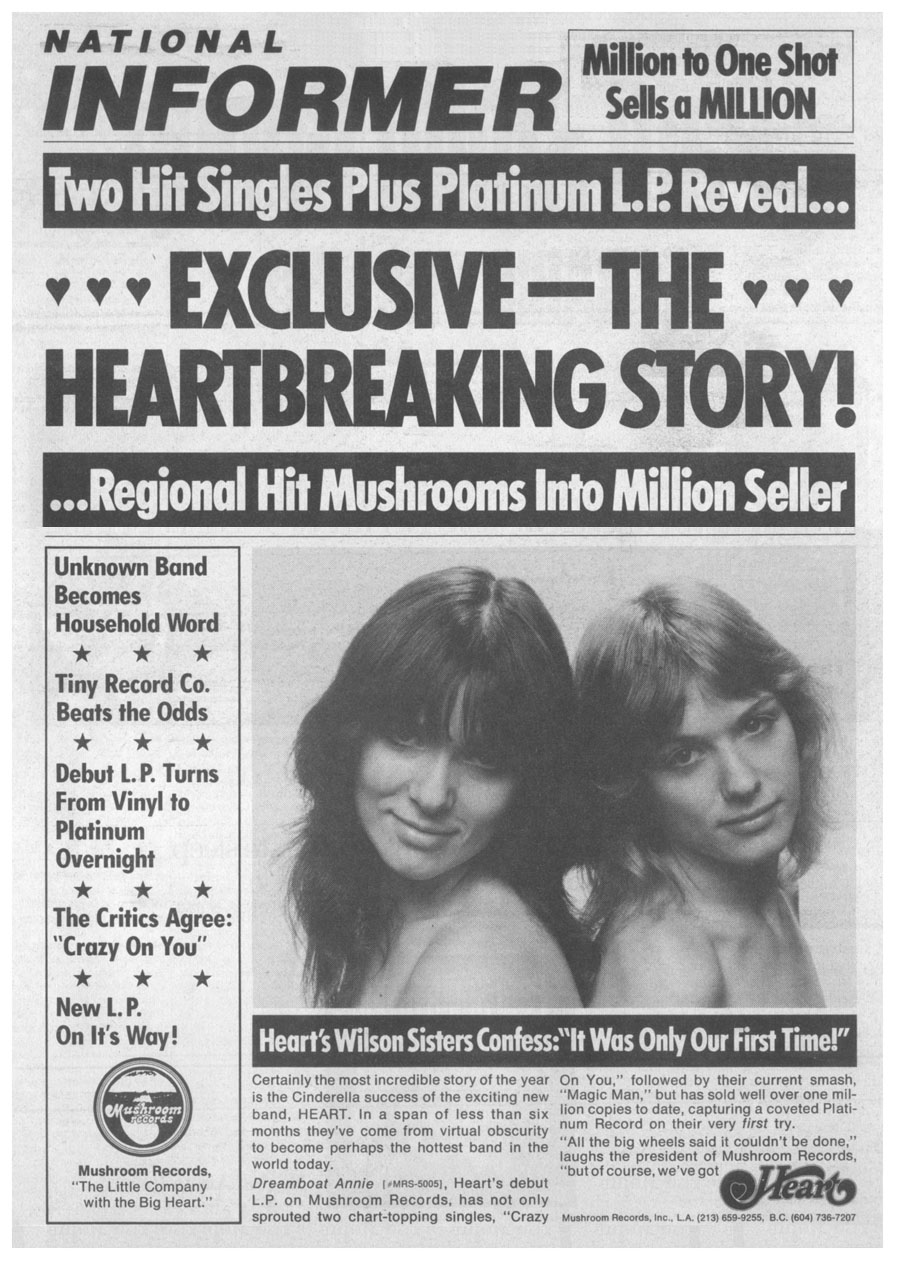
The relationship broke down completely when the label bought a full-page ad in Rolling Stone, mocked up like a National Enquirer front page.[9] The ad used a photo similar to the one on the Dreamboat Annie album cover, showing Ann and Nancy back to back with bare shoulders. The caption under the photo read, "It Was Only Our First Time!" The band had not been consulted and was furious with the double meaning of the caption.Lua error in package.lua at line 80: module 'Module:Footnotes/anchor_id_list' not found.
Since the label could no longer provide Flicker as producer as the contract specified, the band took the position that they were free to move to another label and signed with Portrait Records. Mushroom insisted that the band was still bound to the contract which called for two albums. So, Mushroom released Magazine with incomplete tracks, studio outtakes and live material and a disclaimer on the cover.Lua error in package.lua at line 80: module 'Module:Footnotes/anchor_id_list' not found.
The band got a federal injunction to stop distribution of the 1977 edition of Magazine. Most of the initial 50,000 pressings were recalled from stores. The court eventually decided that the band could sign with Portrait, but that they did owe Mushroom a second album. The band returned to the studio to re-record, remix, edit, and re-sequence the recordings. Magazine was re-released in 1978 and sold a million copies in less than a month.Lua error in package.lua at line 80: module 'Module:Footnotes/anchor_id_list' not found.
Shelly Siegel, the promoter behind the "First Time" ad and vice president of the record label, died a few months after the re-release, and Mushroom Records went bankrupt two years later. The episode had at least one more repercussion. Not long after the ad appeared, a radio promoter asked Ann about her lover; he was referring to Nancy, thus implying that the sisters were incestuous lesbian lovers. The encounter infuriated Ann who went back to her hotel and wrote the words to what became one of Heart's signature songs, "Barracuda".Lua error in package.lua at line 80: module 'Module:Footnotes/anchor_id_list' not found.
Track listing
Lua error in package.lua at line 80: module 'Module:Track listing/configuration' not found. Lua error in package.lua at line 80: module 'Module:Track listing/configuration' not found.
Personnel
Credits adapted from the liner notes of Dreamboat Annie.[10]
Heart
- Ann Wilson – lead vocals (all tracks); flute (tracks 3, 8, 10); backing vocals (tracks 3, 7–9); acoustic guitar (track 9)
- Nancy Wilson – electric guitar (tracks 1, 6); acoustic guitar (tracks 1, 3, 5–7, 9, 10); backing vocals (tracks 3, 5–10); 12-string acoustic guitar, 6-string acoustic guitar (track 4)
- Roger Fisher – electric guitar (tracks 1, 3, 4, 6–9); acoustic guitar (track 1); lap steel (track 7)
- Howard Leese – electric guitar (tracks 1, 3); synthesizer (track 1); orchestral arrangements (tracks 4, 7, 9, 10); bells (track 5); orchestra bells (track 7); backing vocals (track 8)
- Steve Fossen – bass (tracks 1, 3–8, 10)
- Mike Derosier – drums (tracks 6, 8)
- Heart – arrangements
Additional musicians
- Dave Wilson – drums (track 1)
- Ray Ayotte – conga (track 1); percussion (track 4)
- Mike Flicker – percussion (track 1); timpani (track 10); arrangements
- Kat Hendrikse – drums (tracks 3–5, 7, 10)
- Rob Deans – synthesizer (tracks 3, 9); orchestral arrangements (tracks 4, 7, 9, 10); piano (tracks 9, 10)
- Geoff Foubert – backing vocals (tracks 3, 5, 7, 10); banjo (track 5)
- Tessie Bensussen – backing vocals (tracks 3, 5, 10)
- Jim Hill – backing vocals (tracks 3, 5, 10)
- Brian Newcombe – bass (track 9)
- Duris Maxwell – drums (track 9)
Technical
- Mike Flicker – production, engineering
- Mike Fisher – special direction
- Howard Leese – production assistance
- Rolf Hennemann – engineering
- Patrick Collins – mastering
Artwork
- Toby Rankin – photography
- Jim Rimmer – signature lettering
- Captain Paste-Up – layout
Charts
Page Template:Col-begin/styles.css has no content.
Weekly charts
|
Year-end charts
|
Certifications
| Region | Certification | Certified units/sales |
|---|---|---|
| Australia (ARIA)[14] | Gold | 20,000 |
| Canada (Music Canada)[15] | 2× Platinum | 200,000 |
| United States (RIAA)[16] | Platinum | 1,000,000 |
|
^ Shipments figures based on certification alone. | ||
References
Page Template:Reflist/styles.css has no content.
- ^ Page Module:Citation/CS1/styles.css has no content.Read, Jeani (October 2, 1976). "Canada! Coast Industry Focuses on Its Uniqueness". Billboard. Vol. 88, no. 40. p. C-20. ISSN 0006-2510 – via Google Books.
- ^ Page Module:Citation/CS1/styles.css has no content.Siegel, Shelley (February 11, 2011). "A Canadian Success Story Not To Be Forgotten". Archived from the original on October 9, 2011. Retrieved April 4, 2011.
- ^ Page Module:Citation/CS1/styles.css has no content."Deborah Shackleton". Emily Carr University of Art and Design. Retrieved June 30, 2013.
- ^ Page Module:Citation/CS1/styles.css has no content."Heart". Behind the Music. Season 2. Episode 18. January 24, 1999. VH1.
- ^ Cite error: The named reference
canwas invoked but never defined (see the help page). - ^ a b Page Module:Citation/CS1/styles.css has no content.Kent, David (1993). Australian Chart Book 1970–1992. St Ives, N.S.W.: Australian Chart Book. p. 136. ISBN 0-646-11917-6.
- ^ Cite error: The named reference
nlwas invoked but never defined (see the help page). - ^ Cite error: The named reference
ukwas invoked but never defined (see the help page). - ^ Page Module:Citation/CS1/styles.css has no content."Mushroom Records Ad" (JPG). Mushroom Records (Canada). Retrieved May 20, 2014.
- ^ Page Module:Citation/CS1/styles.css has no content.Dreamboat Annie (liner notes). Heart. Mushroom Records. 1975. MRS-5005.
{{cite AV media notes}}: CS1 maint: others in cite AV media (notes) (link) - ^ Page Module:Citation/CS1/styles.css has no content.Oricon Album Chart Book: Complete Edition 1970–2005 (in 日本語). Roppongi, Tokyo: Oricon Entertainment. 2006. ISBN 4-87131-077-9.
- ^ Page Module:Citation/CS1/styles.css has no content."Billboard 200 Albums – Year-End 1976". Billboard. Archived from the original on December 22, 2018. Retrieved December 22, 2018.
- ^ Page Module:Citation/CS1/styles.css has no content."Jaaroverzichten – Album 1977" (in Nederlands). Dutch Charts. Retrieved December 22, 2018.
- ^ Page Module:Citation/CS1/styles.css has no content."Heart" (PDF). Cash Box. Vol. XL, no. 30. December 9, 1978. p. 8. ISSN 0008-7289 – via World Radio History.
- ^ Script error: No such module "cite".
- ^ Script error: No such module "cite".
Bibliography
- Page Module:Citation/CS1/styles.css has no content.Wilson, Ann; Wilson, Nancy; Cross, Charles R. (2012). Kicking & Dreaming: A Story of Heart, Soul, and Rock and Roll. New York: It Books. ISBN 978-0-0621-0167-9.
Lua error in package.lua at line 80: module 'Module:Navbox/configuration' not found. Lua error in package.lua at line 80: module 'Module:Authority control/config' not found.