Elecampane
Template:Short description Script error: No such module "about".
Script error: No such module "Autotaxobox".| Script error: No such module "Automated taxobox". | |
|---|---|
| Lua error in package.lua at line 80: module 'Module:InfoboxImage/data' not found. | |
| Elecampane (Inula helenium) flower, photographed in Ottawa, Ontario in 2019 | |
| Scientific classification Edit this classification | |
| Script error: No such module "Taxobox ranks".: | <div style="display:inline" class="script error: no such module "taxobox ranks".">Template:Taxon infoTemplate:Taxon italics |
| Binomial name | |
| Template:Taxon infoTemplate:Taxon italics | |
| Lua error in package.lua at line 80: module 'Module:InfoboxImage/data' not found. | |
| Synonyms[1] | |
| |
Page Template:Taxobox/core/styles.css has no content.Template:Taxonbar/candidateTemplate:Speciesbox/parameterCheckScript error: No such module "Check for conflicting parameters".
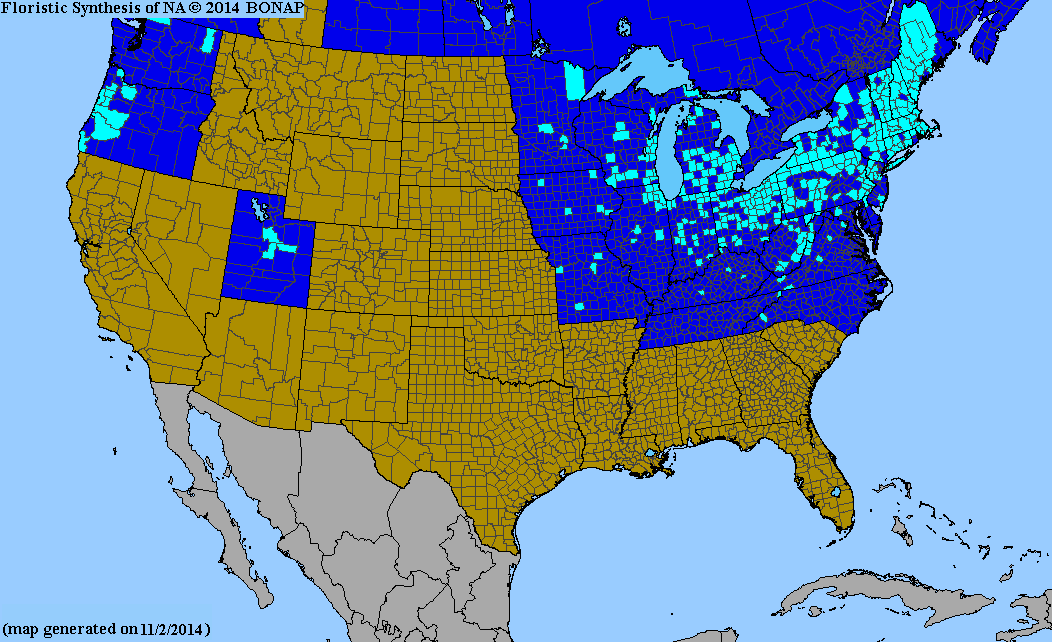
Elecampane (Inula helenium), pronounced /ˌɛlɪkæmˈpeɪn/[2] and also called horse-heal or elfdock, is a widespread plant species in the sunflower family Asteraceae. It is native to Eurasia from Spain to Xinjiang province in western China, and naturalized in parts of North America.[3][4][5][6][7]
Description
Elecampane is a rather rigid herb, the stem of which attains a height of about 90–150 cm (35–59 in). The leaves are large and toothed, the lower ones stalked, the rest embracing the stem; blades egg-shaped, elliptical, or lance-shaped, as big as 30 cm (12 in) long and 12 cm (4.7 in) wide. Leaves are green on the upper side with light, scattered hairs, but whitish on the underside because of a thick layer of wool. The flower heads up to 5 cm (2 inches) broad, each head containing 50-100 yellow ray flowers and 100-250 yellow disc flowers. The root is thick, branching and mucilaginous, and has a bitter taste and a camphoraceous odour with sweet floral (similar to violet) undertones.[5][7]
Folklore
The plant's specific name, helenium, derives from Helen of Troy; elecampane is said to have sprung up from where her tears fell. It was sacred to the ancient Celts, and once had the name "elfwort".[8] The plant traditionally was held to be associated with the elves and fairy folk.[9]
Corrupted variations of the name Elecampane, such as alicompagne, hallecumb pain, and jollup and plain, have been used as miracle cures that can revive the dead in Mummers' play in Britain and Ireland.[10][11][12][13]
The 17th-century herbalist Nicholas Culpeper considered elecampane to be ruled by Mercury and used it to warm a cold and windy stomach, to resist poison, to strengthen sight, and to clear internal blockages.[14]
Uses
The herb has been used since Ancient Greek times. Theophrastus recommended using the plant in oil and wine to treat the bites of vipers, spiders and pine caterpillars in his Historia Plantarum.[15]
In Roman times, Apicius, a cookbook from the 1st century AD, describes it as a plant for testing whether honey is spoilt or not, the plant is immersed in the honey and then lit, if it burns brightly the honey is considered fine.[16] The root was mentioned by Pliny in his Natural History both as a medicine and as a condiment.
In Medieval Europe, the roots were candied and eaten as confectionery.[17]
In France and Switzerland it has been used in the manufacture of absinthe.[18] In England it was formerly in great repute as an aromatic tonic and stimulant of the secretory organs.[18] It is mentioned in an 1817 New-England almanack as a cure for hydrophobia when the root is bruised and used with a strong decoction of milk.[19] It is used in herbal medicine as an expectorant and for water retention.[20]
Chemical constituents
Besides the storage polysaccharide inulin (C6H12O6[C6H10O5]n), a polymer of fructose, the root contains helenin (C15H20O2), a phytochemical compound consisting of alantolactone and isoalantolactone. Helenin is a stearoptene, which may be prepared in white acicular crystals, insoluble in water, but freely soluble in alcohol. When freed from the accompanying inula-camphor by repeated crystallization from alcohol, helenin melts at 110 °C.[18]
References
Page Template:Reflist/styles.css has no content.
- ^ Page Module:Citation/CS1/styles.css has no content."Inula helenium L. — The Plant List". www.theplantlist.org.
- ^ Page Module:Citation/CS1/styles.css has no content.Oxford English Dictionary (3rd ed.). Oxford University Press. September 2005.
- ^ B.-E. van Wyk and M. Wink. (2004). Medicinal Plants of the World, p. 181, Singapore: Times Editions.
- ^ Altervista Flora Italiana, Inula helenium L. includes photos and European distribution map
- ^ a b Page Module:Citation/CS1/styles.css has no content."Inula helenium in Flora of North America @ efloras.org". www.efloras.org.
- ^ Page Module:Citation/CS1/styles.css has no content."Biota of North America Program 2014 county distribution map".
- ^ a b Page Module:Citation/CS1/styles.css has no content."Inula helenium in Flora of China @ efloras.org". www.efloras.org.
- ^ Page Module:Citation/CS1/styles.css has no content.Howard, Michael (1987). Traditional Folk Remedies. Century. p. 135. ISBN 0-7126-1731-0.
- ^ Page Module:Citation/CS1/styles.css has no content.Greer, John Michael (2017). The Encyclopedia of Natural Magic (First ed.). Woodbury, Minnesota: Llewellyn. p. 101. ISBN 978-0-7387-0674-0.
- ^ Page Module:Citation/CS1/styles.css has no content.Millington, Peter (November 12, 2020). "Master Mummers - Folk Play Script: Tenby Guisers' Play - 1857 - L.P.Barnaschone (1857)". www.mastermummers.org.
- ^ Page Module:Citation/CS1/styles.css has no content.Millington, Peter (November 12, 2020). "Master Mummers - Folk Play Script: Tipteerers' Duologue from Cocking, Sussex - 1903-1906 - R.J.E.Tiddy (1923) pp.200-202". www.mastermummers.org.
- ^ Page Module:Citation/CS1/styles.css has no content.Millington, Peter (November 12, 2020). "Master Mummers - Folk Play Script: Words of the Ripon Sword-Dance - 1920 - D.Kennedy (1930) pp.23-25". www.mastermummers.org.
- ^ Alford, Violet. Folklore, vol. 70, no. 4, 1959, pp. 563–65. JSTOR, http://www.jstor.org/stable/1258237. Accessed 3 Jan. 2023.
- ^ Page Module:Citation/CS1/styles.css has no content.Culpeper, Nicholas (1814). Culpeper's Complete Herbal. No. 8, White's Row, Spitalfields: Richard Evans. p. 70.
{{cite book}}: CS1 maint: location (link) - ^ Page Module:Citation/CS1/styles.css has no content.Roques, Alain (2015). Processionary moths and climate change : an update. Dordrecht: Springer. p. 1. ISBN 978-94-017-9339-1. OCLC 893559920.
- ^ Page Module:Citation/CS1/styles.css has no content.De Re Coquinaria of Apicius. pp. Book I, 18.
- ^ Page Module:Citation/CS1/styles.css has no content.Sanderson, Helen; Renfrew, Jane M. (2005). Prance, Ghillean; Nesbitt, Mark (eds.). The Cultural History of Plants. Routledge. p. 102. ISBN 0415927463.
- ^ a b c One or more of the preceding sentences incorporates text from a publication now in the public domain: Script error: No such module "template wrapper".
- ^ Page Module:Citation/CS1/styles.css has no content.Daboll, N. (1816). The New-England almanack, for the year of our Lord Christ, 1817: Fitted to the meridian of N. London. New London: Samuel Green.
- ^ Page Module:Citation/CS1/styles.css has no content.Bartram, T. (1998). Bartram's Encyclopedia of Herbal Medicine. London: Robinson Publishing Ltd. ISBN 978-1854875860.
External links
Page Module:Side box/styles.css has no content.Page Template:Sister project/styles.css has no content.
- Elecampane at Plants for a Future
- Elecampane from Maud Grieve, A Modern Herbal
- photo of herbarium specimen at Missouri Botanical Garden, collected in Missouri in 1933
Script error: No such module "Taxonbar".