Pallava script
Page Module:Message box/ambox.css has no content.
 |
Page Module:Infobox/styles.css has no content.
| Pallava script | |
|---|---|
| Lua error in package.lua at line 80: module 'Module:InfoboxImage/data' not found. Pallava Script Chart in modern font | |
| Script type | |
Period | 4th century CE to Present[1] |
| Direction | Lua error in package.lua at line 80: module 'Module:GetParameters' not found. |
| Languages | Tamil, Malayalam,Sanskrit, Telugu, Kannada, Konkani, Marathi, Old Khmer, Old Malay, Burmese, Thai, Sinhala, Lao, Mon, Balinese, etc. |
| Related scripts | |
Parent systems | |
Child systems | Tamil, Grantha, Mon-Burmese, Khmer, Cham, Kawi |
Sister systems | Vattezhuthu, Kolezhuthu |
Lua error in package.lua at line 80: module 'Module:Sidebar/configuration' not found.
The Pallava script, or Pallava Grantha, named after the Pallava dynasty of Southern India (Tamilakam) and is attested to since the 4th century CE. The Pallava script evolved from Tamil-Brahmi.[2] It was used to originally write Tamil and Sanskrit texts – the court languages of Pallavas, thus, it features glyphs to render the sounds of both languages. Both the Tamil script via the intermediate script/step called Chozha-Pallava-Script[3][4] and Grantha script have originated from the Pallava script.[5]
Pallava also spread to Southeast Asia and evolved into scripts such as Balinese,[6] Baybayin,[7] Javanese,[8] Kawi,[9] Khmer,[10] Lanna,[11] Lao,[12] Mon–Burmese,[13] New Tai Lue,[14] Sundanese,[15] and Thai.[16] This script is the sister of the Vatteluttu script which was also used to write Tamil and Malayalam in the past.[17]
Epigrapher Arlo Griffiths argues that the name of the script is misleading as not all of the relevant scripts referred to have a connection with the Pallava dynasty. He instead advocates that these scripts be called Late Southern Brāhmī scripts.[1]
History
During the rule of the Pallavas, the script accompanied priests, monks, scholars, and traders into Southeast Asia. Pallavas developed the Pallava script based on Tamil-Brahmi. The main characteristics of the newer script are aesthetically matched and fuller consonant glyphs, similarly visible in the writing systems of Chalukya,[18] Kadamba, and Vengi at the time of Ikshvakus. Brahmi's design was slightly different from the scripts of Cholas, Pandyas, and Cheras. Pallava script was the first significant development of Brahmi in India, combining rounded and rectangular strokes and adding typographical effects, and was suitable for civic and religious inscriptions.
It served as parent script for several modern-day-scripts, such as Chozha-Pallava-Script, which ultimately gave rise to Tamil script and also Grantha script. Once the Pallava dynasty was integrated via the conquest by Aditya I in 897 CE,[19] which laid the foundation for the future Chola Empire – the Chozha-Pallava was subsequently developed under that dynasty and replaced both the Pallava and Grantha scripts to write Tamil texts, whereas Grantha remained to be in usage for rendering Manipravalam texts.[20] It also supplanted the Vatteluttu, when the Pandya Nadu in c. 850 CE was conquered by the Cholas as well.[21] The Chozha-Pallava script resembled the same glyph developments like its counterpart Grantha script, but it didn't feature any foreign sounds from Sanskrit, thus, simplifying the script and ultimately becoming the modern-day Tamil script.[3][4]
Kadamba-Pallava script[22] evolved into early forms of Kannada and Telugu scripts. Glyphs become more rounded and incorporate loops because of writing upon leaves and paper.[22]
The script is not yet a part of Unicode but proposals have been made to include it. In 2018, Anshuman Pandey made a proposal.[23]
Characteristics
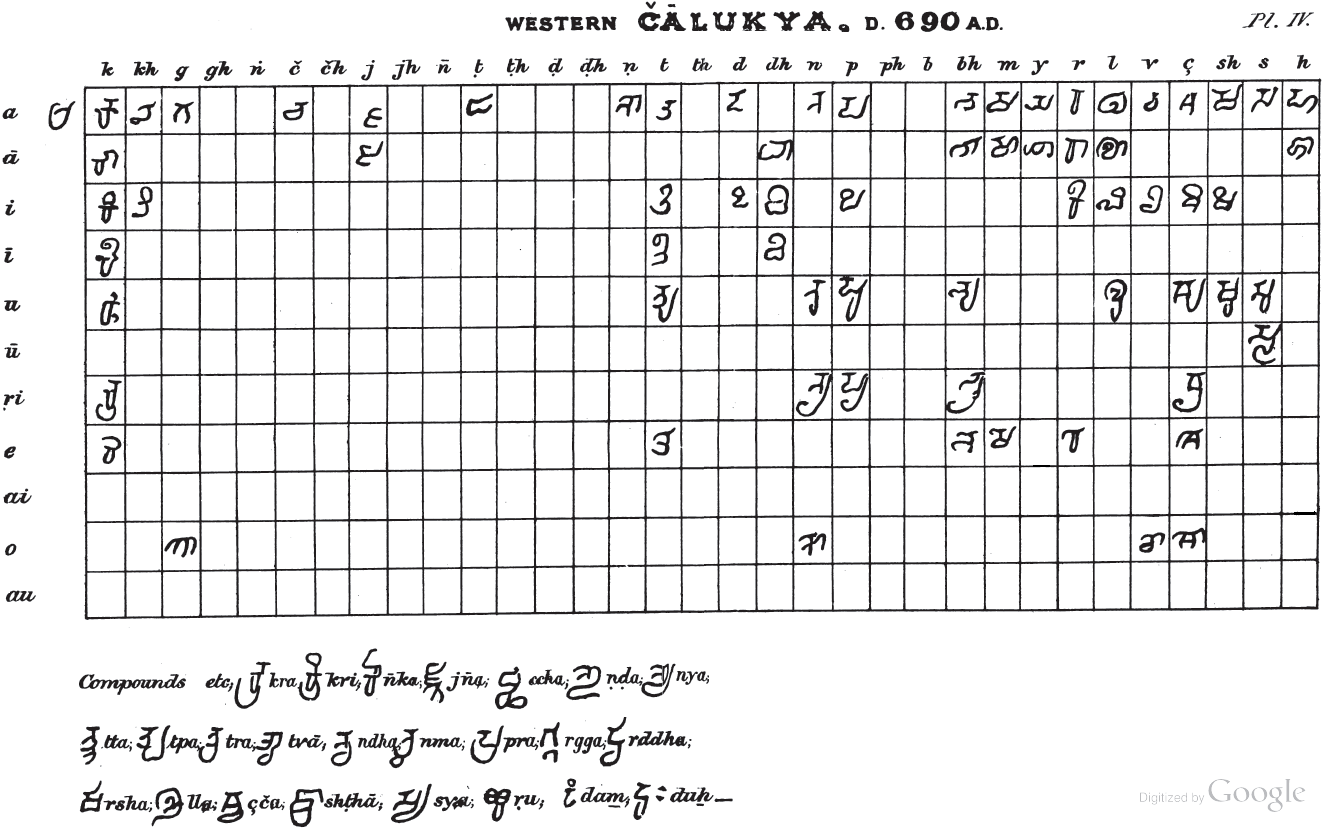
The form shown here is based on examples from the 7th century CE. Letters labeled * have uncertain sound value, as they have little occurrence in Southeast Asia.
Consonants
Each consonant has an inherent /a/, which will be sounded if no vowel sign is attached. If two consonants follow one another without intervening vowel, the second consonant is made into a subscript form, and attached below the first.
Independent Vowels
| a | ā | i | ī | u | e | o | ai* | au* |
|---|---|---|---|---|---|---|---|---|
| File:Pallava A.svg | File:Pallava Aa.svg | File:Pallava I.svg | File:Pallava Ii.svg | File:Pallava U.svg | File:Pallava E.svg | File:Pallava O.svg | File:Pallava Ai.svg | File:Pallava Au.svg |
Examples
Lua error in package.lua at line 80: module 'Module:Plain text' not found.
Unicode
A proposal to encode the script in Unicode was submitted in 2018.[23]
References
Page Template:Div col/styles.css has no content.
- ^ a b Page Module:Citation/CS1/styles.css has no content.Griffiths, Arlo (2014). "53-57". LOST KINGDOMS: Hindu-Buddhist Sculpture of Early Southeast Asia. New York: The Metropolitan Museum of Art. ISBN 9781588395245.
- ^ Page Module:Citation/CS1/styles.css has no content.Salomon, Richard (1998). Indian Epigraphy. p. 40.
- ^ a b University of Madras Tamil Lexicon, page 148: "Script error: No such module "Lang". [ Script error: No such module "lang". n Script error: No such module "lang". . < Script error: No such module "Lang".¹ +. 1. The letter Script error: No such module "Lang"., as being regarded as neither a vowel nor a consonant; Script error: No such module "Lang".. (Script error: No such module "Lang".) 2. Consonants; Script error: No such module "Lang"."][permanent dead link]
- ^ a b Page Module:Citation/CS1/styles.css has no content.Griffiths, Arlo (2014). "Early Indic Inscriptions of Southeast Asia".
- ^ Page Module:Citation/CS1/styles.css has no content."Grantha alphabet". Retrieved 13 September 2018.
- ^ Page Module:Citation/CS1/styles.css has no content."Balinese alphabet". Retrieved 13 July 2019.
- ^ Page Module:Citation/CS1/styles.css has no content."Tagalog". Retrieved 13 September 2018.
- ^ Page Module:Citation/CS1/styles.css has no content."Javanese alphabet". Retrieved 13 September 2018.
- ^ Page Module:Citation/CS1/styles.css has no content."Kawi alphabet". Retrieved 13 September 2018.
- ^ Page Module:Citation/CS1/styles.css has no content."Khmer". Retrieved 13 September 2018.
- ^ Page Module:Citation/CS1/styles.css has no content."Lanna alphabet". Retrieved 13 September 2018.
- ^ Page Module:Citation/CS1/styles.css has no content."Lao". Retrieved 13 September 2018.
- ^ Page Module:Citation/CS1/styles.css has no content."Mon". Retrieved 13 September 2018.
- ^ Page Module:Citation/CS1/styles.css has no content."New Tai Lue script". Retrieved 13 September 2018.
- ^ Page Module:Citation/CS1/styles.css has no content."Sundanese". Retrieved 13 September 2018.
- ^ Page Module:Citation/CS1/styles.css has no content."Thai". Retrieved 13 September 2018.
- ^ Page Module:Citation/CS1/styles.css has no content.Coulmas, Florian (1999). The Blackwell Encyclopedia of Writing Systems. Blackwell Publishing. p. 542. ISBN 9780631214816.
- ^ Page Module:Citation/CS1/styles.css has no content."Western Calukya script". 690. Archived from the original on 2011-02-15.
- ^ Page Module:Citation/CS1/styles.css has no content.Gabriel Jouveau-Dubreuil, The Pallavas, Asian Educational Services, 1995 - Art, Indic - 86 pages, p. 83
- ^ Page Module:Citation/CS1/styles.css has no content.Blackburn, Stuart (2006). Print, folklore, and nationalism in colonial South India. New York, Springer. p. 29.
After about AD 1500, translations from Sanskrit did appear, and unassimilated words began to flood literary Malayalam; eventually a hybrid idiom (manipravalam) mixing Sanskrit and tamil words, and Sanskrit words with tamil inflections, was devised
- ^ Sastri, K. A. Nilakanta. (1958, second ed.) A History of South India from Prehistoric Times to the Fall of Vijayanagar. Madras, Oxford University Press. 167–68.
- ^ a b Page Module:Citation/CS1/styles.css has no content."Pallava script". Skyknowledge.com. 2014-02-02. Retrieved 2014-03-13.
- ^ a b Pandey, Anshuman. (2018). Preliminary proposal to encode Pallava in Unicode.
Bibliography
- Sivaramamurti, C, Indian Epigraphy and South Indian Scripts. Bulletin of the Madras Government Museum. Chennai 1999
External links
- Page Template:Sister-inline/styles.css has no content.Script error: No such module "Sister project logo". Media related to Script error: No such module "Commons link". at Wikimedia Commons
Script error: No such module "navbox with collapsible groups".