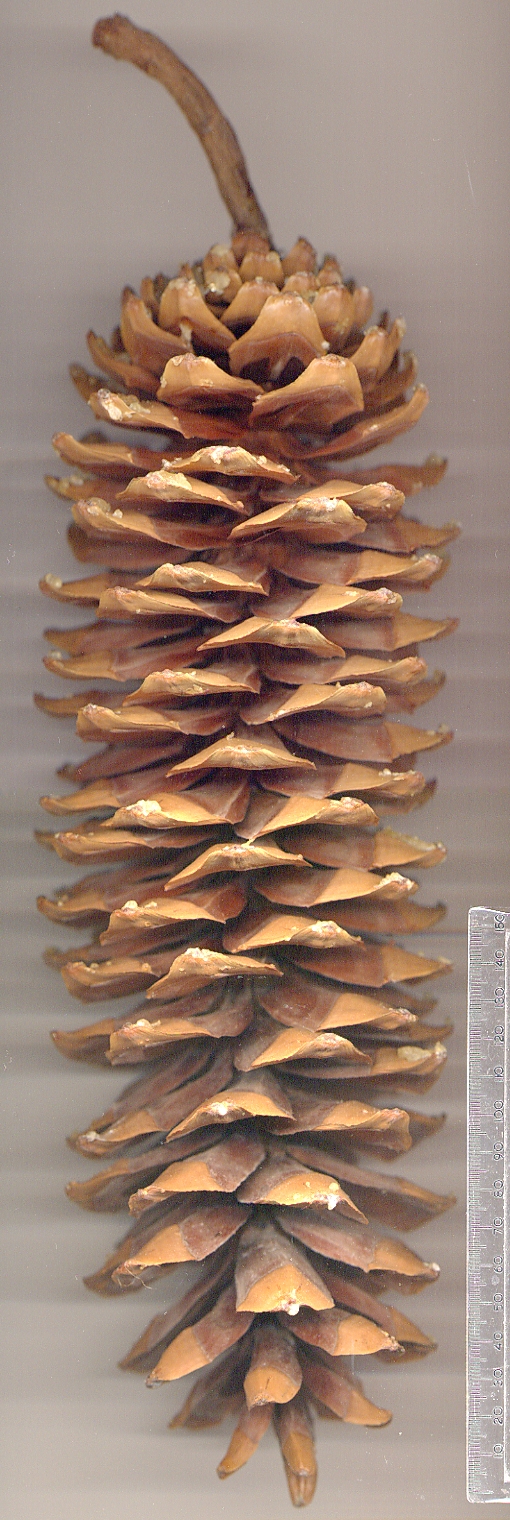
Pinus lambertiana
Template:Short description Lua error in package.lua at line 80: module 'Module:Hatnote list' not found.
Script error: No such module "Autotaxobox".| Script error: No such module "Automated taxobox". | |
|---|---|
| Lua error in package.lua at line 80: module 'Module:InfoboxImage/data' not found. | |
Script error: No such module "Conservation status".
| |
| Scientific classification Edit this classification | |
| Script error: No such module "Taxobox ranks".: | <div style="display:inline" class="script error: no such module "taxobox ranks".">Template:Taxon infoTemplate:Taxon italics |
| Binomial name | |
| Template:Taxon infoTemplate:Taxon italics | |
| Lua error in package.lua at line 80: module 'Module:InfoboxImage/data' not found. | |
| Natural range of Pinus lambertiana | |
| Lua error in package.lua at line 80: module 'Module:InfoboxImage/data' not found. | |
Page Template:Taxobox/core/styles.css has no content.Template:Taxonbar/candidateTemplate:Speciesbox/parameterCheckScript error: No such module "Check for conflicting parameters".
Pinus lambertiana (commonly known as the sugar pine) is the tallest and most massive pine tree and has among the longest cones of any conifer. It is native to coastal and inland mountain areas along the Pacific coast of North America, as far north as Oregon and as far south as Baja California in Mexico.
Description
Growth
The sugar pine is the tallest and largest Pinus species, commonly growing to 40–60 meters (130–195 ft) tall, exceptionally to Template:Cvt tall, with a trunk diameter of Template:Cvt, exceptionally Template:Cvt.[2] The tallest recorded specimen is 83.45 m (273 ft 9 in) tall, is located in Yosemite National Park, and was discovered in 2015.[3] The second tallest recorded was "Yosemite Giant", an Template:Cvt tall specimen in Yosemite National Park, which died from a bark beetle attack in 2007. Yosemite National Park also has the third tallest, measured to Template:Cvt tall as of June 2013; the Rim Fire affected this specimen, but it survived. The next tallest known living specimens grow in southern Oregon; one in Umpqua National Forest is Template:Cvt tall and another in Siskiyou National Forest is Template:Cvt tall.
The bark of Pinus lambertiana ranges from brown to purple in color and is 5–10 centimeters (2–4 in) thick.[2] The upper branches can reach out over 8 m (26 ft).[2] Like all members of the white pine group (Pinus subgenus Strobus), the leaves ("needles") grow in fascicles ("bundles") of five[2] with a deciduous sheath. They are Template:Cvt long.[4] Sugar pine is notable for having among the longest cones of any conifer, mostly Template:Cvt long,[2][5] although they can occasionally reach as much as Template:Cvt.[6][7] Although the cones of the Coulter pine are more massive; the unripe weight of 1–2 kilograms (2.2–4.4 lb) makes the sugar pine's cones perilous projectiles when chewed off by squirrels.[2] The seeds are Template:Cvt long, with a Page Template:Fraction/styles.css has no content.2–3-centimeter (3⁄4–1+1⁄4-inch) long wing[5] that aids their dispersal by wind. Sugar pine never grows in pure stands, always in a mixed forest, and is shade tolerant in its youth.[8]
Distribution
The sugar pine occurs in Oregon and California in the Western United States southward to Baja California, specifically in the Cascade Range, Sierra Nevada, Coast Ranges, and Sierra San Pedro Martir. It is generally more abundant towards the south and can be found between 500 and 1,500 m (1,600 and 4,900 ft) above sea level.[2]
Genome
The massive 31 gigabase mega-genome of sugar pine has been sequenced in 2016 by the large PineRefSeq consortium.[9] This makes the genome one of the largest sequenced and assembled so far.[9]
The transposable elements that make up the megagenome are linked to the evolutionary change of the sugar pine. The sugar pine contains extended regions of non-coding DNA, most of which is derived from transposable elements. The genome of the sugar pine represents one extreme in all plants, with a stable diploid genome that is expanded by the proliferation of transposable elements, in contrast to the frequent polyploidization events in angiosperms.[10]
Embryonal growth
In late stage of embryonal development, the sugar pine embryo changes from a smooth and narrow paraboloid to a less symmetric structure. This configuration is caused by a transverse orientation of division planes in the upper portion of the embryo axis. The root initial zone is established, and the epicotyl develops as an anlage flanked by regions of that define the cotyledonary buttresses. At this stage, the embryo is composed of the suspensor, root initials and root cap region, hypocotyl-shoot axis, and the epicotyl. The upper (distal) portion of the embryo, which gives rise to the cotyledons and the epicotyl, is considered to be the shoot apex.[11]
Shoot apex
The shoot apex has the following four zones:[12]
- The apical initials produce all cells of the shoot apex through cell division. It is located at the top of the meristem and the cells are larger in size compared to other cells on the surface layer.
- The central mother cell generates the rib meristem and the inner layers of the peripheral tissue zone through cell division. It presents a typical gymnosperm appearance and is characterized by cell expansion and unusual mitosis that occurs in the central region. The rate of mitosis increases on its outer edge.
- The peripheral tissue zone consists of two layers of cells that are characterized by dense cytoplasm and mitosis of high frequency.
- Lastly, the rib meristem is a regular arrangement of vertical files of cells which mature into the pith of the axis.
Etymology
Naturalist John Muir considered sugar pine to be the "king of the conifers". The common name comes from the sweet resin, which Native Americans used as a sweetener.[13] John Muir found it preferable to maple sugar.[14] It is also known as the great sugar pine. The scientific name was assigned by David Douglas in 1826,[2] in honor of the London botanist Aylmer Bourke Lambert.[15]
Ecology
Wildlife
The large size and high nutritional value of the sugar pine seeds are appealing to many species. Yellow pine chipmunks (Neotamias amoenus) and Steller's jays (Cyanocitta stelleri) gather and hoard sugar pine seeds. Chipmunks gather wind-dispersed seeds from the ground and store them in large amounts. Jays collect seeds by pecking the cones with their beaks and catching the seeds as they fall out. Although wind is a main dispersal agent of sugar pine seeds, animals tend to collect and store them before the wind can blow them far.[16]
Black bears (Ursus americanus) feed on sugar pine seeds in the fall months within the Sierra Nevada. Both sugar pine and oak species are currently in decline, directly affecting black bear food sources within the Sierra Nevada.[17]
Threats
The sugar pine has been severely affected by the white pine blister rust (Cronartium ribicola),[18] a fungal pathogen accidentally introduced from Europe in 1909. A high proportion of sugar pines have been killed by the blister rust, particularly in the northern part of the species' range where blister rust has been present longer. The rust has also destroyed much of the Western white pine and whitebark pine throughout their ranges.[19] The U.S. Forest Service has a program for developing rust-resistant varieties of sugar pine and western white pine. Seedlings of these trees have been introduced into the wild. The Sugar Pine Foundation in the Lake Tahoe Basin has been successful in finding resistant sugar pine seed trees. Blister rust is much less common in California, where sugar, Western white and whitebark pines still survive in great numbers.[20]
Sugar pine trees have been affected by the mountain pine beetle (Dendroctonus ponderosae), which is native to western North America. The beetles lay their eggs inside of the tree and inhibit the tree's ability to defend itself against invading species. Beetle infestation can also cause nutrient deficiencies that slowly weaken the tree's overall health, making pines more susceptible to other threats such as fires and white pine blister rust.[21] Blister rust can weaken the tree and enable further infestation by mountain pine beetles.[22]
The species is generally resistant to fire because of its thick bark and because it clears away competing species.[2] However, its mortality has been directly linked to drier conditions and higher temperatures. Climate change presents a threat to species health: higher temperatures can decrease resin levels within the trees, weakening defenses against pathogens. At the same time, warmer winters increase survival of pests and pathogens. The weakened or dying trees then provide fuel for forest fires, which may become more frequent and more intense with rising summer temperatures, particularly if coupled with drier conditions and stronger winds.[23]
Protective efforts
Sugar pine trees are in slow decline due to several threats; white pine blister rust, mountain pine beetles, and climate change. Efforts to restore sugar pines and other white pine trees that have been impacted by invasive species, climate change, and fires have been undertaken by governmental and non-governmental entities. One nonprofit, the Sugar Pine Foundation, was created in 2004 to plant sugar pine seeds in the Sierra Nevada along the border of California and Nevada.[20] They plant seedlings grown from seeds collected from tree strains resistant to blister rust. The foundation's aim is to build in the a wild a sugar pine population that is resistant to white pine rust.[24]
Uses
According to David Douglas, who was guided to the (exceptionally thick) tree specimen he was looking for by a Native American,[2] some tribes ate the sweetish seeds. These were eaten raw and roasted, and also used to make flour or pulverized into a spread.[2] Native Americans also ate the inner bark.[2] The sweet sap or pitch was consumed, in small quantities due to its laxative properties,[25] but could also be chewed as gum.[2] Its flavor is thought largely to be derived from the pinitol it contains.[2]
In the mid-19th century, the trees were used liberally as lumber during the California Gold Rush. In modern times they are used in much lower quantities, being spared for high-end products as with Western white pine.[2]
The odorless wood is also preferred for packing fruit, as well as storing drugs and other goods. Its straight grain also makes it a useful organ pipe material.[25] The wood was also long used for piano keys; in 1907 or 1908 the Connection piano-action maker Pratt, Read & Co. purchased "950,000 feet of clear sugar pine" for that use in & around Placerville, CA.[26]
Folklore
In the Achomawi creation myth, Annikadel, the creator, makes one of the 'First People' by intentionally dropping a sugar pine seed in a place where it can grow. One of the descendants in this ancestry is Sugarpine-Cone man, who has a handsome son named Ahsoballache.[27]
After Ahsoballache marries the daughter of To'kis the Chipmunk-woman, his grandfather insists that the new couple have a child. To this end, the grandfather breaks open a scale from a sugar pine cone, and secretly instructs Ahsoballache to immerse the scale's contents in spring water, then hide them inside a covered basket. Ahsoballache performs the tasks that night; at the next dawn, he and his wife discover the infant Edechewe near their bed.[27]
The Washo language has a word for sugar pine, Script error: No such module "Lang"., and also a word for "sugar pine sugar", Script error: No such module "Lang"..
References
Page Template:Reflist/styles.css has no content.
- ^ Template:Cite iucn
- ^ a b c d e f g h i j k l m n o Page Module:Citation/CS1/styles.css has no content.Arno, Stephen F.; Hammerly, Ramona P. (2020) [1977]. Northwest Trees: Identifying & Understanding the Region's Native Trees (field guide ed.). Seattle: Mountaineers Books. pp. 26, 30–35. ISBN 978-1-68051-329-5. OCLC 1141235469.
- ^ Page Module:Citation/CS1/styles.css has no content."3 Sierra sugar pines added to list of 6 biggest in world". Associated Press. South Lake Tahoe, California. 31 Jan 2021. Retrieved 13 Feb 2023.
- ^ Template:Jepson eFlora
- ^ a b Script error: No such module "template wrapper".
- ^ Page Module:Citation/CS1/styles.css has no content."Oregon State University". Landscape Plants. Retrieved 2025-09-20.
- ^ Page Module:Citation/CS1/styles.css has no content.Habeck, R. J. (1990-10-26). "Pinus lambertiana". US Forest Service. Retrieved 2025-09-20.
- ^ Template:Gymnosperm Database
- ^ a b Page Module:Citation/CS1/styles.css has no content.Stevens, K.A.; et al. (2016). "Sequence of the Sugar Pine Megagenome". Genetics. 204 (4): 1613–1626. doi:10.1534/genetics.116.193227. PMC 5161289. PMID 27794028.
- ^ Page Module:Citation/CS1/styles.css has no content.Gonzalez-Ibeas, Daniel; et al. (2016). "Assessing the Gene Content of the Megagenome: Sugar Pine (Pinus lambertiana)". G3 (Bethesda). 6 (12): 3787–3802. doi:10.1534/g3.116.032805. PMC 5144951. PMID 27799338.
- ^ Page Module:Citation/CS1/styles.css has no content.Berlyn, Graeme P (1967). "The Structure of Germination in Pinus Lambertiana Dougl". Yale School of Forestry & Environmental Studies, Bulletin Series. 77.
- ^ Page Module:Citation/CS1/styles.css has no content.Sacher, J.A. (1954). "Structure and Seasonal Activity of the Shoot Apices of Pinus Lambertiana and Pinus ponderosa". American Journal of Botany. 41 (9): 749–759. Bibcode:1954AmJB...41..749S. doi:10.1002/j.1537-2197.1954.tb14406.x.
- ^ Page Module:Citation/CS1/styles.css has no content."Sugar pine". Oregonencyclopedia.org. Retrieved 18 June 2017.
- ^ Page Module:Citation/CS1/styles.css has no content.Saunders, Charles Francis (1976). Edible and Useful Wild Plants of the United States and Canada. Courier Dover Publications. p. 219. ISBN 0-486-23310-3.
- ^ Page Module:Citation/CS1/styles.css has no content.Muir, John (2010). The Mountains of California. Modern Library Classics Ser. Bill McKibben. Westminster: Random House Publishing Group. pp. 112–114. ISBN 978-0-375-75819-5.
- ^ Page Module:Citation/CS1/styles.css has no content.Thayer, T; Vander Wall, S (2005). "Interactions between Steller's jays and yellow pine chipmunks over scatter-hoarded sugar pine seeds". Journal of Animal Ecology. 74 (2): 365–374. Bibcode:2005JAnEc..74..365T. doi:10.1111/j.1365-2656.2005.00932.x. JSTOR 3505625.
- ^ Page Module:Citation/CS1/styles.css has no content.Mazur, R; Klimley, AP; Folger, K (2013). "Implications of the variable availability of seasonal foods on the home ranges of black bears, Ursus americanus, in the Sierra Nevada of California". Animal Biotelemetry. 1 (16): 16. Bibcode:2013AnBio...1...16M. doi:10.1186/2050-3385-1-16.
- ^ Page Module:Citation/CS1/styles.css has no content.Moore, Gerry; Kershner, Bruce; Craig Tufts; Daniel Mathews; Gil Nelson; Spellenberg, Richard; Thieret, John W.; Terry Purinton; Block, Andrew (2008). National Wildlife Federation Field Guide to Trees of North America. New York: Sterling. p. 79. ISBN 978-1-4027-3875-3.
- ^ Page Module:Citation/CS1/styles.css has no content.Maloney, P; Duriscoe, D; Smith, D; Burton, D; Davis, D; Pickett, J; Cousineau, R; Dunlap, J. "White Pine Blister Rust on High Elevation White Pines in California" (PDF). Archived from the original (PDF) on 2006-10-09. Retrieved 2007-02-05.
- ^ a b Page Module:Citation/CS1/styles.css has no content."Sugar Pine Foundation". Sugarpinefoundation.org. Retrieved 18 June 2017.
- ^ Page Module:Citation/CS1/styles.css has no content."Mountain pine beetle". Ontarios invading species awareness program. 2012. Archived from the original on 2020-09-27.
- ^ Page Module:Citation/CS1/styles.css has no content.Van Mantgem, PJ; Stephenson, NL; Keifer, M; Keeley, J (2004). "Effects of an introduced pathogen and fire exclusion on the demography of sugar pine". Ecological Applications. 14 (5): 1590–1602. Bibcode:2004EcoAp..14.1590V. doi:10.1890/03-5109. JSTOR 4493673.
- ^ Page Module:Citation/CS1/styles.css has no content.Slack, A; Kane, J; Knapp, E; Sherriff, R (2017). "Contrasting impacts of climate and competition on large sugar pine growth and defense in a fire-excluded forest of the central sierra nevada". Forests. 8 (7): 244. Bibcode:2017Fore....8..244S. doi:10.3390/f8070244.
- ^ Page Module:Citation/CS1/styles.css has no content.Maloney, PE; Vogler, DR; Eckert, AJ; Jensen, CE; Neale, DB (2011). "Population biology of sugar pine (Pinus lambertiana Dougl.) with reference to historical disturbances in the Lake Tahoe Basin: Implications for restoration". Forest Ecology and Management. 262 (5): 770–779. Bibcode:2011ForEM.262..770M. doi:10.1016/j.foreco.2011.05.011.
- ^ a b Page Module:Citation/CS1/styles.css has no content.Peattie, Donald Culross (1953). A Natural History of Western Trees. New York: Bonanza Books. p. 55.
- ^ "Buying Lumber for Keys". Music Trade Review 47:10 (5 September 1908), 35.
- ^ a b Page Module:Citation/CS1/styles.css has no content.Woiche, Istet (1992). Merriam, Clinton Hart (ed.). Annikadel: The History of the Universe as Told by the Achumawi Indians of California. Tucson: University of Arizona Press. ISBN 978-0-8165-1283-6. OCLC 631716557.
Further reading
- Page Module:Citation/CS1/styles.css has no content.Chase, J. Smeaton (1911). Cone-bearing Trees of the California Mountains. Eytel, Carl (illustrations). Chicago: A.C. McClurg & Co. pp. 12–14. LCCN 11004975. OCLC 3477527.
- Template:Silvics
- Template:FEIS
External links
Page Module:Side box/styles.css has no content.Page Template:Sister project/styles.css has no content.
- U.C. Jepson Manual treatment for Pinus lambertiana
- US Forest Service – Dorena Genetic Resource Center – USFS rust resistance program
- The Sugar Pine Foundation – The Sugar Pine and Western White Pine Restoration Program
- Pinus lambertiana in the CalPhotos photo database, University of California, Berkeley
- Template:Cite iucn
- Arboretum de Villardebelle: photo of a cone
Script error: No such module "Taxonbar". Lua error in package.lua at line 80: module 'Module:Authority control/config' not found.



.jpg)