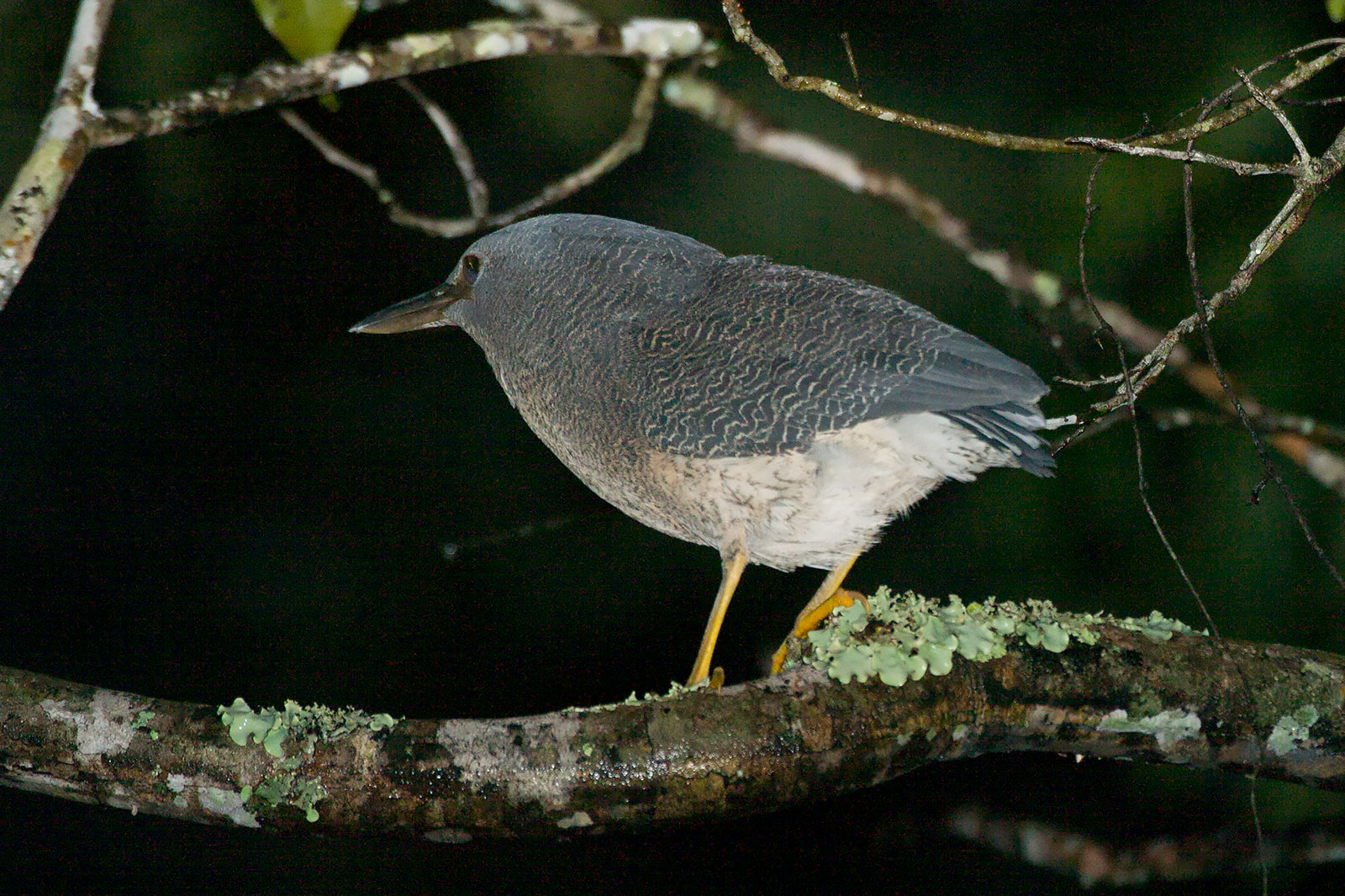
Zigzag heron
| Script error: No such module "Automated taxobox". | |
|---|---|
| Lua error in package.lua at line 80: module 'Module:InfoboxImage/data' not found. | |
Script error: No such module "Conservation status".
| |
| Scientific classification Edit this classification | |
| Script error: No such module "Taxobox ranks".: | <div style="display:inline" class="script error: no such module "taxobox ranks".">Template:Taxon infoTemplate:Taxon italics |
| Binomial name | |
| Template:Taxon infoTemplate:Taxon italics (Gmelin, 1789)
| |
| Lua error in package.lua at line 80: module 'Module:InfoboxImage/data' not found. | |
| Lua error in package.lua at line 80: module 'Module:InfoboxImage/data' not found. | |
Page Template:Taxobox/core/styles.css has no content.Template:Taxonbar/candidateTemplate:Speciesbox/parameterCheckScript error: No such module "Check for conflicting parameters".
The zigzag heron (Zebrilus undulatus) is a species of heron in the family Ardeidae, also including egrets and bitterns. It is in the monotypic genus Zebrilus. It is found in Bolivia, Brazil, Colombia, Ecuador, French Guiana, Guyana, Peru, Suriname, and Venezuela. Its natural habitat is subtropical or tropical swamps.
Taxonomy
The zigzag heron was formally described in 1789 by the German naturalist Johann Friedrich Gmelin in his revised and expanded edition of Carl Linnaeus's Systema Naturae. He placed it with the herons, cranes, storks and bitterns in the genus Ardea and coined the binomial name Ardea undulata.[2] Gmelin based his description on the zigzig bittern from Cayenne that had been described by the English ornithologist John Latham in his multi-volume work A General Synopsis of Birds.[3] Latham had in turn based his account on "Le petit butor de Cayenne" that had been described and illustrated in Comte de Buffon's Histoire Naturelle des Oiseaux.[4][5] The zigzag heron is the only species placed in the genus Zebrilus that was introduced in 1855 by the French naturalist Charles Lucien Bonaparte.[6][7] The genus name Zebrilus is a diminutive of the French zèbre meaning "zebra". The specific epithet undulatus is Latin meaning "furnished with wave-like markings".[8] The species is monotypic: no subspecies are recognised.[7]
Description
The adult plumage is gray with fine zigzag barring, with a pale underside, standing about Page Template:Fraction/styles.css has no content.32 centimetres (12+1⁄2 inches) in height. Juveniles have a dark back with a brown head and underside.[9] Due to its appearance it was often assigned to the tiger herons (Tigrisoma and allies). But in fact, it is a true bittern, having like these only 10 rectrices (other Ardeidae have 12) and being unequivocally placed in the bittern lineage by DNA sequence data too. Short legs and necks and cryptic plumage may thus be plesiomorphic among Ardeidae in general.
Distribution and habitat
The zigzag heron is a species of the entire Amazon Basin, east of the Andes cordillera, and the five bordering countries on the basin's western periphery, Colombia, Venezuela, Ecuador, Peru, and Bolivia. The range does not extend beyond the Orinoco River basin of Venezuela in the northwest, and in the east-northeast encompasses the Guianas; in the southeast Amazon Basin the range does not extend east of the Tapajós River drainage.
Behaviour
They are reclusive birds, staying hidden in thick cover even while foraging.[9]
References
Page Template:Reflist/styles.css has no content.
- ^ Template:Cite iucn
- ^ Page Module:Citation/CS1/styles.css has no content.Gmelin, Johann Friedrich (1789). Systema naturae per regna tria naturae: secundum classes, ordines, genera, species, cum characteribus, differentiis, synonymis, locis (in Latin). Vol. 1, Part 2 (13th ed.). Lipsiae [Leipzig]: Georg. Emanuel. Beer. p. 637.
{{cite book}}: CS1 maint: unrecognized language (link) - ^ Page Module:Citation/CS1/styles.css has no content.Latham, John (1785). A General Synopsis of Birds. Vol. 3, Part 1. London: Printed for Leigh and Sotheby. p. 61, No. 22.
- ^ Page Module:Citation/CS1/styles.css has no content.Buffon, Georges-Louis Leclerc de (1780). "Le petit butor de Cayenne". Histoire Naturelle des Oiseaux (in French). Vol. 7. Paris: De l'Imprimerie Royale. p. 430.
{{cite book}}: CS1 maint: unrecognized language (link) - ^ Page Module:Citation/CS1/styles.css has no content.Buffon, Georges-Louis Leclerc de; Martinet, François-Nicolas; Daubenton, Edme-Louis; Daubenton, Louis-Jean-Marie (1765–1783). "Petit bucor, de Cayenne". Planches Enluminées D'Histoire Naturelle. Vol. 8. Paris: De L'Imprimerie Royale. Plate 763.
- ^ Page Module:Citation/CS1/styles.css has no content.Bonaparte, Charles Lucien (1855). "Tableaux synoptiques de l'ordre des hérons". Comptes Rendus Hebdomadaires des Séances de l'Académie des Sciences (in French). 40: 718–733 [723].
{{cite journal}}: CS1 maint: unrecognized language (link) - ^ a b Page Module:Citation/CS1/styles.css has no content.Gill, Frank; Donsker, David; Rasmussen, Pamela, eds. (August 2022). "Ibis, spoonbills, herons, Hamerkop, Shoebill, pelicans". IOC World Bird List Version 12.2. International Ornithologists' Union. Retrieved 25 November 2022.
- ^ Page Module:Citation/CS1/styles.css has no content.Jobling, James A. (2010). The Helm Dictionary of Scientific Bird Names. London: Christopher Helm. pp. 413, 396. ISBN 978-1-4081-2501-4.
- ^ a b Page Module:Citation/CS1/styles.css has no content."Zigzag Heron (Zebrilus undulatus) - Peru Aves | Peru Birds". Retrieved 2016-06-30.
External links
Page Template:Sister-inline/styles.css has no content.Script error: No such module "Sister project logo". Media related to Script error: No such module "Commons link". at Wikimedia Commons Template:Wikispecies-inline
- Zigzag heron videos on the Internet Bird Collection
- Zigzag heron photo gallery Script error: No such module "webarchive". VIREO Photo-high res Script error: No such module "webarchive".
- Photo-high res
- PhotoArticle - sunbirdtours
Template:Pelecaniformes genera Script error: No such module "Taxonbar".