Cheget
Page Module:Message box/ambox.css has no content.
 | Page Template:Hidden begin/styles.css has no content. You can help expand this article with text translated from the corresponding article in русский. (January 2026) Click [show] for important translation instructions.
|

Cheget (Template:Langx) is a "nuclear briefcase" (named after Mount Cheget in Kabardino-Balkaria) and a part of the automatic system for the command and control of Russia's Strategic Nuclear Forces (SNF) named Kazbek (Script error: No such module "Lang"., named after Mount Kazbek on the Georgia–Russia border).[1] From when it was first developed, a "nuclear suitcase" has been available to the Russian head of state, Minister of Defense and the head of the General Staff.[2]
History
The cheget was developed during Yuri Andropov's administration in the early 1980s. The suitcase was put into service just as Mikhail Gorbachev took office as General Secretary of the Communist Party of the Soviet Union in March 1985.[3] It is connected to the special communications system code-named Kavkaz (Script error: No such module "Lang"., the Russian name for the Caucasus region), which "supports communication between senior government officials while they are making the decision whether to use nuclear weapons, and in its own turn is plugged into Kazbek, which embraces all the individuals and agencies involved in command and control of the Strategic Nuclear Forces."
The President of Russia (the Supreme Commander-in-Chief) has a cheget on hand at all times. It is one of three, with the other two held by the Minister of Defence and the Chief of the General Staff. It may be that affirmations from two of the three are needed to trigger an actual launch.[4][5][6] The General Staff receives the signal and initiates the nuclear strike through the passing of authorization codes to missile silo launch complexes/ballistic missile submarines or by remotely launching individual land-based intercontinental ballistic missiles (ICBMs)/submarine-launched ballistic missiles (SLBMs).[7]
On 25 January 1995, the cheget was activated in response to a misidentified three-stage scientific sounding rocket (Brant XII as third stage) launched by Norwegian and U.S. scientists; it was the only known time a nuclear briefcase has been activated in preparation for an attack.[3]
Gallery
-

-
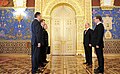 The ceremony of passing the "nuclear briefcase" during Vladimir Putin's third inauguration on 7 May 2012.


See also
Lua error in mw.title.lua at line 404: bad argument #2 to 'title.new' (unrecognized namespace name 'Portal').
- Designated survivor – a person chosen from the US Presidential line of succession to be kept distant from the others
- Nuclear football – the American counterpart to Cheget
- Letters of last resort – the British counterpart to Cheget
- Two-man rule
- Cold War
- World War III
- Dead Hand – Soviet nuclear-control system
References
Page Template:Reflist/styles.css has no content.
- ^ Page Module:Citation/CS1/styles.css has no content."О дискуссии по поводу планов создания ОГК ССС: Не все так однозначно - комментарий И.В. Сутягина" [On the discussion about the plans to create OGK SSS: Not everything is so simple - comment by I.V. Sutyagin]. Archived from the original on 25 December 2007. Retrieved 14 January 2008.
- ^ Page Module:Citation/CS1/styles.css has no content."Приключения ядерного чемоданчика" [The Adventures of the Nuclear Suitcase]. 6 June 2014. Retrieved 25 January 2023.
- ^ a b Page Module:Citation/CS1/styles.css has no content.David Hoffman (15 March 1998). "Cold-War Doctrines Refuse to Die". Washington Post. Retrieved 7 August 2014.
- ^ Do Russia’s military setbacks increase the risk of nuclear conflict?, The Economist, 14 Sept 2022, accessed 25 January 2023
- ^ Page Module:Citation/CS1/styles.css has no content.Mikhail Tsypkin (September 2004). "Adventures of the "Nuclear Briefcase"". Strategic Insights. 3 (9). Archived from the original on 23 September 2004.
- ^ Page Module:Citation/CS1/styles.css has no content.Alexander Golts (20 May 2008). "A 2nd Briefcase for Putin". Moscow Times. Archived from the original on 4 June 2011.
- ^ Page Module:Citation/CS1/styles.css has no content.Alexander A. Pikayev (Spring–Summer 1994). "Post-Soviet Russia and Ukraine: Who can push the Button?" (PDF). The Nonproliferation Review. 1 (3): 31–46. doi:10.1080/10736709408436550. Retrieved 6 August 2014.


