Quotation mark
Template:Short description Script error: No such module "Hatnote". Script error: No such module "Redirect-distinguish". Script error: No such module "Unsubst". Script error: No such module "Unsubst".
Template:Infobox punctuation mark
Template:Contains special characters
Quotation marksTemplate:Efn are punctuation marks used in pairs in various writing systems to identify direct speech, a quotation, or a phrase. The pair consists of an opening quotation mark and a closing quotation mark, which may or may not be the same glyph.[1] Quotation marks have a variety of forms in different languages and in different media.
History
Script error: No such module "Unsubst". The single quotation mark is traced to Ancient Greek practice, adopted and adapted by monastic copyists. Isidore of Seville, in his seventh-century encyclopedia, Script error: No such module "Lang"., described their use of the Greek diplé, a symbol like a right angle bracket:
The double quotation mark derives from a marginal notation used in fifteenth-century manuscript annotations to indicate a passage of particular importance (not necessarily a quotation); the notation was placed in the outside margin of the page and was repeated alongside each line of the passage.[2] In his edition of the works of Aristotle, which appeared in 1483 or 1484, the Milanese Renaissance humanist Francesco Filelfo marked literal and appropriate quotes with oblique double dashes on the left margin of each line.[3] Until then, literal quotations had been highlighted or not at the author's discretion.[3] Script error: No such module "Unsubst". were marked on the edge. After the publication of Filelfo's edition, the quotation marks for literal quotations prevailed.[3] During the seventeenth century this treatment became specific to quoted material, and it grew common, especially in Britain, to print quotation marks (now in the modern opening and closing forms) at the beginning and end of the quotation as well as in the margin; the French usage is a remnant of this. In most other languages, including English, the marginal marks dropped out of use in the last years of the eighteenth century. The usage of a pair of marks, opening and closing, at the level of lower case letters was generalized.[2]
.png)

By the nineteenth century, the design and usage began to be specific to each region. In Western Europe the custom became to use the quotation mark pairs with the convexity of each mark aimed outward. In Britain those marks were elevated to the same height as the top of capital letters: Template:Char.


In France, by the end of the nineteenth century, the marks were modified to an angular shape. Some authors claim that the reason for this was a practical one, in order to get a character that was clearly distinguishable from apostrophes, commas, and parentheses. Also, in other scripts, the angular quotation marks are distinguishable from other punctuation characters: the Greek breathing marks, the Armenian emphasis and apostrophe, the Arabic comma, the decimal separator, the thousands separator, etc. Other authors[4]Script error: No such module "Unsubst". claim that the reason for this was an aesthetic one: the elevated quotation marks created extra white space before and after the word, below the quotation marks. This was considered aesthetically unpleasing, while the in-line quotation marks helped to maintain the typographical color, since the quotation marks had the same height and were aligned with the lower case letters.[2] Nevertheless, while other languages do not insert spaces between the quotation marks and the word(s) quoted, the French usage does insert them, even if they are narrow spaces.
The curved quotation marks ("66–99") usage, Template:Char, was exported to some non-Latin scripts, notably where there was some English influence, for instance in Native American scripts and Indic scripts.[5][6] On the other hand, Greek, Cyrillic, Arabic and Ethiopic adopted the French "angular" quotation marks, Template:Char. The Far East angle bracket quotation marks, Template:Char, are also a development of the in-line angular quotation marks.Script error: No such module "Unsubst".
In Central Europe, the practice was to use the quotation mark pairs with the convexity aimed inward. The German tradition preferred the curved quotation marks, the first one at the level of the commas, the second one at the level of the apostrophes: Template:Char. Alternatively, these marks could be angular and in-line with lower case letters, but still pointing inward: Template:Char. Some neighboring regions adopted the German curved marks tradition with lower–upper alignment, while some, e.g. Poland, adopted a variant with the convexity of the closing mark aimed rightward like the opening one, Template:Char.[7]
Sweden (and Finland) chose a convention where the convexity of both marks was aimed to the right but lined up both at the top level: Template:Char.
In Eastern Europe,Script error: No such module "Unsubst". there was hesitation between the French tradition Template:Char and the German tradition Template:Char. The French tradition prevailed in Eastern Europe (Russia, Ukraine, and Belarus), whereas the German tradition, or its modified version with the convexity of the closing mark aimed rightward, has become dominant in Southeastern Europe, e.g. in the Balkan countries. In Romania the: Template:Char version is officially recognized by the Romanian Academy.
In some languages using the angular quotation marks, the usage of the single guillemet, Template:Char, became obsolete, being replaced by double curved ones: Template:Char, though the single ones still survive, for instance, in Switzerland. In Russia, Ukraine and Belarus, the curved quotation marks, Template:Char, are used as a secondary level or in handwriting, while the angular marks, Template:Char, are used as the primary level on printed text.
In English
Script error: No such module "anchor". Script error: No such module "Labelled list hatnote". In English writing, quotation marks are placed in pairs around a word or phrase to indicate:
- Quotation or direct speech: Template:Xt3
- Mention in another work of the title of a short or subsidiary work, such as a chapter or an episode: Template:Xt3.
- Scare quotes, used to mean "so-called" or to express sarcasm: Template:Xt3.
In American writing, quotation marks are normally the double kind (the primary style). If quotation marks are used inside another pair of quotation marks, then single quotation marks are used. For example: Template:Xt3 If another set of quotation marks is nested inside single quotation marks, double quotation marks are used again, and they continue to alternate as necessary (though this is rarely done).
British publishing is regarded as more flexible about whether double or single quotation marks should be used.[8] A tendency to use single quotation marks in British writing is thought to have arisen after the mid-19th century invention of steam-powered presses and the consequent rise of London and New York as distinct, industrialized publishing centers whose publishing houses adhered to separate norms.[9] The King's English in 1908 noted that the prevailing British practice was to use double marks for most purposes, and single ones for quotations within quotations.[10] Different media now follow different conventions in the United Kingdom.
Script error: No such module "anchor".Different varieties and styles of English have different conventions regarding whether terminal punctuation should be written inside or outside the quotation marks. North American printing usually puts full stops and commas (but not colons, semicolons, exclamation or question marks) inside the closing quotation mark, whether it is part of the original quoted material or not.[11][12] Styles elsewhere vary widely and have different rationales for placing it inside or outside, often a matter of house style.
Typographic forms
Script error: No such module "Labelled list hatnote". Regarding their appearance, two shape classifications of quotation marks are used in English-language texts:
- Template:Char and Template:Char are known as neutral, vertical, straight, typewriter, dumb, or ASCII quotation marks. The left and right marks are identical. These are the symbols found on typical QWERTY keyboards, although they are sometimes automatically converted to the other type by software.
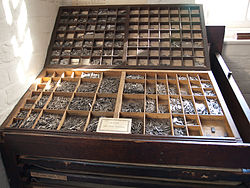
- Template:Char and Template:Char are known as typographic, curly, curved, book, or smart quotation marks. (The doubled ones are more informally known as "66 and 99".[13][14]) The beginning marks look like commas raised to the ascender line and rotated 180 degrees (and thus known as 'inverted commas'). The ending marks look like commas raised to the ascender line. Curved quotation marks are used mainly in manuscript, printing, and typesetting. Type cases (of any language) generally have the curved quotation mark metal types for the respective language, and may lack the vertical quotation mark metal types. Because most computer keyboards lack keys to enter typographic quotation marks directly, much that is written using word-processing programs has vertical quotation marks. The "smart quotes" feature in some computer software can convert vertical quotation marks to curly ones, although sometimes inappropriately.
The closing or right single quotation mark is identical in form to the apostrophe and similar to the prime symbol. The double quotation mark is identical to the ditto mark in English-language usage. It is also similar to—and often used to represent—the double prime symbol. These all serve different purposes and have distinct Unicode codepoints.
-
-
-
 A wired computer keyboard for desktop use


Summary table
Other languages have similar conventions to English, but use different symbols or different placement.
Template:Sticky headerTemplate:Sort-underTemplate:Table alignment
Template:Notelist-lr Template:Notelist
Specific language features
Bulgarian
Contemporary Bulgarian employs the em dash or the quotation dash (the horizontal bar) followed by a space character at the beginning of each direct-speech segment by a different character in order to mark direct speech in prose and in most journalistic question and answer interviews; in such cases, the use of standard quotation marks is left for in-text citations or to mark the names of institutions, companies, and sometimes also brand or model names.Script error: No such module "Unsubst".
Air quotes are also widely used in face-to-face communication in contemporary Bulgarian but usually resemble " ... " (secondary: ' ... ') unlike written Bulgarian quotation marks.
Dutch
Script error: No such module "Unsubst". The standard form in the preceding table is taught in schools and used in handwriting. Most large newspapers have kept these low-high quotation marks, Template:Char and Template:Char; otherwise, the alternative form with single or double English-style quotes is now often the only form seen in printed matter. Neutral (straight) quotation marks, Template:Char and Template:Char, are used widely, especially in texts typed on computers and on websites.[74]
Although not generally common in the Netherlands any more, double angle (guillemet) quotation marks are still sometimes used in Belgium. Examples include the Flemish HUMO magazine and the Metro newspaper in Brussels.[75]
German

The symbol used as the left (typographical) quote in English is used as the right quote in Germany and Austria and a "low double comma" Template:Char (not used in English) is used for the left quote. Its single quote form Template:Char looks like a comma.
| Samples | Unicode (decimal) | HTML | Description | Wrong Symbols |
|---|---|---|---|---|
| ‚Page Template:Color/styles.css has no content.A‘ | Script error: No such module "list". | Script error: No such module "list". | German single quotes (left and right) | Script error: No such module "list". |
| „Page Template:Color/styles.css has no content.A“ | Script error: No such module "list". | Script error: No such module "list". | German double quotes (left and right) | " – neutral (vertical) double quotes (U+0022) |
Some fonts, e.g. Verdana, were not designed with the flexibility to use an English left quote as a German right quote. Such fonts are therefore typographically incompatible with this German usage.
Double quotes are standard for denoting speech in German.
This style of quoting is also used in Bulgarian, Czech, Danish, Estonian, Georgian, Icelandic, Latvian, Lithuanian, Russian, Serbo-Croatian, Slovak, Slovene and in Ukrainian. Script error: No such module "Unsubst".
Sometimes, especially in novels, guillemets (angled quotation marks) are used in Germany and Austria (but pointing in the opposite direction compared to French): Template:Char
In Switzerland, the French-style angle quotation mark sets are also used for German printed text: «A ‹B›?»
Finnish and Swedish
In Finnish and Swedish, right quotes, called citation marks, Template:Char, are used to mark both the beginning and the end of a quote. Double right-pointing angular quotes, Template:Char, can also be used.
Alternatively, an en-dash followed by a (non-breaking) space can be used to denote the beginning of quoted speech, in which case the end of the quotation is not specifically denoted (see section Quotation dash below). A line-break should not be allowed between the en-dash and the first word of the quotation.
| Samples | Unicode (decimal) | HTML | Description |
|---|---|---|---|
| ’Page Template:Color/styles.css has no content.A’ | U+2019 (8217) | ’ | Secondary level quotation |
| ”Page Template:Color/styles.css has no content.A” | U+201D (8221) | ” | Primary level quotation |
| »Page Template:Color/styles.css has no content.A» | U+00BB (187) | » | Alternative primary level quotation |
| – Page Template:Color/styles.css has no content.A | U+2013 (8211) | – | Alternative denotation at the beginning of quoted speech |
French
Script error: No such module "Unsubst".
French uses angle quotation marks (guillemets, or duck-foot quotes), adding a 'quarter-em space'Template:Efn within the quotes. With proper localization, computers automatically add the proper spacing. When localization is not available, many people use a non-breaking space between the quotation mark and the nearest word inside itScript error: No such module "Unsubst". because the difference between a non-breaking space and a four-per-em space is virtually imperceptible, many computer fonts do not include a quarter-em space, and the Unicode quarter-em space is breakable. Even more commonly, many people put a normal (breaking) space inside the quotation marksScript error: No such module "Unsubst". because the non-breaking space cannot be accessed easily from the keyboard, or because they are not aware of this typographical refinement. Using a breakable space of any kind often results in a quotation mark appearing alone at the beginning of a line, since the quotation mark is erroneously treated as an independent word.
French news sites such as Libération, Les Échos and Le Figaro do not add manual spacing, leaving it up to localization and the browser to space the guillemets properly.
| Sample | Unicode (decimal) HTML | Description | |
|---|---|---|---|
| Quote | Space | ||
| « Page Template:Color/styles.css has no content.A » | Script error: No such module "list". | U+00A0 (160) | French double angle quotes (left and right), legacy (approximative) spacing usual on the web, with normal (four per em) no-break space (justifying, thus inappropriate) |
| «Template:ThinspPage Template:Color/styles.css has no content.ATemplate:Thinsp» | U+202F (8239)   | French double angle quotes (left and right), correct spacing used by typographers, with narrow (six per em) non-breaking spaces, represented on the web using narrow no-break space | |
| «Page Template:Color/styles.css has no content.A» | French double angle quotes (left and right) without space (not recommended in French) | ||
| ‹ Page Template:Color/styles.css has no content.A › | Script error: No such module "list". | U+00A0 (160) | French single angle quotes (left and right), alternate form for embedded quotations, legacy (approximative) spacing usual on the web, with normal (four per em) no-break space (justifying, thus inappropriate) |
| ‹Template:ThinspPage Template:Color/styles.css has no content.ATemplate:Thinsp› | U+202F (8239)   | French single angle quotes (left and right), alternate form for embedded quotations, correct spacing used by typographers, with narrow (six per em) non-breaking spaces, represented on the web using narrow no-break space | |
| ‹Page Template:Color/styles.css has no content.A› | French single angle quotes (left and right) without space (not recommended in French) | ||
Initially, the French guillemets were not angle shaped but also used the comma (6/9) shape.Script error: No such module "Unsubst". They were different from English quotes because they were standing (like today's guillemets) on the baseline (like lowercase letters), not raised above it (like apostrophes and English quotation marks) or hanging below it (like commas). At the beginning of the nineteenth century, this shape evolved to look like Template:Char small parentheses Template:Char. The angle shape was introduced later to make them easier to distinguish from apostrophes, commas and parentheses in handwritten manuscripts submitted to publishers. Unicode currently does not provide alternate codes for these 6/9 guillemets on the baseline, as they are considered to be form variants of guillemets, implemented in older French typography (such as the Didot font design). With this older style there was also not necessarily any distinction of shape between the opening and closing guillemets; both often pointed to the right (as today's French closing guillemets do).Script error: No such module "Unsubst".
In old-style printed books, when quotations span multiple lines of text (including multiple paragraphs), an additional closing quotation sign is traditionally used at the beginning of each line continuing a quotation; this right-pointing guillemet at the beginning of a line does not close the current quotation. This convention was consistently used from the beginning of the 19th century by most book printers, but is no longer in use today. Such insertion of continuation quotation marks was rigidly maintained, even at a word hyphenation break. Since these continuation marks are obsolete in French, there is no support for automatic insertion of continuation guillemets in HTML or CSS, nor in word-processors. Old-style typesetting is emulated by breaking up the final layout with manual line breaks, and inserting the quotation marks at line start, much like angle brackets before quoted plain text e-mail:
Unlike English, French does not identify unquoted material within a quotation by using a second set of quotation marks. Compare:
For clarity, some newspapers put nested quoted material in italics:
The French Imprimerie nationale (cf. Lexique des règles typographiques en usage à l'Imprimerie nationale, presses de l'Imprimerie nationale, Paris, 2002) does not use different quotation marks for nesting quotes: Template:Block indent
In this case, when there should be two adjacent opening or closing marks, only one is written:
The use of English quotation marks is increasing in French and usually follows English rules, for instance in situations when the keyboard or the software context doesn't allow the use of guillemets. The French news site L'Humanité uses straight quotation marks along with angle ones.
English quotes are also used sometimes for nested quotations: Template:Block indent
But the most frequent convention used in printed books for nested quotations is to style them in italics. Single quotation marks are much more rarely used, and multiple levels of quotations using the same marks is often considered confusing for readers:
Further, running dialogue does not use quotation marks beyond the first sentence, as changes in speaker are indicated by a dash, as opposed to the English use of closing and re-opening the quotation. (For other languages employing dashes, see section Quotation dash below.) The dashes may be used entirely without quotation marks as well. In general, quotation marks are extended to encompass as much speech as possible, including not just unspoken text such as "he said" (as previously noted), but also as long as the conversion extends. The quotation marks end at the last word of spoken text (rather than extending to the end of the paragraph) when the final part is not spoken. Template:Block indent
Greek
Greek uses angled quotation marks (Script error: No such module "Lang". – isagogiká): Template:Block indent and the quotation dash (Script error: No such module "Lang". – pávla): Template:Block indent which translate to: Template:Block indent A closing quotation mark, Template:Char, is added to the beginning of each new paragraph within a quotation.
When quotations are nested, the nested parts use English-style quotation marks, double and then (if necessary) single: Template:Char.[41]
| Samples | Unicode (decimal) | HTML | Description |
|---|---|---|---|
| «Page Template:Color/styles.css has no content.Α» | Template:Cslist | Template:Cslist | Greek first level double quotes (Script error: No such module "Lang".) |
| ― Page Template:Color/styles.css has no content.Α | U+2014 (8212) | — | Greek direct quotation em-dash |
Hungarian
According to current recommendation by the Hungarian Academy of Sciences the main Hungarian quotation marks are comma-shaped double quotation marks set on the base-line at the beginning of the quote and at apostrophe-height at the end of it for first level, (Template:Char), reversed »French quotes« without space (the German tradition) for the second level, and thus the following nested quotation pattern emerges:
... and with third level:
In Hungarian linguistic tradition the meaning of a word is signified by uniform (unpaired) apostrophe-shaped quotation marks:
A quotation dash is also used, and is predominant in belletristic literature.
| Samples | Unicode (decimal) | HTML | Description |
|---|---|---|---|
| „Page Template:Color/styles.css has no content.A” | Template:Cslist | Template:Cslist | Hungarian first level double quotes (left and right) |
| »Page Template:Color/styles.css has no content.A« | Template:Cslist | Template:Cslist | Hungarian second level double quotes (left and right) |
| ’Page Template:Color/styles.css has no content.A’ | U+2019 (8217) | ’ | Hungarian unpaired quotes signifying "meaning of the preceding term" |
Hebrew
In Israel, the traditional practice in printing and handwriting is to use „low-high” quote marks.[43] Since the 2000s, the plain quotes have become more common.Script error: No such module "Unsubst". The 2013 revision of the SI-1452 standard for Hebrew keyboard, available since 2012 in Windows 8 and in desktop Linux systems, supports both systems, as does the Gboard keyboard for touchscreen devices.
Norwegian
Norwegian uses angled quotation marks (Script error: No such module "Lang".)
| Samples | Unicode (decimal) | HTML | Description |
|---|---|---|---|
| «Page Template:Color/styles.css has no content.Α» | Template:Cslist | Template:Cslist |
Polish
Script error: No such module "Unsubst". According to current PN-83/P-55366 standard from 1983 (but not dictionaries, see below), Typesetting rules for composing Polish text (Zasady składania tekstów w języku polskim) one can use either „ordinary Polish quotes” or «French quotes» (without space) for first level, and ‚single Polish quotes’ or «French quotes» for second level, which gives three styles of nested quotes:
There is no space on the internal side of quote marks, with the exception of Page Template:Fraction/styles.css has no content.1⁄4 firet (≈ Page Template:Fraction/styles.css has no content.1⁄4 em) space between two quotation marks when there are no other characters between them (e.g. ,„ and ’”).
The above rules have not changed since at least the previous BN-76/7440-02 standard from 1976 and are probably much older.
These rules on the use of guillemets conflict with the ones given by Polish dictionaries, including the Wielki Słownik Ortograficzny PWN recommended by the Polish Language Council. The PWN rules state:
Page Template:Blockquote/styles.css has no content.
In specific uses, guillemets also appear. Guillemet marks pointing inwards are used for highlights and in case a quotation occurs inside a quotation. Guillemet marks pointing outwards are used for definitions (mainly in scientific publications and dictionaries), as well as for enclosing spoken lines and indirect speech, especially in poetic texts.[76]
Script error: No such module "Check for unknown parameters".
In Polish printed books and publications, this dictionary-recommended style for guillemets (also known as »German quotes«) is used almost exclusively. In addition to being standard for second level quotes, guillemet quotes are sometimes used as first level quotes in headings and titles, but almost never for ordinary text in paragraphs.
Another style of quoting is to use an em-dash to open a quote; this is used almost exclusively for quoting dialogues rather than for single statements, and is virtually always the one used for that purpose in works of fiction.
An en-dash is sometimes used in place of the em-dash, especially so in newspaper texts.
| Samples | Unicode (decimal) | HTML | Description |
|---|---|---|---|
| ‚Page Template:Color/styles.css has no content.A’ | Template:Cslist | Template:Cslist | Polish single quotes (left and right) |
| „Page Template:Color/styles.css has no content.A” | Template:Cslist | Template:Cslist | Polish double quotes (left and right) |
| — Page Template:Color/styles.css has no content.A | U+2014 (8212) | — | Polish direct quotation em-dash |
| – Page Template:Color/styles.css has no content.A | U+2013 (8211) | – | Polish direct quotation en-dash |
Portuguese
Neither the Portuguese language regulator nor the Brazilian prescribe a particular shape for quotation marks, they only prescribe when and how they should be used.
In Portugal, angular quotation marks[77][60] (ex. «quote») are traditionally used. They are the Latin tradition quotation marks, normally used by typographers, and are also the usual style in reference sources,[78][79][80] as well as on some websites dedicated to the Portuguese language.[81]
The Código de Redação[82] for Portuguese-language documents published in the European Union prescribes three levels of quotation marks, Template:Char:
- in black: main sentence which contains the quotations;
- in green: 1st level quotation;
- in red: 2nd level quotation;
- in blue: 3rd level quotation;
The usage of curved quotation marks (ex. “quote” and ‘quote’) is growing in Portugal,[83]Script error: No such module "Unsubst". probably due to the omnipresence of the English language and to the corresponding difficulty (or even inability) to enter angular quotation marks on some machines (mobile phones, cash registers, calculators, etc.).
In Brazil, angular quotation marks are rare, and curved quotation marks (“quote” and ‘quote’) are almost always used. An example of this can be seen in the difference between a Portuguese keyboard (which has a key for Template:Char and Template:Char) and a Brazilian keyboard.
The Portuguese-speaking African countries tend to follow Portugal's conventions, not the Brazilian ones.
Other usages of quotation marks (Template:Char for double, Template:Char for single) are obsolete in Portuguese.Script error: No such module "Unsubst"..
Belarusian, Russian, and Ukrainian
In Belarusian, Russian, and Ukrainian, the angled quotation marks (Template:Langx, Template:Langx, Template:Langx) are used without spaces. In case of quoted material inside a quotation, rules and most noted style manuals prescribe the use of different kinds of quotation marks.
Example in Russian:
Script error: No such module "Lang".
(Pushkin wrote to Delvig: "Waiting for 'Gypsies', and publish at once.")
Example in Ukrainian:
Script error: No such module "Lang".
("And, of course, you can't avoid using a dictionary. One of my acquaintances, a poet and literary critic, once jokingly said: 'I prefer to read dictionaries than poems. The dictionary has the same words as in the poem, but is presented in a systematic way'. It's a joke, but 'reading dictionaries' is not as amazing and bizarre as it may seem.")
Russian keyboard layout has no angled quotation marks, but has English quotation marks (" ") that are not even supposed to be used in Russian. For that reason one may often see non-standard use of English quotation marks on the Russian web.
Spanish
Spanish uses angled quotation marks (Script error: No such module "Lang"., Script error: No such module "Lang". or Script error: No such module "Lang".), with no space between the quotation mark and the quoted material.
When quotations are nested in more levels than inner and outer quotation, the system is:[84]
The use of English quotation marks is increasing in Spanish;Script error: No such module "Unsubst". the El País style guide, which is widely followed in Spain, recommends them. Hispanic Americans often use them, owing to influence from the United States.
Chinese, Japanese and Korean
Corner brackets are well-suited for Chinese, Japanese, and Korean languages, because they accommodate vertical and horizontal writing equally well. China, South Korea, and Japan all use corner brackets when writing vertically. Usage differs when writing horizontally:
- In Japan, corner brackets are used.
- In South Korea, corner brackets and English-style quotes are used.
- In North Korea, angle quotes are used.Script error: No such module "Unsubst".
- In mainland China, English-style quotes (full width “ ”) are official and prevalent; corner brackets are rare today. The Unicode code points used are the English quotes (rendered as fullwidth by the font), not the fullwidth forms.
- In Taiwan, Hong Kong and Macau, where traditional characters are used, corner brackets are prevalent, although English-style quotes are also used.
- In the Chinese language, double angle brackets are placed around titles of books, documents, movies, pieces of art or music, magazines, newspapers, laws, etc. When nested, single angle brackets are used inside double angle brackets. With some exceptions, this usage parallels the usage of italics in English:
- 「你看過《三國演義》嗎?」他問我。
- "Have you read Romance of the Three Kingdoms?", he asked me.
When corner brackets are being used for quotations, quote-within-quote segments are marked with white corner brackets.
Quotation dash
Script error: No such module "anchor". Script error: No such module "Labelled list hatnote".Another typographical style is to omit quotation marks for lines of dialogue, replacing them with an initial dash, as in lines from James Joyce's Ulysses:
This style is particularly common in Bulgarian, French, Greek, Hungarian, Polish, Portuguese, Romanian, Russian, Spanish, Swedish, Turkish, and Vietnamese.[73]
In Finnish, the beginning of a reporting clause is marked only by the punctuation already existing in the sentence, or (if there was none) by adding a comma. When a quote continues after the reporting clause, the clause ends with a comma, and the continuation begins with another dash:[85]
| Finnish example | – Et sinä ole paljon minkään näköinen, sanoi Korkala melkein surullisesti, – mutta ei auta. |
|---|---|
| English translation | "You don't seem to be anything special," said Korkala almost sadly, "but there's no help to it." |
| English translation formatted in Finnish quotation style | – You don't seem to be anything special, said Korkala almost sadly, – but there's no help to it. |
| Finnish example | – Frakki, älähti Huikari. – Missä on frakki? – Räätälissä, sanoi Joonas rauhallisesti. |
| English translation | "Tailcoat", yelped Huikari. "Where is the tailcoat?" "At the tailor's", said Joonas calmly. |
| English translation formatted in Finnish quotation style | – Tailcoat, yelped Huikari. – Where is the tailcoat? – At the tailor's, said Joonas calmly. |
The Unicode standard introduced a separate character Expression error: Unexpected < operatorScript error: No such module "Check for unknown parameters". to be used as a quotation dash.[86]
Electronic documents
Different typefaces, character encodings and computer languages use various encodings and glyphs for quotation marks.
Typewriters and early computers
On most keyboards, typographical quotation marks are absent.
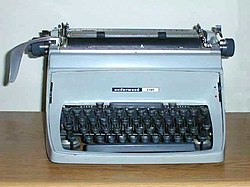
When typewriter keyboards were designed, curved quotation marks were not implemented. Instead, to limit the number of characters (and keys) required, straight quotation marks were invented as a compromise. At that time typesetting did use curved quotation marks.Script error: No such module "Unsubst". The ASCII character set, which has been used on a wide variety of computers since the 1960s, contains the straight versions only (Expression error: Unexpected < operatorScript error: No such module "Check for unknown parameters". and Expression error: Unexpected < operatorScript error: No such module "Check for unknown parameters".). All other forms of quotation marks, such as angled, lowered, inverted, were not provided by British or American typewriters.
Many systems, such as the personal computers of the 1980s and early 1990s, actually drew these ASCII quotes like closing quotes (or primes) on-screen and in printouts, so text would appear like this (approximately):
These same systems often drew the backtick (the free standing character Expression error: Unexpected < operatorScript error: No such module "Check for unknown parameters".) as an 'open quote' glyph (usually a mirror image so it still sloped in the direction of a grave accent). Using this character as the opening quote gave a typographic approximation of curved single quotes. Nothing similar was available for the double quote, so many people resorted to using two single quotes for double quotes, which would look approximately like the following:
The typesetting application TeX uses this convention for input files. The following is an example of TeX input which yields proper curly quotation marks.
``Good morning, Dave,'' said HAL.`Good morning, Dave,' said HAL.
The Unicode standard added codepoints for slanted or curved quotes (Expression error: Unexpected < operatorScript error: No such module "Check for unknown parameters". and Expression error: Unexpected < operatorScript error: No such module "Check for unknown parameters"., described further below), shown here for comparison:
The Unicode mapping for PostScript Standard Encoding preserves the typographic approximation convention by mapping its equivalent of ASCII grave and single-quote to the Unicode curly quotation mark characters.
Keyboard layouts
Early computer keyboards copied layouts that had been established by typewriter keyboards. Most computer keyboards do not have specific keys for curved quotation marks or angled quotation marks. This may also have to do with computer character sets:
- IBM character sets generally do not include curved quotation mark characters, therefore, keys for those marks are absent from most IBM computer keyboards.[87]
- Microsoft followed the example of IBM in its character set and keyboard design. Curved quotation marks were implemented later in Windows character sets, but most Microsoft computer keyboards[88] do not have a dedicated key for the curved quotation mark characters. On keyboards with the Script error: No such module "key". key or both the Script error: No such module "key". key and the numeric keypad, they are accessible through a series of keystrokes that involve these keys.Template:Efn Also, techniques using their Unicode code points are available; see Unicode input.
- Macintosh character sets have always had curved quotation marks available. Nevertheless, these are mostly only accessible through a series of keystrokes involving the Script error: No such module "key". key.
In languages that use the curved “...” quotation marks, they are availableTemplate:Efn in:
In languages that use angular «...» quotation marks, they are availableTemplate:Efn in:
- Macintosh Arabic keyboard;[89]
- Armenian keyboard[89][87][90]
- Canadian keyboard[89][87][91]
- French BÉPO keyboard[92]
- Greek keyboard[89][87][93]
- Khmer keyboard[89]
- Latvian ergonomic keyboard[89][87][94]
- Pashto keyboard[89][95]
- Persian keyboard[89][87][96]
- Portuguese keyboard[89][87][97]
- Syriac keyboard[89][98]
- Uyghur keyboard[89][99]
In languages that use the corner bracket 「...」 quotation marks, they are availableTemplate:Efn in:
In languages that use the angle bracket 《...》Template:Efn they are available in:
In languages that use the curved „...“ quotation marks, they are availableTemplate:Efn in:
In languages that use the curved „...” quotation marks, they are availableTemplate:Efn in:
In languages that use the curved ”...” quotation marks, they are availableTemplate:Efn in:
- none
Curved quotes within and across applications
Historically, support for curved quotes was a problem in information technology, primarily because the widely used ASCII character set did not include a representation for them.Template:Efn
The term "smart quotes", Template:Char, is from the name in several word processors of a function aimed this problem: automatically converting straight quotes typed by the user into curved quotes, the feature attempts to be "smart" enough to determine whether the punctuation marked opening or closing. Since curved quotes are the typographically correct ones,Script error: No such module "Unsubst". word processors have traditionally offered curved quotes to users (at minimum as available characters). Before Unicode was widely accepted and supported, this meant representing the curved quotes in whatever 8-bit encoding the software and underlying operating system was using. The character sets for Windows and Macintosh used two different pairs of values for curved quotes, while ISO 8859-1 (historically the default character set for the Unixes and older Linux systems) has no curved quotes, making cross-platform and cross-application compatibility difficult.
Performance by these "smart quotes" features was far from perfect overall (variance potential by e.g. subject matter, formatting/style convention, user typing habits). As many word processors (including Microsoft Word and OpenOffice.org) have the function enabled by default, users may not have realized that the ASCII-compatible straight quotes they were typing on their keyboards ended up as something different (conversely users could incorrectly assume its functioning in other applications, e.g. composing emails).
The curved apostrophe is the same character as the closing single quote.[105] "Smart quotes" features wrongly convert initial apostrophes (as in 'tis, 'em, 'til, and '89) into opening single quotes. (An example of this error appears in the advertisements for the television show 'Til Death.) The two very different functions of this character can cause confusion, particularly in British styles,Template:Efn in which single quotes are the standard primary.
Unicode support has since become the norm for operating systems. Thus, in at least some cases, transferring content containing curved quotes (or any other non-ASCII characters) from a word processor to another application or platform has been less troublesome, provided all steps in the process (including the clipboard if applicable) are Unicode-aware. But there are still applications which still use the older character sets, or output data using them, and thus problems still occur.
There are other considerations for including curved quotes in the widely used markup languages HTML, XML, and SGML. If the encoding of the document supports direct representation of the characters, they can be used, but doing so can cause difficulties if the document needs to be edited by someone who is using an editor that cannot support the encoding. For example, many simple text editors only handle a few encodings or assume that the encoding of any file opened is a platform default, so the quote characters may appear as the generic replacement character Template:Char or "mojibake" (gibberish). HTML includes a set of entities for curved quotes: ‘ (left single), ’ (right single or apostrophe), ‚ (low 9 single), “ (left double), ” (right double), and „ (low 9 double). XML does not define these by default, but specifications based on it can do so, and XHTML does. In addition, while the HTML 4, XHTML and XML specifications allow specifying numeric character references in either hexadecimal or decimal, SGML and older versions of HTML (and many old implementations) only support decimal references. Thus, to represent curly quotes in XML and SGML, it is safest to use the decimal numeric character references. That is, to represent the double curly quotes use “ and ”, and to represent single curly quotes use ‘ and ’. Both numeric and named references function correctly in almost every modern browser. While using numeric references can make a page more compatible with outdated browsers, using named references are safer for systems that handle multiple character encodings (i.e. RSS aggregators and search results).
In Windows file and folder names, the straight double quotation mark is prohibited, as it is a reserved character. The curved quotation marks, as well as the straight single quotation mark, are permitted.
Usenet and email
The style of quoting known as Usenet quoting uses the greater-than sign, Template:Char prepended to a line of text to mark it as a quote. This convention was later standardized in Template:IETF RFC, and was adopted subsequently by many email clients when automatically including quoted text from previous messages (in plain text mode).
Unicode code point table
In Unicode, 30 characters are marked Quotation Mark=Yes by character property.[106] They all have general category "Punctuation", and a subcategory Open, Close, Initial, Final or Other (Ps, Pe, Pi, Pf, Po). Several other Unicode characters with quotation mark semantics lack the character property.
| Character | Comments |
|---|---|
| Expression error: Unexpected < operatorScript error: No such module "Check for unknown parameters". | Typewriter ("programmer's") quote, ambidextrous. Also known as "double quote". |
| Expression error: Unexpected < operatorScript error: No such module "Check for unknown parameters". | Typewriter ("programmer's") straight single quote, ambidextrous |
| Expression error: Unexpected < operatorScript error: No such module "Check for unknown parameters". | Double angle quote (chevron, guillemet, duck-foot quote), left |
| Expression error: Unexpected < operatorScript error: No such module "Check for unknown parameters". | Double angle quote, right |
| Expression error: Unexpected < operatorScript error: No such module "Check for unknown parameters". | Single curved quote, left. Also known as inverted comma or turned commaTemplate:Efn |
| Expression error: Unexpected < operatorScript error: No such module "Check for unknown parameters". | Single curved quote, rightTemplate:Efn |
| Expression error: Unexpected < operatorScript error: No such module "Check for unknown parameters". | Low single curved quote, left |
| Expression error: Unexpected < operatorScript error: No such module "Check for unknown parameters". | also called single reversed comma, quotation mark |
| Expression error: Unexpected < operatorScript error: No such module "Check for unknown parameters". | Double curved quote, left |
| Expression error: Unexpected < operatorScript error: No such module "Check for unknown parameters". | Double curved quote, right |
| Expression error: Unexpected < operatorScript error: No such module "Check for unknown parameters". | Low double curved quote, left |
| Expression error: Unexpected < operatorScript error: No such module "Check for unknown parameters". | also called double reversed comma, quotation mark |
| Expression error: Unexpected < operatorScript error: No such module "Check for unknown parameters". | Single angle quote, left |
| Expression error: Unexpected < operatorScript error: No such module "Check for unknown parameters". | Single angle quote, right |
| Expression error: Unexpected < operatorScript error: No such module "Check for unknown parameters". | also called double low reversed comma, quotation mark |
| Quotation marks in Miscellaneous Technical | |
| Expression error: Unexpected < operatorScript error: No such module "Check for unknown parameters". | jointly, these are also called Quine corners, indicating quasi-quotation or Gödel numerals |
| Expression error: Unexpected < operatorScript error: No such module "Check for unknown parameters". | |
| Quotation marks in dingbats | |
| Expression error: Unexpected < operatorScript error: No such module "Check for unknown parameters". | Quotation Mark=No
|
| Expression error: Unexpected < operatorScript error: No such module "Check for unknown parameters". | Quotation Mark=No
|
| Expression error: Unexpected < operatorScript error: No such module "Check for unknown parameters". | Quotation Mark=No
|
| Expression error: Unexpected < operatorScript error: No such module "Check for unknown parameters". | Quotation Mark=No
|
| Expression error: Unexpected < operatorScript error: No such module "Check for unknown parameters". | Quotation Mark=No
|
| Expression error: Unexpected < operatorScript error: No such module "Check for unknown parameters". | Quotation Mark=No
|
| Expression error: Unexpected < operatorScript error: No such module "Check for unknown parameters". | Quotation Mark=No
|
| Quotation marks in Braille Patterns | |
| Expression error: Unexpected < operatorScript error: No such module "Check for unknown parameters". | Braille double closing quotation mark; Quotation Mark=No
|
| Expression error: Unexpected < operatorScript error: No such module "Check for unknown parameters". | Braille double opening quotation mark; Quotation Mark=No
|
| Quotation marks in Chinese, Japanese, and Korean (CJK) | |
| Expression error: Unexpected < operatorScript error: No such module "Check for unknown parameters". | CJK |
| Expression error: Unexpected < operatorScript error: No such module "Check for unknown parameters". | CJK |
| Expression error: Unexpected < operatorScript error: No such module "Check for unknown parameters". | CJK |
| Expression error: Unexpected < operatorScript error: No such module "Check for unknown parameters". | CJK |
| Expression error: Unexpected < operatorScript error: No such module "Check for unknown parameters". | CJK |
| Expression error: Unexpected < operatorScript error: No such module "Check for unknown parameters". | CJK |
| Expression error: Unexpected < operatorScript error: No such module "Check for unknown parameters". | CJK |
| Alternate encodings | |
| Expression error: Unexpected < operatorScript error: No such module "Check for unknown parameters". | CJK Compatibility Form (vertical form to be used in horizontal texts), preferred use: U+300C |
| Expression error: Unexpected < operatorScript error: No such module "Check for unknown parameters". | CJK Compatibility Form (vertical form to be used in horizontal texts), preferred use: U+300D |
| Expression error: Unexpected < operatorScript error: No such module "Check for unknown parameters". | CJK Compatibility Form (vertical form to be used in horizontal texts), preferred use: U+300E |
| Expression error: Unexpected < operatorScript error: No such module "Check for unknown parameters". | CJK Compatibility Form (vertical form to be used in horizontal texts), preferred use: U+300F |
| Expression error: Unexpected < operatorScript error: No such module "Check for unknown parameters". | Halfwidth and Fullwidth Forms, fullwidth form corresponds with narrow U+0022 |
| Expression error: Unexpected < operatorScript error: No such module "Check for unknown parameters". | Halfwidth and Fullwidth Forms, fullwidth form corresponds with narrow U+0027 |
| Expression error: Unexpected < operatorScript error: No such module "Check for unknown parameters". | Halfwidth and Fullwidth Forms, halfwidth form corresponds with wide U+300C |
| Expression error: Unexpected < operatorScript error: No such module "Check for unknown parameters". | Halfwidth and Fullwidth Forms, halfwidth form corresponds with wide U+300D |
Explanatory notes
References
Page Template:Reflist/styles.css has no content.
- ↑ Script error: No such module "citation/CS1".
- ↑ a b c Script error: No such module "citation/CS1".
- ↑ a b c Script error: No such module "citation/CS1".
- ↑ a b Script error: No such module "citation/CS1".
- ↑ Script error: No such module "citation/CS1".
- ↑ Script error: No such module "Citation/CS1".
- ↑ Script error: No such module "citation/CS1".
- ↑ Script error: No such module "citation/CS1".
- ↑ Script error: No such module "citation/CS1". Revised text of a lecture given on 13 October 2015.
- ↑ Script error: No such module "citation/CS1".
- ↑ Script error: No such module "citation/CS1".
- ↑ Script error: No such module "citation/CS1".
- ↑ Script error: No such module "citation/CS1".
- ↑ Script error: No such module "citation/CS1".
- ↑ ISO-639-2 where available, otherwise ISO-639-3.
- ↑ With
_regionfor disambiguation; suitable for localisation using{{{1}}}as per Posix. - ↑ Script error: No such module "citation/CS1".
- ↑ a b c d Script error: No such module "citation/CS1".
- ↑ Script error: No such module "citation/CS1".
- ↑ Script error: No such module "citation/CS1".
- ↑ a b Script error: No such module "citation/CS1".
- ↑
- „Page Template:Color/styles.css has no content....“ is sometimes replaced by "Page Template:Color/styles.css has no content...." or very rarely by “Page Template:Color/styles.css has no content....”
- ’Page Template:Color/styles.css has no content....’ and ‘Page Template:Color/styles.css has no content....’ are sometimes written as 'Page Template:Color/styles.css has no content....', ‘Page Template:Color/styles.css has no content....’ or ‛Page Template:Color/styles.css has no content....’
- There is some limited use of alternative secondary quotation marks: ’Page Template:Color/styles.css has no content....‘; ,Page Template:Color/styles.css has no content....‘; ’Page Template:Color/styles.css has no content....’; ,Page Template:Color/styles.css has no content....’; ‹Page Template:Color/styles.css has no content....›.
- ↑ Script error: No such module "citation/CS1".
- ↑
- Simplified Chinese and Traditional Chinese agree on the names of the vertical rectangle quotation marks (Template:Css-styleand Template:Css-style) but disagree on which pair being the primary one.
- In Simplified Chinese, rectangle quotation marks are only used in vertical texts. The horizontal rectangle quotation marks are not commonly used in Simplified Chinese, and in the rare cases where they are used, often the convention of Traditional Chinese is followed.
- ↑ Script error: No such module "citation/CS1".
- ↑ Script error: No such module "citation/CS1".
- ↑
- Simplified Chinese and Traditional Chinese agree on the names of the vertical rectangle quotation marks (Template:Css-styleand Template:Css-style) but disagree on which pair being the primary one.
- In Traditional Chinese, curly quotation marks are not commonly used, and in the rare cases where they are used, often the convention of Simplified Chinese is followed.
- ↑ a b Script error: No such module "citation/CS1".
- ↑ Script error: No such module "citation/CS1".
- ↑ Script error: No such module "citation/CS1".
- ↑ Script error: No such module "citation/CS1".
- ↑ Script error: No such module "citation/CS1".
- ↑ Script error: No such module "citation/CS1".
- ↑ Script error: No such module "citation/CS1".
- ↑ The usage of single or double marks historically (and still) has been subject to varying standards dependent on individual or institution, though the older usage is double marking. Due to global influence, it has been popularly observed that double markings are more commonly employed in both formal and informal writing.Script error: No such module "Unsubst".
- ↑ a b Script error: No such module "citation/CS1".
- ↑ a b Regulated by the standard SFS 4175:2006, “Typing of numbers, marks and signs." Released by the National standards organization of Finland.
- ↑
- ↑ a b Script error: No such module "citation/CS1".
- ↑ Δημήτρης Ν. Μαρωνίτης, «Το Εγκόλπιο της Ορθής Γραφής» (1998)
- ↑ a b Script error: No such module "citation/CS1".
- ↑ Yannis Haralambous, "Guidelines and Suggested Amendments to the Greek Unicode Tables", 21th International Unicode Conference, May 2002.
- ↑ a b Script error: No such module "citation/CS1".
- ↑ Script error: No such module "citation/CS1".
- ↑ Script error: No such module "citation/CS1".
- ↑ Script error: No such module "citation/CS1".
- ↑ Script error: No such module "citation/CS1".
- ↑ a b Script error: No such module "citation/CS1".
- ↑ Script error: No such module "citation/CS1".
- ↑ a b Script error: No such module "citation/CS1".
- ↑
There is no standardized way on how quotation marks used in Latvian, depending on several usages:
- “Page Template:Color/styles.css has no content....” is preferred as widespread use in Latvian, which is same as English.
- „Page Template:Color/styles.css has no content....” is preferred for use in traditional handwriting and used in the Latvian Language Agency's (LVA) website.
- «Page Template:Color/styles.css has no content....» is rarely seen in Latvian but can be found in several textbooks. It was also used in widespread usage during the occupation of the Soviet Union.
- ↑ According to the Microsoft Lithuanian Style Guide Script error: No such module "webarchive"., Lithuanian quotation marks are low-99 high-66 style only.
- ↑ Script error: No such module "citation/CS1".
- ↑ Script error: No such module "citation/CS1".
- ↑ a b pp. 141-143, Правопис на македонскиот литературен јазик, Б. Видеоски etal., Просветно Дело-Скопје (2007)
- ↑ Inferred from keyboard layout Script error: No such module "webarchive". and fonts Script error: No such module "webarchive".; Mongolian Baiti font shows the wrong direction.
- ↑ Inferred from keyboard layout Script error: No such module "webarchive". and fonts Script error: No such module "webarchive"..
- ↑ "Anførselstegn (sitattegn): Slik bruker du anførselstegn i norsk" Script error: No such module "webarchive"., Korrekturavdelingen, Retrieved on 30 May 2018.
- ↑ Inferred from keyboard layout Script error: No such module "webarchive"..
- ↑ a b c Bergström, Magnus, & Neves Reis 2004. Prontuário Ortográfico e Guia da Língua Portuguesa. Editorial Notícias, Lisboa.
- ↑ Academia Română, Institutul de Lingvistică „Iorgu Iordan“, Îndreptar ortografic, ortoepic și de punctuație, ediția a V-a, Univers Enciclopedic, București, 1995
- ↑ a b Script error: No such module "citation/CS1".
- ↑ Script error: No such module "citation/CS1".
- ↑ Script error: No such module "citation/CS1".
- ↑ a b Script error: No such module "citation/CS1".
- ↑ Inferred from keyboard layout Script error: No such module "webarchive". and fonts Script error: No such module "webarchive"..
- ↑ Inferred from fonts Script error: No such module "webarchive"..
- ↑ Script error: No such module "citation/CS1".
- ↑ Template:Cite Q
- ↑ Script error: No such module "citation/CS1".
- ↑ Inferred from keyboard layout Script error: No such module "webarchive"..
- ↑ Script error: No such module "citation/CS1".
- ↑ a b Script error: No such module "citation/CS1".
- ↑ Script error: No such module "citation/CS1".
- ↑ Script error: No such module "citation/CS1".
- ↑ Script error: No such module "citation/CS1".
- ↑ Cite error: Script error: No such module "Namespace detect".Script error: No such module "Namespace detect".
- ↑ Script error: No such module "citation/CS1".
- ↑ Dicionário da Língua Portuguesa Contemporânea. Academia das Ciências, Lisboa, 2001
- ↑ Cunha, Celso & Lindley Cintra. Gramática do Português Contemporâneo. Edições João Sá da Cunha, Lisboa, 2013
- ↑ Script error: No such module "citation/CS1".
- ↑ Script error: No such module "citation/CS1".
- ↑ Script error: No such module "citation/CS1".
- ↑ This system follows the rules laid down in section 5.10 of the orthography guide Ortografía de la lengua española Script error: No such module "webarchive". published by the Real Academia Española (RAE).
- ↑ Script error: No such module "citation/CS1".
- ↑ Script error: No such module "citation/CS1".
- ↑ a b c d e f g h i Script error: No such module "citation/CS1".
- ↑ Script error: No such module "citation/CS1".
- ↑ a b c d e f g h i j k l m n o p q r Script error: No such module "citation/CS1".
- ↑ Script error: No such module "citation/CS1".
- ↑ Script error: No such module "citation/CS1".
- ↑ Script error: No such module "citation/CS1".
- ↑ Script error: No such module "citation/CS1".
- ↑ Script error: No such module "citation/CS1".
- ↑ Script error: No such module "citation/CS1".
- ↑ Script error: No such module "citation/CS1".
- ↑ Script error: No such module "citation/CS1".
- ↑ Script error: No such module "citation/CS1".
- ↑ Script error: No such module "citation/CS1".
- ↑ Script error: No such module "citation/CS1".
- ↑ Script error: No such module "citation/CS1".
- ↑ Script error: No such module "citation/CS1".
- ↑ Script error: No such module "citation/CS1".
- ↑ Script error: No such module "citation/CS1".
- ↑ "Smart" apostrophes The Chicago Manual of Style Online (17th ed.). Part 2, Chapter 6.117. Retrieved 3 January 2019. Subscription required (free trial available).
- ↑ Script error: No such module "citation/CS1".
Script error: No such module "Check for unknown parameters".
External links
Script error: No such module "Side box".
- "Curling Quotes in HTML, SGML, and XML", David A Wheeler (2017)
- "ASCII and Unicode quotation marks" by Markus Kuhn (1999) – includes detailed discussion of the ASCII 'backquote' problem
- The Gallery of "Misused" Quotation Marks
- "Commonly confused characters", Greg's References Pages, Greg Baker (2016)
- "Smart Quotes", David Dunham (2006)
- "How to type “smart quotes” (U+201C, U+201D)", on Unix/Linux, at Stack Exchange
- Index of quotation-marks-related material at the EnglishGrammar website
- "Œuvrez les guillemets" Template:In lang, Pauline Morfouace (2002) – French quotation mark typography
Script error: No such module "Navbox". Template:Navbox punctuation


