1125 China
Template:Short description Script error: No such module "For". Template:DMCA
Page Module:Infobox/styles.css has no content.
| Lua error in package.lua at line 80: module 'Module:InfoboxImage/data' not found. Modelled shape of China from its lightcurve | |
| Discovery[1] | |
|---|---|
| Discovered by | Y. C. Chang[2] |
| Discovery site | Purple Mountain Obs. |
| Discovery date | 30 October 1957 |
| Designations | |
Named after | China (country)[2] |
| Template:Mp · 1959 EL 1971 KX · 1974 VM A909 BE | |
| Page Template:Plainlist/styles.css has no content. | |
| Orbital characteristics[1] | |
| Epoch 4 September 2017 (JD 2458000.5) | |
| Uncertainty parameter 0 | |
| Observation arc | 108.75 yr (39,722 days) |
| Aphelion | 3.8083 AU |
| Perihelion | 2.4452 AU |
| 3.1267 AU | |
| Eccentricity | 0.2180 |
| 5.53 yr (2,019 days) | |
| 215.01° | |
| Template:Deg2DMS / day | |
| Inclination | 3.0407° |
| 97.172° | |
| 10.745° | |
| Physical characteristics | |
| 21.86±6.06 km[6] 23.95±6.03 km[7] 26.084±0.199 km[8] 26.513±0.354 km[9] 26.64 km (calculated)[10] 30.49±1.97 km[11] | |
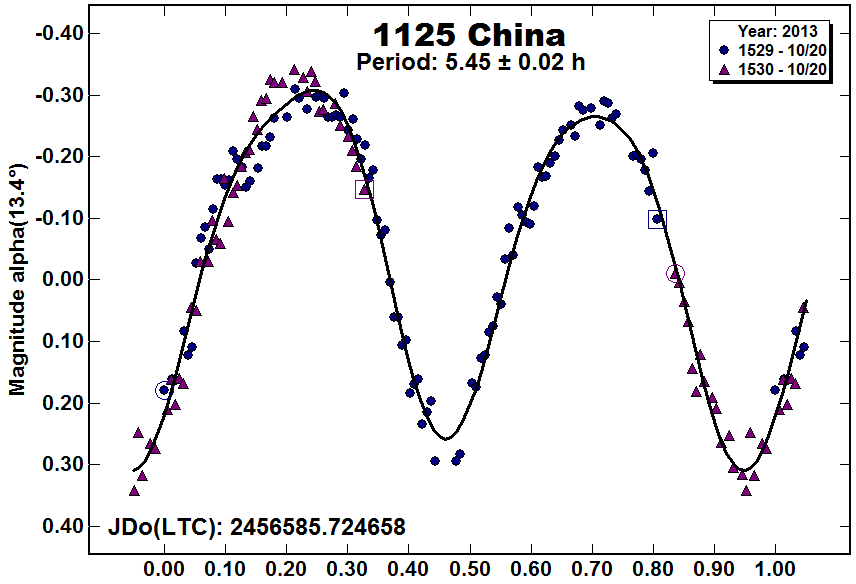
| 5.367±0.002 h[12] 5.45±0.02 h[13][a] | |
Pole ecliptic latitude | Page Template:Plainlist/styles.css has no content. |
| 0.057 (assumed)[10] 0.057±0.004[9] 0.06±0.03[7] 0.063±0.009[11] 0.08±0.06[6] 0.0860±0.0223[8] | |
| C (assumed)[10] | |
| 11.20[8][11] · 11.26±0.19[12] · 11.60[1][10][7] · 11.70[6] | |
| Page Template:Reflist/styles.css has no content. | |
Script error: No such module "Check for conflicting parameters".
1125 China (prov. designation: Template:Mp) is a dark background asteroid from the outer regions of the asteroid belt. It was discovered on 30 October 1957, by astronomer Zhāng Yùzhé (Y. C. Chang, 张钰哲) at the Chinese Purple Mountain Observatory (紫金山天文台) in Nanjing, and named in honor of the country China.[3] The assumed C-type asteroid has a short rotation period of 5.4 hours and measures approximately 26 kilometers (16 miles) in diameter.
The name and number 1125 China were actually reassigned from another asteroid that had been lost. That asteroid was eventually recovered and given the new designation 3789 Zhongguo, which means "China" in Mandarin. "1125 China" is thus the only permanent designation and name of an asteroid that is ambiguous.[2][14]
Orbit and classification
China is a non-family asteroid of the main belt's background population when applying the hierarchical clustering method to its proper orbital elements.[4][5] It orbits the Sun in the outer asteroid belt at a distance of 2.4–3.8 AU once every 5 years and 6 months (2,019 days; semi-major axis of 3.13 AU). Its orbit has an eccentricity of 0.22 and an inclination of 3° with respect to the ecliptic.[1] The asteroid was first observed as Template:Mp at Heidelberg Observatory in January 1909, where the body's observation arc begins three week later in February 1909, or more than 48 years prior to its official discovery observation at Nanking, China.[3]
Naming
This minor planet was named after People's Republic of China where the asteroid was discovered. The official naming citation was published by the Minor Planet Center on 31 May 1988 (M.P.C. 13179).[2][15]
Accidentally usurped designation
Script error: No such module "Labelled list hatnote".
While studying in Chicago in 1928, Zhang Yuzhe discovered an asteroid that was given the provisional designation Template:Mp, and later the number 1125. He named it "China" or "中華" (Zhōnghuá). However, this asteroid was not observed beyond its initial appearance and a precise orbit could not be calculated. In 1957, the Purple Mountain Observatory in China discovered a new asteroid, and with Zhang Yuzhe's agreement the new object Template:Mp was reassigned the official designation 1125 China in place of the lost Template:Mp. However, in 1986, the newly discovered object Template:Mp was confirmed to be a rediscovery of the original Template:Mp, and this object was named 3789 Zhongguo. Zhongguo is the Chinese word for China.[14]
Physical characteristics
China is an assumed carbonaceous C-type asteroid.[10]
Rotation period and poles
In February 2009, a rotational lightcurve of China was obtained from photometric observations by Kenneth T. Menzies at the Tigh Speuran Observatory Template:Obscode in Massachusetts, United States. Lightcurve analysis gave a well-defined rotation period of 5.367 hours with a brightness variation of 0.38 magnitude (U=3).[12] In October 2013, Robert Stephens measured a similar period of 5.45 hours and an amplitude of 0.62 magnitude at the Center for Solar System Studies Template:Obscode in California (U=3-).[13][a]
Published in 2016, an additional lightcurve was modeled from photometric data obtained by a large international collaboration of astronomers. Modelling gave a concurring sidereal rotation period of 5.36863±0.00005 hours, as well as two spin axes of (132.0°, −46.0°) and (305.0°, −49.0°) in ecliptic coordinates.[16]
Diameter and albedo
According to the surveys carried out by the Japanese Akari satellite and the NEOWISE mission of NASA's Wide-field Infrared Survey Explorer, China measures between 21.86 and 30.49 kilometers in diameter and its surface has an albedo between 0.057 and 0.0860.[6][7][8][9][11]
The Collaborative Asteroid Lightcurve Link assumes a standard albedo for carbonaceous asteroids of 0.057 and calculates a diameter of 26.64 kilometers based on an absolute magnitude of 11.6.[10]
Notes
Page Template:Reflist/styles.css has no content.
- ^ a b Stephens (2013): lightcurve plot of (1125) China, rotation period 5.45±0.02 hours. Summary figures at the LCDB
References
Page Template:Reflist/styles.css has no content.
- ^ a b c d e Page Module:Citation/CS1/styles.css has no content."JPL Small-Body Database Browser: 1125 China (1957 UN1)" (2017-10-29 last obs.). Jet Propulsion Laboratory. Retrieved 23 January 2018.
- ^ a b c d Page Module:Citation/CS1/styles.css has no content.Schmadel, Lutz D. (2007). "(1125) China". Dictionary of Minor Planet Names – (1125) China. Springer Berlin Heidelberg. p. 95. doi:10.1007/978-3-540-29925-7_1126. ISBN 978-3-540-00238-3.
- ^ a b c Page Module:Citation/CS1/styles.css has no content."1125 China (1957 UN1)". Minor Planet Center. Retrieved 23 January 2018.
- ^ a b Page Module:Citation/CS1/styles.css has no content."Asteroid 1125 China – Proper Elements". AstDyS-2, Asteroids – Dynamic Site. Retrieved 13 March 2020.
- ^ a b c d Page Module:Citation/CS1/styles.css has no content."Asteroid 1125 China". Small Bodies Data Ferret. Retrieved 13 March 2020.
- ^ a b c d Page Module:Citation/CS1/styles.css has no content.Nugent, C. R.; Mainzer, A.; Bauer, J.; Cutri, R. M.; Kramer, E. A.; Grav, T.; et al. (September 2016). "NEOWISE Reactivation Mission Year Two: Asteroid Diameters and Albedos". The Astronomical Journal. 152 (3): 12. arXiv:1606.08923. Bibcode:2016AJ....152...63N. doi:10.3847/0004-6256/152/3/63.
- ^ a b c d Page Module:Citation/CS1/styles.css has no content.Nugent, C. R.; Mainzer, A.; Masiero, J.; Bauer, J.; Cutri, R. M.; Grav, T.; et al. (December 2015). "NEOWISE Reactivation Mission Year One: Preliminary Asteroid Diameters and Albedos". The Astrophysical Journal. 814 (2): 13. arXiv:1509.02522. Bibcode:2015ApJ...814..117N. doi:10.1088/0004-637X/814/2/117. S2CID 9341381.
- ^ a b c d Page Module:Citation/CS1/styles.css has no content.Mainzer, A.; Grav, T.; Masiero, J.; Hand, E.; Bauer, J.; Tholen, D.; et al. (November 2011). "NEOWISE Studies of Spectrophotometrically Classified Asteroids: Preliminary Results". The Astrophysical Journal. 741 (2): 25. arXiv:1109.6407. Bibcode:2011ApJ...741...90M. doi:10.1088/0004-637X/741/2/90. S2CID 35447010.
- ^ a b c Page Module:Citation/CS1/styles.css has no content.Masiero, Joseph R.; Mainzer, A. K.; Grav, T.; Bauer, J. M.; Cutri, R. M.; Dailey, J.; et al. (November 2011). "Main Belt Asteroids with WISE/NEOWISE. I. Preliminary Albedos and Diameters". The Astrophysical Journal. 741 (2): 20. arXiv:1109.4096. Bibcode:2011ApJ...741...68M. doi:10.1088/0004-637X/741/2/68. S2CID 118745497.
- ^ a b c d e f Template:Cite LCDB
- ^ a b c d Page Module:Citation/CS1/styles.css has no content.Usui, Fumihiko; Kuroda, Daisuke; Müller, Thomas G.; Hasegawa, Sunao; Ishiguro, Masateru; Ootsubo, Takafumi; et al. (October 2011). "Asteroid Catalog Using Akari: AKARI/IRC Mid-Infrared Asteroid Survey". Publications of the Astronomical Society of Japan. 63 (5): 1117–1138. Bibcode:2011PASJ...63.1117U. doi:10.1093/pasj/63.5.1117. (online, AcuA catalog p. 153)
- ^ a b c Page Module:Citation/CS1/styles.css has no content.Menzies, Kenneth T. (July 2009). "Lightcurve Analysis of 1125 China" (PDF). Minor Planet Bulletin. 36 (3): 83–84. Bibcode:2009MPBu...36...83M. ISSN 1052-8091. Archived from the original (PDF) on 26 November 2021. Retrieved 13 March 2020.
- ^ a b Page Module:Citation/CS1/styles.css has no content.Stephens, Robert D. (April 2014). "Asteroids Observed from CS3: 2013 October–December" (PDF). Minor Planet Bulletin. 41 (2): 92–95. Bibcode:2014MPBu...41...92S. ISSN 1052-8091.
- ^ a b Page Module:Citation/CS1/styles.css has no content.Schmadel, Lutz D. (2007). "(3789) Zhongguo". Dictionary of Minor Planet Names – (3789) Zhongguo. Springer Berlin Heidelberg. p. 320. doi:10.1007/978-3-540-29925-7_3783. ISBN 978-3-540-00238-3.
- ^ Page Module:Citation/CS1/styles.css has no content."MPC/MPO/MPS Archive". Minor Planet Center. Retrieved 23 January 2018.
- ^ Page Module:Citation/CS1/styles.css has no content.Hanuš, J.; Ďurech, J.; Oszkiewicz, D. A.; Behrend, R.; Carry, B.; Delbo, M.; et al. (February 2016). "New and updated convex shape models of asteroids based on optical data from a large collaboration network". Astronomy and Astrophysics. 586: A108. arXiv:1510.07422. Bibcode:2016A&A...586A.108H. doi:10.1051/0004-6361/201527441. ISSN 0004-6361. S2CID 119112278.
External links
- Lightcurve Database Query (LCDB), at www.minorplanet.info
- Dictionary of Minor Planet Names, Google books
- Asteroids and comets rotation curves, CdR – Geneva Observatory, Raoul Behrend
- Discovery Circumstances: Numbered Minor Planets (1)-(5000) – Minor Planet Center
- Template:AstDys
- 1125 China at the JPL Small-Body DatabaseTemplate:Edit at Wikidata
Lua error in package.lua at line 80: module 'Module:Navbox/configuration' not found. Lua error in package.lua at line 80: module 'Module:Navbox/configuration' not found. Lua error in package.lua at line 80: module 'Module:Authority control/config' not found.