4Q120
Page Module:Infobox/styles.css has no content.
| 4Q120 | |
|---|---|
| Rockefeller Archeological Museum | |
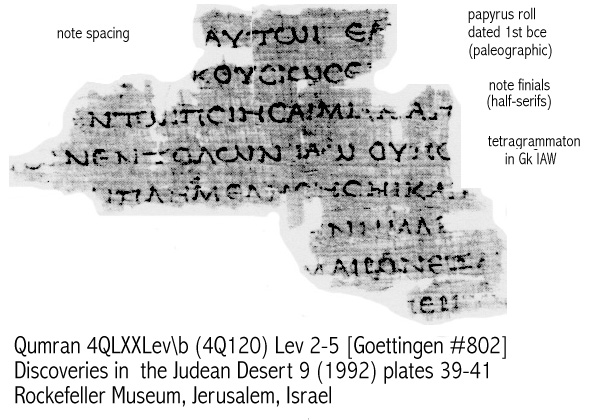
| Lua error in package.lua at line 80: module 'Module:InfoboxImage/data' not found. 4Q120, fragment 20, 1st-century BCE, showing portions of verses 26 through 28 of Leviticus 4 | |
| Also known as | pap4QLXXLevb |
| Type | Scroll, Septuagint manuscript |
| Date | 1st-century BCE (Hasmonean period) |
| LanguageTemplate:Pluralize from text | Koine Greek |
| ScribeTemplate:Pluralize from text | Professional scribe |
| AuthorTemplate:Pluralize from text | Unknown |
| Material | Papyrus |
| Format | Parchment on scroll |
| Condition | Too fragmented |
| Script | Uncial, scripto continua |
| Contents | Book of Leviticus |
| ExemplarTemplate:Pluralize from text | Septuagint |
| Previously kept | Palestine Archaeological Museum |
| Discovered | Cave No. 4 Nahal Hever |
| Accession | The Leon Levy Dead Sea Scrolls Digital Library |
| Other | This manuscript is notable for its antiquity, its witness to an early form of the original Septuagint, and its preservation of the Trigrammaton rendered as Script error: No such module "Lang".. |
The manuscript 4Q120 (also pap4QLXXLevb; AT22; VH 46; Rahlfs 802; LDAB 3452) is a Septuagint manuscript (LXX) of the biblical Book of Leviticus written on papyrus, found at Qumran. The Rahlfs-No. is 802. Paleographically it dates from the first century BCE. Currently the manuscript is housed in the Rockefeller Museum in Jerusalem.
History
The manuscript was written in the Hasmonean period, and Patrick W. Skehan dated 4Q120 to "late first century BCE or opening years of the first century CE".Lua error in package.lua at line 80: module 'Module:Footnotes/anchor_id_list' not found. The manuscript was found at Qumran, Cave 4b. Cave 4 was discovered in August 1952, and was excavated on 22–29 September 1952 by Gerald Lankester Harding, Roland de Vaux, and Józef Milik.Lua error in package.lua at line 80: module 'Module:Footnotes/anchor_id_list' not found.Lua error in package.lua at line 80: module 'Module:Footnotes/anchor_id_list' not found.
Description
This scroll is in a very fragmented condition. Today it consists of 97 fragments. However, only 31 of those fragments can be reasonably reconstructed and deciphered, allowing for a reading of Leviticus 1.11 through 5.25; the remaining fragments are too small to allow for reliable identification. Additionally, space bands are occasionally used for the separation of concepts, and divisions within the text. A special sign (⌐) for separation of paragraphs is found fragment 27, between the lines 6 and 7. While the later divisions would label these verses 5:20-26, it appears to testify to a classical transition from chapter 5 to 6. Scriptio continua is used throughout.
Version
Emanuel Tov agrees with Eugene Ulrich that "4QLXXNum is a superior representative of the Old Greek text than LXXGö."Lua error in package.lua at line 80: module 'Module:Footnotes/anchor_id_list' not found. Albert Pietersma says that "the genuinely Septuagintal credentials of 4QLXXLevb are well-nigh impeccable."Lua error in package.lua at line 80: module 'Module:Footnotes/anchor_id_list' not found. Within what he called "limited scope of evidence", Patrick W. Skehan describes it "as a considerable reworking of the original LXX to make it conform both in quantity and in diction to a Hebrew consonantal text nearly indistinguishable [...] from that of MT."Lua error in package.lua at line 80: module 'Module:Footnotes/anchor_id_list' not found. According to Wilkinson, 4Q120 "is an irreproachably Septuagint text from the 1st century B.C. which bears no trace of having been subsequently conformed to the Hebrew text".Lua error in package.lua at line 80: module 'Module:Footnotes/anchor_id_list' not found.
God's name ΙΑŌ
Apart from minor variants, the main interest of the text lies in its use of Script error: No such module "Lang". (Iaō) to translate the tetragrammaton in Leviticus 3:12 (frg. 6) and 4:27 (frg. 20). The presence of the name of God in this ancient manuscript has supported the conclusion of some scholars that this was the original form in the Septuagint.Lua error in package.lua at line 80: module 'Module:Footnotes/anchor_id_list' not found. Skehan, Tov and Ulrich agrees that "this writing of the divine name is more original than Κύριος".Lua error in package.lua at line 80: module 'Module:Footnotes/anchor_id_list' not found. Meyer states that the fact that Script error: No such module "Lang". appears with the same script in the fragments indicates that the same scribe wrote the name, and does not support Johann Lust of an original Κύριος.Lua error in package.lua at line 80: module 'Module:Footnotes/anchor_id_list' not found.
Skehan suggests that, in the Septuagint version of the Pentateuch, Script error: No such module "Lang". is more original than the Script error: No such module "Lang". (Kyrios, "Lord") of editions based on later manuscripts, and he assumes that, in the books of the prophets, the Septuagint did use Script error: No such module "Lang". to translate both Script error: No such module "Lang". (the tetragrammaton) and Script error: No such module "Lang". (Adonai), the word that traditionally replaced the tetragrammaton when reading aloud.Lua error in package.lua at line 80: module 'Module:Footnotes/anchor_id_list' not found.Lua error in package.lua at line 80: module 'Module:Footnotes/anchor_id_list' not found.
Emanuel Tov claims the use here of Script error: No such module "Lang". as proof that the "papyrus represents an early version of the Greek scripture" antedating the text of the main manuscripts.Lua error in package.lua at line 80: module 'Module:Footnotes/anchor_id_list' not found. He states that "the writing of the Tetragrammaton in Hebrew characters in Greek revisional texts is a relatively late phenomenon. On the basis of the available evidence, the analysis of the original representation of the Tetragrammaton in Greek Scriptures therefore focuses on the question of whether the first translators wrote either Script error: No such module "Lang". or Script error: No such module "Lang".."Lua error in package.lua at line 80: module 'Module:Footnotes/anchor_id_list' not found. Tov wrote: "this papyrus represents an early version of Greek Scripture, as shown by several unusual renderings, including the transliteration of the Tetragrammaton as Script error: No such module "Lang"., instead of its translation as Script error: No such module "Lang". in the later Christian manuscripts of the Septuagint. 4QpapLXXLevb probably reflects a version antedating the text of the main manuscript tradition of the LXX".Lua error in package.lua at line 80: module 'Module:Footnotes/anchor_id_list' not found.
Frank E. Shaw says that "the appearance of Script error: No such module "Lang". in 4Q120, roundly judged a good, third century B.C.E. exemplar of the LXX of Leviticus 1-5, evinces that some early Septuagintal manuscripts used Ιαω to represent the Tetragram (p. 33)."Lua error in package.lua at line 80: module 'Module:Footnotes/anchor_id_list' not found. According to Shaw:
According to Meyer, 4Q127 ("though technically not a Septuagint manuscript, perhaps a paraphrase of Exodus or an apocalyptic work") appears to have two occurrences of Script error: No such module "Lang"..Lua error in package.lua at line 80: module 'Module:Footnotes/anchor_id_list' not found. The Codex Marchalianus gives Script error: No such module "Lang"., not as a part of the Scripture text, but instead in marginal notes on Ezekiel 1:2 and 11:1,Lua error in package.lua at line 80: module 'Module:Footnotes/anchor_id_list' not found.Lua error in package.lua at line 80: module 'Module:Footnotes/anchor_id_list' not found. as in several other marginal notes it gives ΠΙΠΙ.Lua error in package.lua at line 80: module 'Module:Footnotes/anchor_id_list' not found.Lua error in package.lua at line 80: module 'Module:Footnotes/anchor_id_list' not found.Lua error in package.lua at line 80: module 'Module:Footnotes/anchor_id_list' not found.
Greek text
Page Template:Column/styles.css has no content.
Text according to A. R. Meyer:
Lev 4:27
[αφεθησεται ]αυτωι εαν[ δε ψυχη μια]
[αμαρτ]η[ι α]κουσιως εκ[ του λαου της]
[γης ]εν τωι ποιησαι μιαν απ[ο πασων]
των εντολων ιαω ου πο[ιηθησε] Lua error in package.lua at line 80: module 'Module:Footnotes/anchor_id_list' not found.
Lev 3:12–13
[τωι ιαω] 12 εαν δ[ε απο των αιγων]
[το δωρ]ον αυτο[υ και προσαξει εν]
[αντι ι]αω 13 και ε[πιθησει τας χει] Lua error in package.lua at line 80: module 'Module:Footnotes/anchor_id_list' not found.
Romanization of Meyer:
Lev 4:27
[aphethēsetai ]autōi ean[ de psychē mia]
[hamart]ē[i a]kousiōs ek[ tou laou tēs]
[gēs ]en tōi poiēsai mian ap[o pasōn]
tōn entolōn iaō hou po[iēthēse] Lua error in package.lua at line 80: module 'Module:Footnotes/anchor_id_list' not found.
Lev 3:12–13
[tōi iaō] 12 ean d[e apo tōn aigōn]
[to dōr]on auto[u kai prosaxei en]
[anti i]aō 13 kai e[pithēsei tas chei] Lua error in package.lua at line 80: module 'Module:Footnotes/anchor_id_list' not found.
NIV:
Lev 4:27
he will be forgiven. If any member of the community
sins unintentionally and does
what is forbidden in any of the LORD’s
commands, when they realize...
Lev 3:12–13
...to the LORD. If your offering is
a goat, you are to present
it before the LORD, lay your hand...
References
Page Template:Reflist/styles.css has no content.
Bibliography
- Page Module:Citation/CS1/styles.css has no content.Aune, David Edward (2006). Apocalypticism, Prophecy and Magic in Early Christianity: Collected Essays. Mohr Siebeck. p. 363. ISBN 3-16-149020-7.
- Page Module:Citation/CS1/styles.css has no content.De Troyer, Kristin (2006). "The Choice is Yours! On Names of God". In Bieberstein, Sabine; Buday, Kornélia; Rapp, Ursula (eds.). Brücken Bauen in Einem Vielgestaltigen Europa. Jahrbuch der Europäischen Gesellschaft für Theologische Forschung von Frauen: European Society of Women in Theological Research, Jahrbuch der Europäischen Gesellschaft für die Theologische Forschung von Frauen, European Society of Women in Theological Research, Journal of the European Society of Women in Theological Research. Vol. 14. Peeters Publishers. p. 60. ISBN 9042918950.
- Page Module:Citation/CS1/styles.css has no content.Metzger, Bruce Manning (1981). Manuscripts of the Greek Bible: An Introduction to Greek Palaeography. Oxford University Press. p. 35. ISBN 9780195029246.
- Page Module:Citation/CS1/styles.css has no content.Meyer, Anthony R. (2016-01-01). "Review of Shaw, Frank, The Earliest Non-Mystical Jewish Use of Ιαω (Contributions to Biblical Exegesis and Theology, 70; Leuven/Paris/Walpole, MA: Peeters, 2014)". Journal of Hebrew Scriptures. 16. doi:10.5508/jhs.2016.v16.r6. ISSN 1203-1542.
- Page Module:Citation/CS1/styles.css has no content.Meyer, Anthony R. (2017). The Divine Name in Early Judaism: Use and Non-Use in Aramaic, Hebrew, and Greek (Thesis). McMaster University. hdl:11375/22823.
- Page Module:Citation/CS1/styles.css has no content.Milik (1957). "Dix ans de découverte dans le désert de Juda". Discoveries in the Judaean Desert.
- Page Module:Citation/CS1/styles.css has no content.Meyer, Anthony R. (2022). Naming God in Early Judaism: Aramaic, Hebrew, and Greek. Studies in Cultural Contexts of the Bible. Vol. 2. Brill I Schoeningh. ISBN 978-3-657-70350-0.
- Page Module:Citation/CS1/styles.css has no content.Milik (1976). "Black M.". The Books of Enoch: Aramaic Fragments Qumran Cave 4.
- Page Module:Citation/CS1/styles.css has no content.Pietersma, Albert; Cox, Claude E.; Wevers, John William (1984). "Kyrios or Tetragram: A Renewed Quest for the Original LXX". In Albert Pietersma; John William Wevers (eds.). De Septuaginta: Studies in Honour of John William Wevers on His Sixty-Fifth Birthday (PDF). Mississauga, Ont., Canada: Benben Publications. ISBN 0920808107. OCLC 11446028.
- Page Module:Citation/CS1/styles.css has no content.Ross, William A.; Glenny, W. Edward (2021-01-14). T&T Clark Handbook of Septuagint Research. T&T Clark Handbooks. Bloomsbury Publishing. ISBN 9780567680266.
- Page Module:Citation/CS1/styles.css has no content.Rösel, Martin (2018). Tradition and Innovation: English and German Studies on the Septuagint. SBL Press. p. 295. ISBN 9780884143246.
- Page Module:Citation/CS1/styles.css has no content.Skehan, Patrick W. (1957-06-02). "The Qumran Manuscripts and Textual Criticism". In Anderson, G. W.; Cazzelles, Henri; De Boer, P. A. H.; E. Hammershaimb, E.; Burrows, Millar; Noth, Martin (eds.). Volume du Congrès International pour l'étude de l'Ancien Testament, Strasbourg 1956. Supplements to Vetus Testamentum. Vol. 4. Leiden: Brill Publishers. pp. 148–160. doi:10.1163/9789004275270_012.
- Page Module:Citation/CS1/styles.css has no content.Skehan, Patrick W. (1980). "The Divine Name at Qumran in the Masada Scroll and in the Septuagint" (PDF). Bulletin of the International Organization for Septuagint and Cognate Studies. 13. The Catholic University of America: 14–44. ISSN 0145-3890.
- Page Module:Citation/CS1/styles.css has no content.Tov, Emanuel (2008). "Chapter 23: The Greek Biblical Texts from the Judean Desert". Hebrew Bible, Greek Bible and Qumran: Collected Essays (PDF). Texts and Studies in Ancient Judaism. Vol. 121. Mohr Siebeck. pp. 339–364. doi:10.1628/978-3-16-151454-8. ISBN 978-3-16-151454-8.
- Page Module:Citation/CS1/styles.css has no content.Troxel, Ronald L. (2016). "F. Shaw, The Earliest Non-Mystical Jewish Use of Ιαω (Contributions to Biblical Exegesis and Theology; Leuven: Peeters, 2015)". Henoch. 38 (1): 128–131. ISSN 0393-6805.
- Page Module:Citation/CS1/styles.css has no content.Schiffman, Lawrence H.; VanderKam, James C. (2000). Encyclopedia of the Dead Sea Scrolls: N-Z. Encyclopedia of the Dead Sea Scrolls, Lawrence H. Schiffman, ISBN 0195084500, 9780195084504. Vol. 2. Oxford University Press. ISBN 9780195137972.
- Page Module:Citation/CS1/styles.css has no content.Ulrich, Eugene (1992). 120. pap4QLXXLeviticusb in: Discoveries in the Judean Desert: IX. Qumran Cave 4. Vol. IV. Oxford: Clarendon Press. pp. 167–186. ISBN 0-19-826328-7.
- Page Module:Citation/CS1/styles.css has no content.Ulrich, Eugene (1992). "The Septuagint Manuscripts from Qumran: A Reappraisal of Their Value". Septuagint, Scrolls, and Cognate Writings. By George J. Brooke; Barnabas Lindars. 33. Atlanta: Scholars Press. pp. 49–80.
- Page Module:Citation/CS1/styles.css has no content.VanderKam, James C. (1994). The Dead Sea Scrolls Today. Grand Rapids: Eerdmans.
- Page Module:Citation/CS1/styles.css has no content.Vasileiadis, Pavlos D. (2013). "The pronunciation of the sacred Tetragrammaton: An overview of a nomen revelatus that became a nomen absconditus" (PDF). Judaica Ukrainica. 2. National University of Kyiv-Mohyla Academy.
- Page Module:Citation/CS1/styles.css has no content.Vasileiadis, Pavlos D. (2014). "Aspects of rendering the sacred Tetragrammaton in Greek". Open Theology. 1 (1). Berlin, Germany: De Gruyter: 56–88. doi:10.2478/opth-2014-0006. ISSN 2300-6579. OCLC 927128789.
- Page Module:Citation/CS1/styles.css has no content.Vasileiadis, Pavlos D. (2017). "The god Iao and his connection with the Biblical God, with special emphasis on the manuscript 4QpapLXXLevb" [Ο θεός Ιαώ και η σχέση του με τον Βιβλικό Θεό, με ιδιαίτερη εστίαση στο χειρόγραφο 4QpapLXXLevb]. Vetus Testamentum et Hellas. 4. Aristotle University of Thessaloniki, Greece: School of Pastoral and Social Theology: 48–51. ISSN 2459-2552. OCLC 1085412017.
- Page Module:Citation/CS1/styles.css has no content.Vasileiadis, Pavlos D. (2018). "Jesus, the New Testament, and the sacred Tetragrammaton" [Ο Ιησούς, η Καινή Διαθήκη και το ιερό Τετραγράμματο]. Synthesis.
- Page Module:Citation/CS1/styles.css has no content.Vasileiadis, Pavlos D.; Gordon, Nehemia (2019). "Transmission of the Tetragrammaton in Judeo-Greek and Christian Sources" [Η Μεταβίβαση του Τετραγράμματου στις Ιουδαιο-Ελληνικές και Χριστιανικές Πηγές]. Accademia: Revue de la Société Marsile Ficin. 18. ISSN 1296-7645. OCLC 43343733.
- Page Module:Citation/CS1/styles.css has no content.Wilkinson, Robert J. (2015-02-05). Tetragrammaton: Western Christians and the Hebrew Name of God: From the Beginnings to the Seventeenth Century. Studies in the History of Christian Traditions. Vol. 179. Leiden: Koninklijke Brill B. V. doi:10.1163/9789004288171. ISBN 978-90-04-28817-1.
External links
- Page Module:Citation/CS1/styles.css has no content."Image of fragment 20 of the 4Q120 scroll".
- Page Module:Citation/CS1/styles.css has no content."The Dead Sea Scrolls - 4Q papLXXLeviticus". The Leon Levy Dead Sea Scrolls Digital Library. Retrieved 2022-08-18.
Lua error in package.lua at line 80: module 'Module:Navbox/configuration' not found. Template:Book of Leviticus
Lua error in package.lua at line 80: module 'Module:Authority control/config' not found.