5120 Bitias
Template:Short description Template:DMCA
Page Module:Infobox/styles.css has no content.
| Discovery[1] | |
|---|---|
| Discovered by | C. Shoemaker |
| Discovery site | Palomar Obs. |
| Discovery date | 13 October 1988 |
| Designations | |
| Pronunciation | /ˈbɪtiəs/[2] |
Named after | Bĭtĭas (Virgil)[1] |
| Template:Mp | |
| Jupiter trojan[1][3] Trojan[4] · background[5] | |
| Adjectives | Bitiantian |
| Orbital characteristics[3] | |
| Epoch 23 March 2018 (JD 2458200.5) | |
| Uncertainty parameter 0 | |
| Observation arc | 29.45 yr (10,755 d) |
| Aphelion | 5.8591 AU |
| Perihelion | 4.6928 AU |
| 5.2759 AU | |
| Eccentricity | 0.1105 |
| 12.12 yr (4,426 d) | |
| 198.32° | |
| Template:Deg2DMS / day | |
| Inclination | 24.999° |
| 295.89° | |
| 23.524° | |
| Jupiter MOID | 0.4103 AU |
| TJupiter | 2.8000 |
| Physical characteristics | |
| 47.99±0.55 km[6] 50.77 km (calculated)[7] | |
| 15.21±0.02 h[8][a] | |
| 0.057 (assumed)[7] 0.122±0.031[6] | |
| C (assumed)[7] B–V = 0.780±0.060[9] V–R = 0.450±0.040[9] V–I = 0.780±0.037[7] | |
| 9.5[6] 10.2[1][3][7] | |
| Page Template:Reflist/styles.css has no content. | |
Script error: No such module "Check for conflicting parameters".
5120 Bitias /ˈbɪtiəs/ is a Jupiter trojan from the Trojan camp, approximately 48 kilometers (30 miles) in diameter. It was discovered on 13 October 1988, by American astronomer Carolyn Shoemaker at the Palomar Observatory in California.[1] The assumed C-type asteroid has a rotation period of 15.2 hours. It was named after Bitias, a companion of Aeneus in Virgil's Aeneid.[1]
Orbit and classification
Bitias is a dark Jovian asteroid in a 1:1 orbital resonance with Jupiter. It is located in the trailing Trojan camp at the Gas Giant's L5 Lagrangian point, 60° behind on its orbit Page Template:Crossreference/styles.css has no content.Page Module:Hatnote/styles.css has no content..[4] It is also a non-family asteroid of the Jovian background population.[5]
It orbits the Sun at a distance of 4.7–5.9 AU once every 12 years and 1 month (4,426 days; semi-major axis of 5.28 AU). Its orbit has an eccentricity of 0.11 and an inclination of 25° with respect to the ecliptic.[3] The body's observation arc begins with its first observation at Palomar in September 1988, just one month prior to its official discovery observation.[1]
Physical characteristics
Bitias is an assumed, carbonaceous C-type asteroid. It has a low V–I color index of 0.78.[7]
Rotation period
In March 1993, a rotational lightcurve of Bitias was obtained from photometric observations over four consecutive nights by Stefano Mottola using the ESO 1-metre telescope at La Silla Observatory in Chile. Lightcurve analysis gave a rotation period of 11.582 hours with a brightness variation of at least 0.38 magnitude (U=2).[7][10]
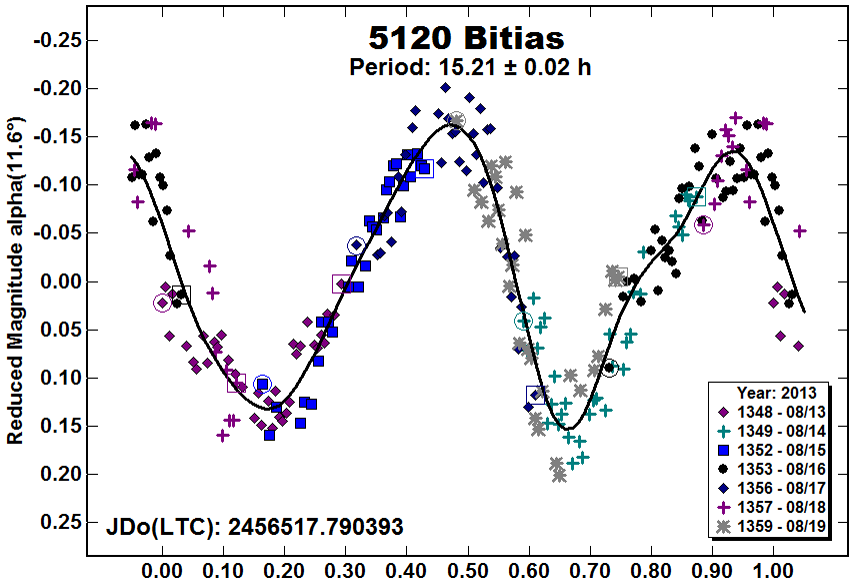
In August 2013, a more refined period determination from observations over seven consecutive nights by Robert Stephens at the Center for Solar System Studies gave a well-defined period of 15.21±0.02 hours with an amplitude of 0.32 magnitude (U=3).[8][a]
Diameter and albedo
According to the survey carried out by the NEOWISE mission of NASA's Wide-field Infrared Survey Explorer, Bitias measures between 47.987 and 47.99 kilometers in diameter and its surface has an albedo,[6] while the Collaborative Asteroid Lightcurve Link assumes a standard albedo for a carbonaceous asteroid of 0.057 and calculates a diameter of 50.77 kilometers based on an absolute magnitude of 10.2.[7]
Template:Largest Jupiter trojans
Naming
This minor planet was named by the discoverer from Greek mythology after the Trojan warrior Bitias. He survived the Trojan War and was a companion in Aeneas' exile. He was later killed in Italy with a whirling pike during the Latin War.[1] The official naming citation was published by the Minor Planet Center on 4 June 1993 (M.P.C. 22248).[11]
Notes
Page Template:Reflist/styles.css has no content.
- ^ a b Lightcurve plots of (3317) Paris from Aug 2013 by Robert Stephens at the Center for Solar System Studies Template:Obscode. Quality code is 3- (lightcurve rating at CS3). Summary figures at the LCDB and CS3.
References
Page Template:Reflist/styles.css has no content.
- ^ a b c d e f g h Page Module:Citation/CS1/styles.css has no content."5120 Bitias (1988 TZ1)". Minor Planet Center. Retrieved 21 June 2018.
- ^ Template:L&S
- ^ a b c d Page Module:Citation/CS1/styles.css has no content."JPL Small-Body Database Browser: 5120 Bitias (1988 TZ1)" (2018-02-24 last obs.). Jet Propulsion Laboratory. Retrieved 21 June 2018.
- ^ a b Page Module:Citation/CS1/styles.css has no content."List of Jupiter Trojans". Minor Planet Center. 1 June 2018. Retrieved 21 June 2018.
- ^ a b Page Module:Citation/CS1/styles.css has no content."Asteroid (5120) Bitias – Proper Elements". AstDyS-2, Asteroids – Dynamic Site. Retrieved 21 June 2018.
- ^ a b c d Page Module:Citation/CS1/styles.css has no content.Grav, T.; Mainzer, A. K.; Bauer, J. M.; Masiero, J. R.; Nugent, C. R. (November 2012). "WISE/NEOWISE Observations of the Jovian Trojan Population: Taxonomy". The Astrophysical Journal. 759 (1): 10. arXiv:1209.1549. Bibcode:2012ApJ...759...49G. doi:10.1088/0004-637X/759/1/49. S2CID 119101711. (online catalog)
- ^ a b c d e f g h Template:Cite LCDB
- ^ a b Page Module:Citation/CS1/styles.css has no content.Stephens, Robert D.; French, Linda M.; Davitt, Chelsea; Coley, Daniel R. (April 2014). "At the Scaean Gates: Observations Jovian Trojan Asteroids, July- December 2013". The Minor Planet Bulletin. 41 (2): 95–100. Bibcode:2014MPBu...41...95S. ISSN 1052-8091.
- ^ a b Page Module:Citation/CS1/styles.css has no content.Chatelain, Joseph P.; Henry, Todd J.; French, Linda M.; Winters, Jennifer G.; Trilling, David E. (June 2016). "Photometric colors of the brightest members of the Jupiter L5 Trojan cloud". Icarus. 271: 158–169. Bibcode:2016Icar..271..158C. doi:10.1016/j.icarus.2016.01.026.
- ^ Page Module:Citation/CS1/styles.css has no content.Mottola, Stefano; Di Martino, Mario; Erikson, Anders; Gonano-Beurer, Maria; Carbognani, Albino; Carsenty, Uri; et al. (May 2011). "Rotational Properties of Jupiter Trojans. I. Light Curves of 80 Objects". The Astronomical Journal. 141 (5): 32. Bibcode:2011AJ....141..170M. doi:10.1088/0004-6256/141/5/170.
- ^ Page Module:Citation/CS1/styles.css has no content."MPC/MPO/MPS Archive". Minor Planet Center. Retrieved 21 June 2018.
External links
- Asteroid Lightcurve Database (LCDB), query form (info Script error: No such module "webarchive".)
- Dictionary of Minor Planet Names, Google books
- Discovery Circumstances: Numbered Minor Planets (5001)-(10000) – Minor Planet Center
- Asteroid 5120 Bitias at the Small Bodies Data Ferret
- Template:AstDys
- 5120 Bitias at the JPL Small-Body DatabaseTemplate:Edit at Wikidata
Lua error in package.lua at line 80: module 'Module:Navbox/configuration' not found. Lua error in package.lua at line 80: module 'Module:Navbox/configuration' not found. Lua error in package.lua at line 80: module 'Module:Authority control/config' not found.