5285 Krethon
Template:Short description Template:DMCA
Page Module:Infobox/styles.css has no content.
| Discovery[1] | |
|---|---|
| Discovered by | C. S. Shoemaker E. M. Shoemaker |
| Discovery site | Palomar Obs. |
| Discovery date | 9 March 1989 |
| Designations | |
| Pronunciation | /ˈkriːθɒn/ |
Named after | Crethon (Greek mythology)[1] |
| Template:Mp | |
| Jupiter trojan[1][2] Greek[3] · background[4] | |
| Adjectives | Krethonian |
| Orbital characteristics[2] | |
| Epoch 23 March 2018 (JD 2458200.5) | |
| Uncertainty parameter 0 | |
| Observation arc | 62.18 yr (22,711 d) |
| Aphelion | 5.4265 AU |
| Perihelion | 4.9212 AU |
| 5.1738 AU | |
| Eccentricity | 0.0488 |
| 11.77 yr (4,299 d) | |
| 273.10° | |
| Template:Deg2DMS / day | |
| Inclination | 25.166° |
| 144.29° | |
| 257.16° | |
| Jupiter MOID | 0.0658 AU |
| TJupiter | 2.8090 |
| Physical characteristics | |
| 49.61±0.75 km[5] 52.61±3.58 km[6] 58.53±6.7 km[7] | |
| 12.04 h[8][9][a] | |
| 0.062±0.017[7] 0.077±0.011[6] 0.079±0.010[5] | |
| C (assumed)[10] V–I = 1.090±0.044[10] | |
| 9.80[6] 9.9[5] 10.1[1][2] | |
| Page Template:Reflist/styles.css has no content. | |
Script error: No such module "Check for conflicting parameters".
5285 Krethon /ˈkriːθɒn/ is a Jupiter trojan from the Greek camp, approximately 52 kilometers (32 miles) in diameter. It was discovered on 9 March 1989, by American astronomer couple Carolyn and Eugene Shoemaker at the Palomar Observatory in California.[1] The dark Jovian asteroid belongs the 100 largest Jupiter trojans and has a rotation period of 12.0 hours.[10] It was named from Greek mythology, after the warrior Crethon (Krethon), twin-brother of Orsilochus.[1]
Orbit and classification
Krethon is a dark Jovian asteroid in a 1:1 orbital resonance with Jupiter. It is located in the leading Greek camp at the Gas Giant's L4 Lagrangian point, 60° ahead of its orbit Page Template:Crossreference/styles.css has no content.Page Module:Hatnote/styles.css has no content.. It is also a non-family asteroid in the Jovian background population.[4] It orbits the Sun at a distance of 4.9–5.4 AU once every 11 years and 9 months (4,299 days; semi-major axis of 5.17 AU). Its orbit has an eccentricity of 0.05 and an inclination of 25° with respect to the ecliptic.[2] The body's observation arc begins with a precovery taken at Palomar in March 1956, or 33 years prior to its official discovery observation.[1]
Physical characteristics
Krethon is an assumed, carbonaceous C-type asteroid, while most larger Jupiter trojans are D-types. It has a high V–I color index of 1.09 (see table below).[10]
Rotation period
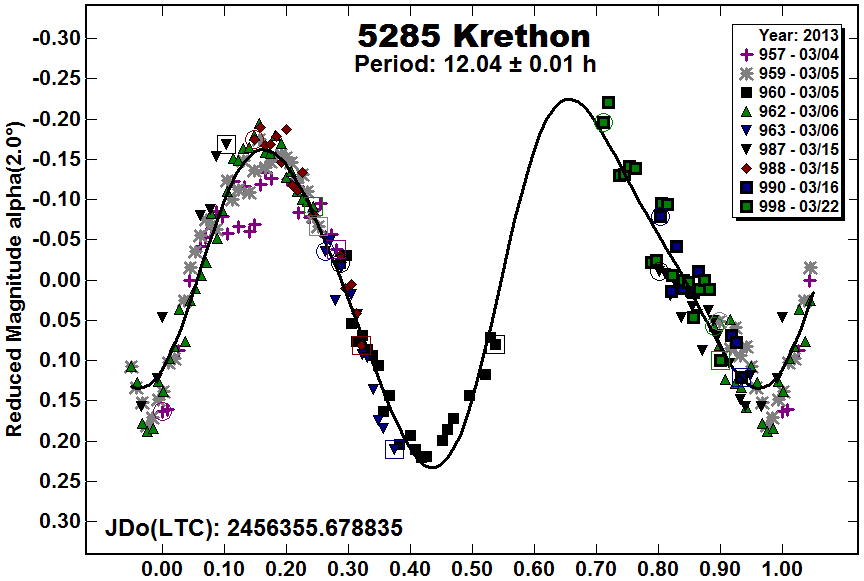
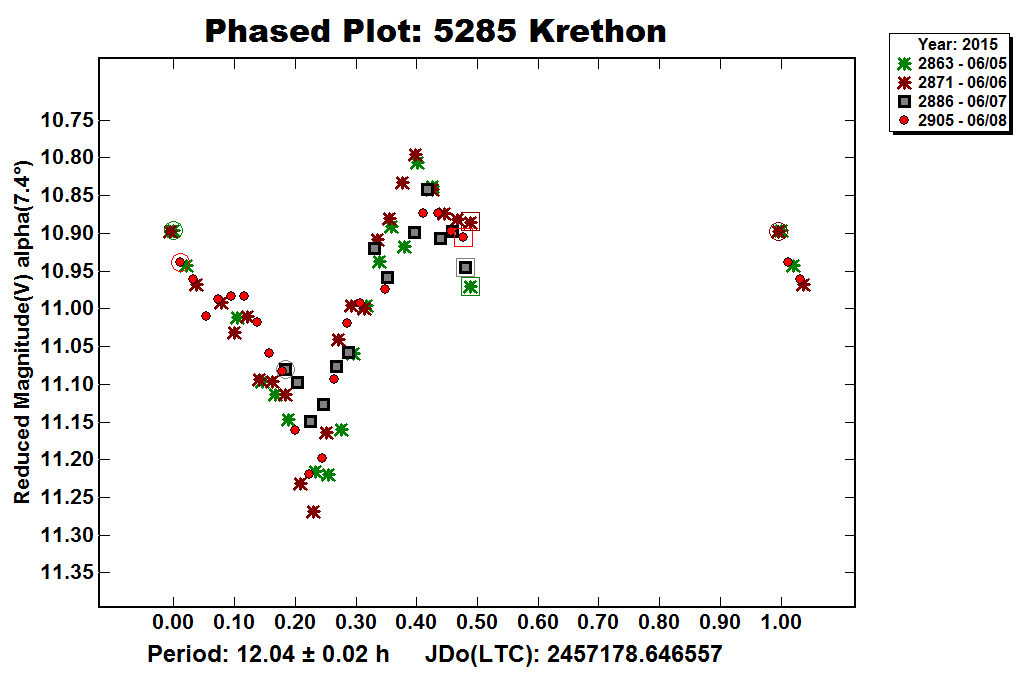
In March 2013 and June 2015, two rotational lightcurves of Krethon were obtained from photometric observations by Robert Stephens at the Center for Solar System Studies in Landers, California. Lightcurve analysis gave an identical rotation period of 12.04 hours with a brightness amplitude between 0.33 and 0.46 magnitude (U=2/2).[8][9][a] This supersedes a previous, poorly-rated period determination of 20.88 hours (U=1).[10][11]
Diameter and albedo
According to the surveys carried out by the Infrared Astronomical Satellite IRAS, the Japanese Akari satellite, and the NEOWISE mission of NASA's Wide-field Infrared Survey Explorer, Krethon measures between 49.606 and 58.53 kilometers in diameter and its surface has an albedo between 0.062 and 0.079.[5][6][7] The Collaborative Asteroid Lightcurve Link assumes a standard albedo for a carbonaceous asteroid of 0.057 and calculates a diameter of 53.16 kilometers based on an absolute magnitude of 10.1.[10]
Template:Largest Jupiter trojans
Naming
This minor planet was named after the Greek warrior Crethon (Krethon), son of Diocles and twin brother of Orsilochus (also see 5284 Orsilocus), who were fighting under Agamemnon and Menelaus in the Trojan War. Both were slain by Aeneas.[1] The official naming citation was published by the Minor Planet Center on 12 July 1995 (M.P.C. 25444).[12]
Notes
Page Template:Reflist/styles.css has no content.
- ^ a b Lightcurve plot of (5285) Krethon from Mar 2013 and Jun 2015 by Robert Stephens at the Center for Solar System Studies Template:Obscode. Quality code is n.a./2+ (lightcurve rating at CS3). Summary figures at the LCDB and CS3.
References
Page Template:Reflist/styles.css has no content.
- ^ a b c d e f g h Page Module:Citation/CS1/styles.css has no content."5285 Krethon (1989 EO11)". Minor Planet Center. Retrieved 20 June 2018.
- ^ a b c d Page Module:Citation/CS1/styles.css has no content."JPL Small-Body Database Browser: 5285 Krethon (1989 EO11)" (2018-05-20 last obs.). Jet Propulsion Laboratory. Retrieved 20 June 2018.
- ^ Page Module:Citation/CS1/styles.css has no content."List of Jupiter Trojans". Minor Planet Center. 1 June 2018. Retrieved 20 June 2018.
- ^ a b Page Module:Citation/CS1/styles.css has no content."Asteroid (5285) Krethon – Proper Elements". AstDyS-2, Asteroids – Dynamic Site. Retrieved 20 June 2018.
- ^ a b c d Page Module:Citation/CS1/styles.css has no content.Grav, T.; Mainzer, A. K.; Bauer, J. M.; Masiero, J. R.; Nugent, C. R. (November 2012). "WISE/NEOWISE Observations of the Jovian Trojan Population: Taxonomy". The Astrophysical Journal. 759 (1): 10. arXiv:1209.1549. Bibcode:2012ApJ...759...49G. doi:10.1088/0004-637X/759/1/49. S2CID 119101711. Retrieved 20 June 2018. (online catalog)
- ^ a b c d Page Module:Citation/CS1/styles.css has no content.Usui, Fumihiko; Kuroda, Daisuke; Müller, Thomas G.; Hasegawa, Sunao; Ishiguro, Masateru; Ootsubo, Takafumi; et al. (October 2011). "Asteroid Catalog Using Akari: AKARI/IRC Mid-Infrared Asteroid Survey". Publications of the Astronomical Society of Japan. 63 (5): 1117–1138. Bibcode:2011PASJ...63.1117U. doi:10.1093/pasj/63.5.1117. (online, AcuA catalog p. 153)
- ^ a b c Page Module:Citation/CS1/styles.css has no content."Asteroid 5285 Krethon". Small Bodies Data Ferret. Retrieved 20 June 2018.
- ^ a b Page Module:Citation/CS1/styles.css has no content.French, Linda M.; Stephens, Robert, D.; Coley, Daniel R.; Wasserman, Lawrence H.; Vilas, Faith; La Rocca, Daniel (October 2013). "A Troop of Trojans: Photometry of 24 Jovian Trojan Asteroids". The Minor Planet Bulletin. 40 (4): 198–203. Bibcode:2013MPBu...40..198F. ISSN 1052-8091. Retrieved 20 June 2018.
{{cite journal}}: CS1 maint: multiple names: authors list (link) - ^ a b Page Module:Citation/CS1/styles.css has no content.Stephens, Robert D.; Coley, Daniel, R.; French, Linda M. (January 2016). "Large L5 Jovian Trojan Asteroid Lightcurves from the Center for Solar System Studies". The Minor Planet Bulletin. 43 (1): 15–22. Bibcode:2016MPBu...43...15S. ISSN 1052-8091. Retrieved 20 June 2018.
{{cite journal}}: CS1 maint: multiple names: authors list (link) - ^ a b c d e f Template:Cite LCDB
- ^ Page Module:Citation/CS1/styles.css has no content.Duffard, R. D.; Melita, M.; Ortiz, J. L.; Licandro, J.; Williams, I. P.; Jones, D. (December 2007). "Light-Curve Survey of the Trojan Asteroids" (PDF). Asteroids. 1405: 8187. Bibcode:2008LPICo1405.8187D. Retrieved 5 July 2018.
- ^ Page Module:Citation/CS1/styles.css has no content."MPC/MPO/MPS Archive". Minor Planet Center. Retrieved 20 June 2018.
External links
- Asteroid Lightcurve Database (LCDB), query form (info Script error: No such module "webarchive".)
- Dictionary of Minor Planet Names, Google books
- Discovery Circumstances: Numbered Minor Planets (5001)-(10000) – Minor Planet Center
- Template:AstDys
- 5285 Krethon at the JPL Small-Body DatabaseTemplate:Edit at Wikidata
Lua error in package.lua at line 80: module 'Module:Navbox/configuration' not found. Lua error in package.lua at line 80: module 'Module:Navbox/configuration' not found. Lua error in package.lua at line 80: module 'Module:Authority control/config' not found.