596 Scheila
Template:Short description Template:DMCA
Page Module:Infobox/styles.css has no content.
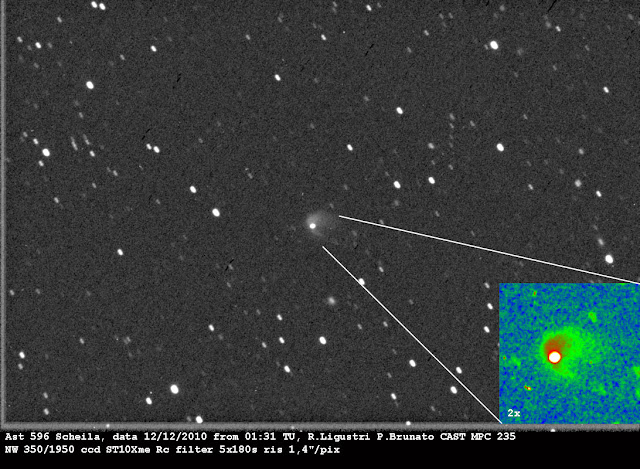
| Lua error in package.lua at line 80: module 'Module:InfoboxImage/data' not found. 596 Scheila outbursting as seen in a 5 min photo with a 24" telescope | |
| Discovery[1] | |
|---|---|
| Discovered by | August Kopff |
| Discovery site | Heidelberg Observatory |
| Discovery date | 21 February 1906 |
| Designations | |
| Pronunciation | /ˈʃiːlə/ |
Named after | Sheila |
| main-belt[1] main-belt comet[2] | |
| Orbital characteristics[1] | |
| Epoch 4 September 2017 (JD 2458000.5) | |
| Uncertainty parameter 0 | |
| Observation arc | 111.19 yr (40,611 days) |
| Aphelion | 3.4062 AU |
| Perihelion | 2.4490 AU |
| 2.9276 AU | |
| Eccentricity | 0.1635 |
| 5.01 yr (1,830 days) | |
| 21.266° | |
| Template:Deg2DMS / day | |
| Inclination | 14.661° |
| 70.606° | |
| 175.16° | |
| Physical characteristics | |
| 56.67±1.15 km (IRAS) | |
Mean density | 2.0 g/cm3 (assumed)[3] 2.5 g/cm3 (assumed)[4] |
Equatorial escape velocity | 60 m/s (calculated)[3] 75 m/s (calculated)[4] |
| 15.8480 h (0.66033 d)[1] | |
| 0.0379±0.002[1] | |
| PCD (Tholen)[1] T (SMASSII)[1] | |
| 11.67 to 15.32 | |
| 8.90[1] | |
| Page Template:Reflist/styles.css has no content. | |
Script error: No such module "Check for conflicting parameters".
596 Scheila is a main-belt asteroid[1] and main-belt comet[2] orbiting the Sun. It was discovered on 21 February 1906 by August Kopff from Heidelberg.[1] Kopff named the asteroid after a female English student with whom he was acquainted.[5]
Overview
On 11 December 2010, Steve Larson of the Catalina Sky Survey detected a comet-like appearance to asteroid Scheila: it displayed a "coma" of about magnitude 13.5.[6] Inspection of archival Catalina Sky Survey observations showed the activity was triggered between 11 November 2010 and 3 December.[7] Imaging with the 2-meter Faulkes Telescope North revealed a linear tail in the anti-sunward direction and an orbital tail, indicative of larger slower particles.[8]
When first detected it was unknown what drove the ejecta plumes. Scheila's gravity is too large for electrostatics to launch dust.[2] Cometary outgassing could not be ruled out until detailed spectroscopic observations indicated the absence of gas in Scheila's plumes.[4] Observations by the Hubble Space Telescope and the Neil Gehrels Swift Observatory's ultraviolet-optical telescope make it most likely that Scheila was impacted at ~5 km/s by a previously unknown asteroid ~35 meters in diameter.[3][4] Each asteroid the size of Scheila might be hit by an impactor 10–100 meters in diameter approximately every 1000 years, so with 200 asteroids of this size or bigger in the asteroid belt, we can observe a collision as often as every 5 years.[4]
As a consequence of the 2010 impact, the surface spectrum of Scheila changed, from a moderately red T-type spectrum to a more reddish D-type spectrum, showing how "fresh" material weathers over time in space. This is similar to laboratory experiments done on the Tagish Lake meteorite.[9]
Scheila last came to perihelion on 2022 May 26.[1]
See also
- 354P/LINEAR
- 493 Griseldis – another main-belt asteroid collision in 2015
- P/2016 G1 (PanSTARRS)
References
- ^ a b c d e f g h i j k Page Module:Citation/CS1/styles.css has no content."JPL Small-Body Database Browser: 596 Scheila (1906 UA)" (2010-11-14 last obs). Retrieved 7 May 2016.
- ^ a b c Page Module:Citation/CS1/styles.css has no content.David C. Jewitt. "Main Belt Comets". UCLA, Department of Earth and Space Sciences. Retrieved 15 December 2010.
- ^ a b c Page Module:Citation/CS1/styles.css has no content.Jewitt, David; Weaver, H.; Mutcher, M.; Larson, S.; Agarwal, J. (2011). "Hubble Space Telescope Observations of Main Belt Comet (596) Scheila". Astrophysical Journal Letters. 733 (1): L4. arXiv:1103.5456. Bibcode:2011ApJ...733L...4J. doi:10.1088/2041-8205/733/1/l4. S2CID 50809352.
- ^ a b c d e Page Module:Citation/CS1/styles.css has no content.Bodewits, Dennis; Kelley, M. S.; Li, J. -Y.; Landsman, W. B.; Besse, S.; A'Hearn, M. F. (2011). "Collisional Excavation of Asteroid (596) Scheila". Astrophysical Journal Letters. 733 (1): L3. arXiv:1104.5227. Bibcode:2011ApJ...733L...3B. doi:10.1088/2041-8205/733/1/L3. S2CID 54187826.
- ^ Page Module:Citation/CS1/styles.css has no content.Schmadel, Lutz D. (2003). Dictionary of Minor Planet Names. Springer Science & Business Media. p. 61. ISBN 978-3-540-00238-3.
- ^ Page Module:Citation/CS1/styles.css has no content.Ernesto Guido & Giovanni Sostero (12 December 2010). "Comet-like appearance of (596) Scheila". Remanzacco Observatory in Italy (blog). Archived from the original on 7 January 2011. Retrieved 12 December 2010.
- ^ Page Module:Citation/CS1/styles.css has no content.Mike Simonsen (12 December 2010). "A Comet Masquerading as an Asteroid". Simostronomy (blog). Retrieved 12 December 2010.
- ^ Richard Miles's posting on Yahoo minor planet mailing list (MPML)
- ^ Page Module:Citation/CS1/styles.css has no content.Hasegawa, Sunao; Marsset, Michaël; Demeo, Francesca E.; Bus, Schelte J.; Ishiguro, Masateru; Kuroda, Daisuke; Binzel, Richard P.; Hanuš, Josef; Nakamura, Akiko M.; Yang, Bin; Vernazza, Pierre (2022). "The Appearance of a "Fresh" Surface on 596 Scheila as a Consequence of the 2010 Impact Event". The Astrophysical Journal Letters. 924 (1): L9. arXiv:2112.04672. Bibcode:2022ApJ...924L...9H. doi:10.3847/2041-8213/ac415a. S2CID 245005881.
External links
- Comet-like appearance of (596) Scheila (Remanzacco Observatory)
- What's up with Scheila (596) (AARTScope Blog)
- Joseph Brimacombe animation on flickr
- (596) Scheila 2010-12-12 10:45:39UT (cbellh47 @ flickr)
- (596) Scheila by Rolando Ligustri (CAST-Italia)
- Comet-like appearance of (596) Scheila[dead link] (MPML at Yahoo Groups)
- Asteroid 596 Scheila "Outburst" (Unmanned SpaceFlight)
- asteroid 596 Scheila goes cometary! (Cloudy Nights)
- UA Catalina Sky Survey Discovers Possible Extinct Comet (University of Arizona 2010 Dec 21)
- NASA's Swift and Hubble Probe Asteroid Collision Debris (04.28.11)
- Page Module:Citation/CS1/styles.css has no content.Yang, Bin; Hsieh, Henry (2011). "Near-Infrared Observations of Comet-Like Asteroid (596) Scheila". The Astrophysical Journal. 737 (2): L39. arXiv:1107.3845. Bibcode:2011ApJ...737L..39Y. doi:10.1088/2041-8205/737/2/L39.
- Page Module:Citation/CS1/styles.css has no content.Ishiguro, Masateru; Hanayama, Hidekazu; Hasegawa, Sunao; Sarugaku, Yuki; Watanabe, Jun-Ichi; Fujiwara, Hideaki; Terada, Hiroshi; Hsieh, Henry H.; Vaubaillon, Jeremie J.; Kawai, Nobuyuki; Yanagisawa, Kenshi; Kuroda, Daisuke; Miyaji, Takeshi; Fukushima, Hideo; Ohta, Kouji; Hamanowa, Hiromi; Kim, Junhan; Pyo, Jeonghyun; Nakamura, Akiko M. (2011). "Interpretation of (596) Scheila's Triple Dust Tails". The Astrophysical Journal. 741 (1): L24. arXiv:1110.1150. Bibcode:2011ApJ...741L..24I. doi:10.1088/2041-8205/741/1/L24.
- The cause of asteroid Scheila's outburst (EPSC-DPS JOINT MEETING 2011 PRESS NOTICE)
- Lightcurve plot of 596 Scheila, Palmer Divide Observatory, B. D. Warner (2005)
- Template:AstDys
- 596 Scheila at the JPL Small-Body DatabaseTemplate:Edit at Wikidata
Lua error in package.lua at line 80: module 'Module:Navbox/configuration' not found. Lua error in package.lua at line 80: module 'Module:Navbox/configuration' not found. Lua error in package.lua at line 80: module 'Module:Navbox/configuration' not found. Lua error in package.lua at line 80: module 'Module:Authority control/config' not found.