Acid Tests
Template:Short description Script error: No such module "other uses". Template:DMCA
Page Module:Infobox/styles.css has no content.
| Part of the Hippie movement | |
| Lua error in package.lua at line 80: module 'Module:InfoboxImage/data' not found. An Acid Test handbill | |
| Script error: No such module "Infobox mapframe". | |
| Date | 1965–1966 |
|---|---|
| Location | California, Texas |
Script error: No such module "Check for conflicting parameters".
Lua error in package.lua at line 80: module 'Module:Sidebar/configuration' not found.
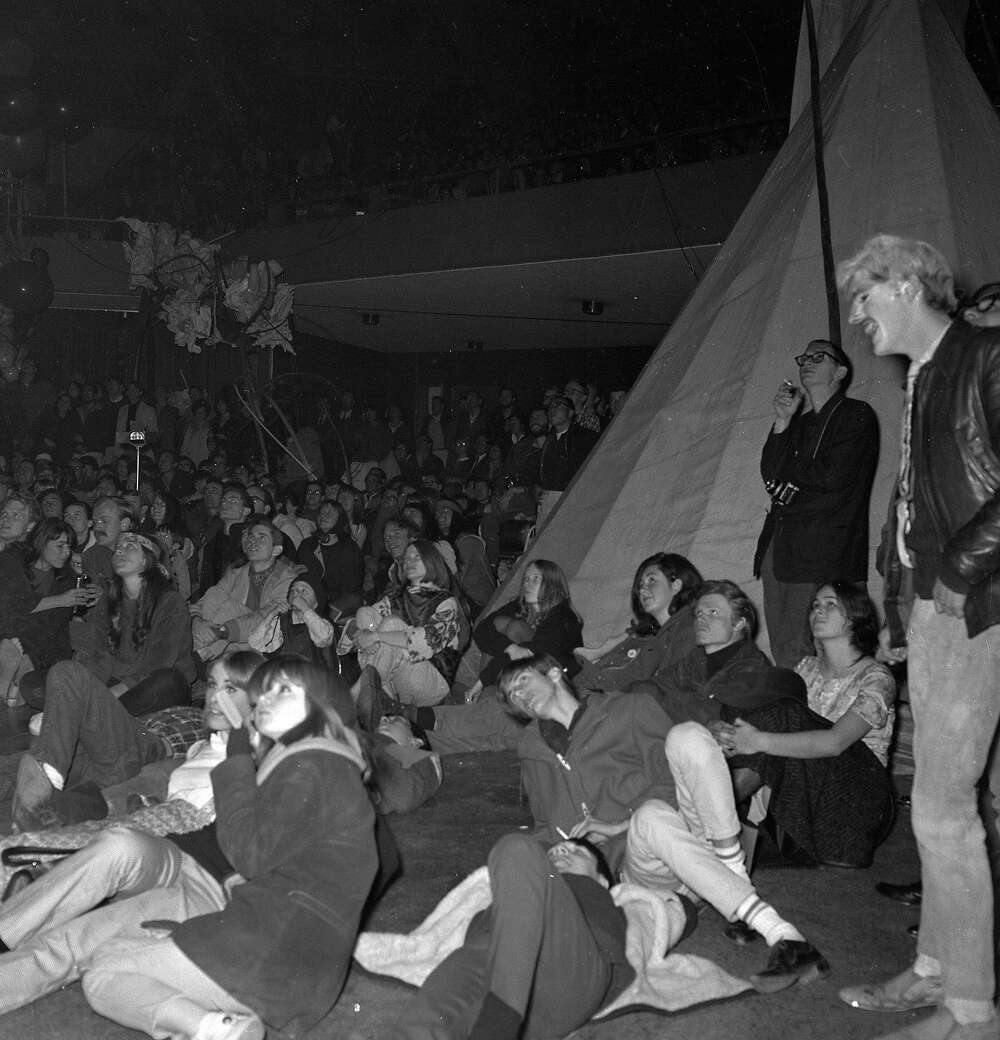
The Acid Tests were a series of parties held by author Ken Kesey primarily in the San Francisco Bay Area during the mid-1960s, centered on the use of and advocacy for the psychedelic drug LSD, commonly known as "acid". LSD was not made illegal in California until October 6, 1966, under Governor Pat Brown's administration.[1]
History
The name "Acid Test" was coined by Kesey, after the term "acid test" used by gold miners in the 1850s. He began throwing parties at his home at La Honda, California.[2] The Merry Pranksters were central to organizing the Acid Tests, including Pranksters such as Lee Quarnstrom and Neal Cassady. Other people, such as LSD chemists Owsley Stanley and Tim Scully, were also involved.
Kesey took the parties to public places, and advertised with posters that read, "Can you pass the acid test?", and the name was later popularized in Tom Wolfe's 1968 book The Electric Kool-Aid Acid Test. Musical performances by the Grateful Dead were commonplace, along with black lights, strobe lights, and fluorescent paint. The Acid Tests are notable for their influence on the LSD-based counterculture of the San Francisco area and subsequent transition from the beat generation to the hippie movement. The Jefferson Airplane song "A Song for All Seasons" (from Volunteers) mentions the Acid Tests.
Timeline

1965
- 27 November; Soquel, California: The first Acid Test was a party at Ken Babbs' house on 27 November 1965; however, Babbs recalls it as being on Halloween night. A flyer[3] allegedly shows that the Warlocks (one week before the band became known as the Grateful Dead) played at Soquel as the Warlocks on November 27. However, the authenticity of this flyer has been questioned. Several witnesses confirm that the Warlocks did not play a set at Soquel; they only casually played some of the Merry Prankster instruments.[4] An original fluorescent paint and newsprint-collage Acid Test sign donated to the Smithsonian's National Museum of American History by event co-organizer Ken Kesey in 1992 lists The Grateful Dead as a musical performer, as well as The Fugs, alongside hand-drawn text on the sign reads: "Your essaying of it will be shared almost certainly (?) by some permutation or combination of the following [...]."[5] In his book, Phil Lesh confirms that he did attend: "We were at the first Test not to play, but just to feel it out, and we hadn't brought any instruments or gear."[6] Most likely Lesh was joined by Bob Weir and Jerry Garcia at the party.[7]
- 4 December; San Jose, California: This time, the newly renamed Grateful Dead did play, the first performance of their long career.[4]
- 11 December; Muir Beach, California
- 18 December, Palo Alto, California[8]
1966
- 8 January; San Francisco, California (Fillmore)
- 15 January; Portland, Oregon
- 21–23 January; San Francisco (Trips Festival at Longshoreman's Hall)[9]
- 29 January; San Francisco, California (Sound City Studios)
- 5 February; Los Angeles, California - Sepulveda Unitarian Universalist Society
- 12 February; Watts, Los Angeles – Youth Opportunities Center[10][11]
- 25 February; Los Angeles, California (Hollywood) – Cinema Theatre
- 12 March; Los Angeles, California (Danish Center)[12][13][14][15]
- 19 March; Los Angeles, California (Pico) Carthay Studios
- 25 March; Los Angeles, California (Sunset Strip) – Troupers Club[16][17][18][19][20]
- 30 September – 2 October; San Francisco State College – Whatever It Is Festival – three days[21][22][23][24]
- 31 October; San Francisco, California — Acid Test Graduation (Bill Graham cancelled Winterland Ballroom event, Grateful Dead played at the California Hall (San Francisco, California) that night, and the event was held at a 69 Harriet St.[25] SoMa warehouse.)[26][27][28][29][30][31]
1967
- 16 March; Houston, Texas (Brown College, Rice University) (despite the "graduation" concept of the final West Coast Acid Test, the actual final Acid Test of The Merry Pranksters was organized in Texas by Kesey's friend Larry McMurtry)[32]
1968
- 24 October; Congress passes the Staggers–Dodd Bill, criminalizing the recreational use of LSD-25[33]
Trips Festival
Page Module:Infobox/styles.css has no content.
| Trips Festival | |
|---|---|
| Lua error in package.lua at line 80: module 'Module:InfoboxImage/data' not found. | |
| Genre | psychedelic |
| Dates | January 21, 22 and 23 |
| LocationTemplate:Pluralize from text | Longshoreman's Hall in San Francisco |
| Years active | 1966 |
| Founders | Ramon Sender, Ken Kesey, Stewart Brand |
Script error: No such module "Check for conflicting parameters".
Ramon Sender co-produced the Trips Festival with Ken Kesey and Stewart Brand. It was a three-day event that,[34] in conjunction with The Merry Pranksters, brought together the nascent hippie movement.[35] The Trips Festival was held at the Longshoreman's Hall in San Francisco in January 1966.[36] Counterculture sound engineer Ken Babbs is mostly credited for the sound systems he created for the Trips Festival. Prior to Babbs' creation, it was discovered that particular music usually sounded distorted when cranked to high levels because of the cement floor on the San Francisco Longshoreman's Union Hall (where the Trips Festival was taking place). Babbs being a sound engineer resolved the problem. He made sound amplifiers that would not create distorted sounds when turned up to high sound levels.[citation needed]
Organized by Stewart Brand, Ken Kesey, Owsley Stanley, Zach Stewart and others,[37][38][39][40] ten thousand people attended this sold-out event, with a thousand more turned away each night.[41] On Saturday January 22, the Grateful Dead and Big Brother and the Holding Company came on stage. Further, 6,000 people arrived to drink punch spiked with LSD and to witness one of the first fully developed light shows of the era.[42]
Big Brother and the Holding Company was formed at the Trips Festival. In the audience was painter and jazz drummer David Getz, who soon joined the band.[43][44][45]
See also
References
Page Template:Reflist/styles.css has no content.
- ^ Page Module:Citation/CS1/styles.css has no content.Jarnow, Jesse (October 7, 2016). "LSD Now: How the Psychedelic Renaissance Changed Acid". Rolling Stone. Retrieved November 18, 2024.
- ^ Page Module:Citation/CS1/styles.css has no content."Psychedelic 60s: Ken Kesey & the Merry Pranksters". 2.lib.virginia.edu. December 16, 2009. Archived from the original on November 4, 2011. Retrieved November 6, 2011.
- ^ Page Module:Citation/CS1/styles.css has no content."View image: 5572". December 22, 2015. Archived from the original on December 22, 2015. Retrieved November 9, 2021.
- ^ a b Page Module:Citation/CS1/styles.css has no content.Jarnow, Jesse (November 30, 2015). "Acid Tests Turn 50: Wavy Gravy, Merry Prankster Reminisce". Rollingstone.com. Retrieved November 9, 2021.
- ^ Page Module:Citation/CS1/styles.css has no content."Signboard, Pass the Acid Test". National Museum of American History. Retrieved August 30, 2023.
- ^ Lesh, Phil, Searching for the Sound, Back Bay Books, San Francisco, 2005 pp 63, 64
- ^ Page Module:Citation/CS1/styles.css has no content."The Acid Test Chronicles - Page 11 - The Warlocks - The Very First Acid Test - The Spread (Ken Babbs House), Soquel, outside of Santa Cruz". Postertrip.com. Retrieved November 9, 2021.
- ^ Page Module:Citation/CS1/styles.css has no content."December 18, 1965: The Big Beat, Palo Alto--Lost and Found". April 11, 2013.
- ^ Page Module:Citation/CS1/styles.css has no content."How pop music and icons have taken San Francisco higher". March 29, 2015.
- ^ Page Module:Citation/CS1/styles.css has no content."Youth Opportunities Center - Home of the Watts Acid Test". December 18, 2015.
- ^ Page Module:Citation/CS1/styles.css has no content.Wolfe, Tom (1968). "Ch. 20: The Electric Kool-Aid Acid Test". The Electric Kool-Aid Acid Test (paperback ed.). New York: Picador/Farrar, Straus and Giroux. p. 273.; Severn Darden attended
- ^ Page Module:Citation/CS1/styles.css has no content."1966-03-12 Danish Center, Los Angeles, CA, USA". Jerrygarcia.com.
- ^ Page Module:Citation/CS1/styles.css has no content."University of Southern California - Breaking ground for new dancing school, 607 South Western Avenue, Los Angeles, CA, 1930". Digitallibrary.usc.edu. Retrieved November 9, 2021.
- ^ Page Module:Citation/CS1/styles.css has no content."University of Southern California - Exterior of building, 607 South Western Avenue, Los Angeles, CA, 1933 [image]". Digitallibrary.usc.edu.
- ^ Page Module:Citation/CS1/styles.css has no content."Valley News from Van Nuys, California on October 3, 1967 · Page 3". Newspapers.com. October 3, 1967. Retrieved November 9, 2021.
- ^ Page Module:Citation/CS1/styles.css has no content.Slide, Anthony (March 12, 2012). The Encyclopedia of Vaudeville. Univ. Press of Mississippi. ISBN 978-1-4968-0108-1.
For many years, the small Troupers Theatre was a familiar site on La Brea Avenue in Hollywood...
- ^ Page Module:Citation/CS1/styles.css has no content."B'nai B'rith Messenger, February 2, 1962". Nli.org.il. Retrieved November 9, 2021.
- ^ Page Module:Citation/CS1/styles.css has no content."Rare Grateful Dead Troupers Club Concert Poster Designed by 1960's Counterculture Icon Owsley Stanley to be Auctioned by Psychedelic Art Exchange". Prweb.com.
- ^ Page Module:Citation/CS1/styles.css has no content."The Acid Test Chronicles - Page 23 - Troupers Club - (12th Acid Test [Sunset] - March 25, 1966". Postertrip.com.
- ^ Page Module:Citation/CS1/styles.css has no content."1966-03-25 Trouper's Club., Los Angeles, CA, USA". Jerrygarcia.com.
- ^ Page Module:Citation/CS1/styles.css has no content."Whatever it is Festival at SF State - Bay Area Television Archive". Diva.sfsu.edu. Retrieved November 9, 2021.
- ^ Page Module:Citation/CS1/styles.css has no content."Grateful Dead Live at San Francisco State University on 1966-10-02". Archive.org. October 2, 1966.
- ^ Page Module:Citation/CS1/styles.css has no content."Acid Test – Grateful Dead – Whatever It Is/SF State Acid Test Poster Handbill". Recordmecca.com. April 29, 2012.
- ^ Page Module:Citation/CS1/styles.css has no content."Whatever It is". Michaeljkramer.net – Michael J. Kramer. March 18, 2016.
- ^ Page Module:Citation/CS1/styles.css has no content."Petulia - Viola Lee Blues Montage". Reel SF. Retrieved April 6, 2026.
- ^ Page Module:Citation/CS1/styles.css has no content."Halloween 1966: The End of One Era, and the Beginning of Another". Summerof.love. October 31, 2016.
- ^ Page Module:Citation/CS1/styles.css has no content.Streshinsky, Ted (July 15, 2016). "Ken Kesey, leader of the Merry Pranksters, speaks at the Acid Test Graduation, encouraging people to move 'beyond acid'". Getty Images. The Warehouse, Harriet Street, San Francisco. Retrieved April 6, 2026.
- ^ Page Module:Citation/CS1/styles.css has no content.Guerrero, Susana (October 31, 2017). "Flashback to the 'Acid Test Graduation' 51 years ago". SFGATE. Retrieved April 6, 2026.
He ended up hosting the soiree at the California Hall, a warehouse on Harriet Street, just two blocks north of the Hall of Justice.
- ^ Page Module:Citation/CS1/styles.css has no content.Streshinsky, Ted. "Acid Test Graduation Harriet". Getty Images. Retrieved April 6, 2026.
- ^ Page Module:Citation/CS1/styles.css has no content.Streshinsky, Shirley (June 6, 2016). "The FBI, My Husband, and Me". The American Scholar. Retrieved April 6, 2026.
Ted Streshinsky
- ^ Page Module:Citation/CS1/styles.css has no content.Piepenbring, Dan (November 28, 2016). "Bombed Out of Their Gourds by Dan Piepenbring". The Paris Review. Retrieved April 6, 2026.
- ^ Page Module:Citation/CS1/styles.css has no content."Lysergic Pranksters in Texas". November 20, 2014. Archived from the original on June 24, 2011. Retrieved November 21, 2014.
- ^ Page Module:Citation/CS1/styles.css has no content.United States Congress (October 24, 1968). "Staggers-Dodd Bill, Public Law 90-639" (PDF). Retrieved September 8, 2009.
- ^ Page Module:Citation/CS1/styles.css has no content."San Francisco sound: From Janis Joplin to Grateful Dead, music from 1960s fuels a social revolution". Sfchronicle.com. July 4, 2015.
- ^ Page Module:Citation/CS1/styles.css has no content."Photographic image of concert audience" (JPG). S.hdnux.com. Retrieved November 9, 2021.
- ^ Andrew Gilbert, "Loading Zone Reloaded", East Bay Express, 13 August 2008 Script error: No such module "webarchive".
- ^ Page Module:Citation/CS1/styles.css has no content."Trips Festival – Acid Test – Grateful Dead – Stewart Brand Memo to Ralph J. Gleason". Recordmecca.com. April 29, 2012.
- ^ Page Module:Citation/CS1/styles.css has no content."Chronology of San Francisco Rock 1965-1969". Sfmuseum.org.
- ^ Page Module:Citation/CS1/styles.css has no content."San Francisco 1966 Beat Generation, Hippies; Trips Festival". Gettyimages.com. February 14, 2020.
- ^ Page Module:Citation/CS1/styles.css has no content."Trips Festival". May 7, 2006. Archived from the original on May 7, 2006. Retrieved November 9, 2021.
- ^ Ralph J. Gleason. The Jefferson Airplane and the San Francisco Sound (1969), Ballantine Books Template:Catalog lookup link cited in: Tamony, Peter. (Summer, 1981). Tripping out from San Francisco. American Speech. Vol. 56, No. 2. pp. 98–103. Tamony, 1981, p.98
- ^ Page Module:Citation/CS1/styles.css has no content."Merry Prankster History Project". Archived from the original on October 11, 2007. Retrieved June 2, 2015.
- ^ Page Module:Citation/CS1/styles.css has no content.Brant, Marley (2008). Join Together: Forty Years of the Rock Music Festival. Hal Leonard Corporation. p. 16.
- ^ Page Module:Citation/CS1/styles.css has no content.Sinclair, Mick (2004). San Francisco: a cultural and literary history. Interlink Books. p. 204. ISBN 9781566564892.
- ^ Page Module:Citation/CS1/styles.css has no content."Chronology". janisjoplin.net. 1998–2010. Retrieved June 10, 2010.
Sources
- Page Module:Citation/CS1/styles.css has no content.Wolfe, Tom (1968). The Electric Kool-Aid Acid Test.
- Page Module:Citation/CS1/styles.css has no content.Lesh, Phil. "The Acid Test Chronicles - Page 16 - Portland Oregon - 6th Acid Test - Jan. 15, 1966". Acid Test Chronicles. Archived from the original on April 25, 2012. Retrieved April 9, 2012.
External links
- Video from the National Museum of American History featuring the Sign for the November 27, 1965 first Acid Test
Lua error in package.lua at line 80: module 'Module:Navbox/configuration' not found. Lua error in package.lua at line 80: module 'Module:Navbox/configuration' not found. Lua error in package.lua at line 80: module 'Module:Navbox/configuration' not found. Lua error in package.lua at line 80: module 'Module:Navbox/configuration' not found.