Aucanquilcha
Template:Short description Template:Infobox mountain Aucanquilcha is a massive stratovolcano located in the Antofagasta Region of northern Chile, just west of the border with Bolivia and within the Alto Loa National Reserve. Part of the Central Volcanic Zone of the Andes, the stratovolcano has the form of a ridge with a maximum height of 6,176 metres (20,262 ft). The volcano is embedded in a larger cluster of volcanoes known as the Aucanquilcha cluster. This cluster of volcanoes was formed in stages over eleven million years of activity with varying magma output, including lava domes and lava flows. Aucanquilcha volcano proper is formed from four units that erupted between 1.04–0.23 million years ago. During the ice ages, both the principal Aucanquilcha complex and the other volcanoes of the cluster were subject to glaciation, resulting in the formation of moraines and cirques.
The cluster has generated lava ranging in composition from andesite to dacite, with the main volcano being exclusively of dacitic composition. Systematic variations in temperature, crystal and biotite content have been recorded during the evolution of the cluster.
At Aucanquilcha volcano there is some fumarolic activity, and sulfur deposits are found at the summit. Several sulfur mines lie in the complex. One mine at an altitude of 5,950 metres (19,520 ft) was opened in 1913 and remained in use from 1950 to 1992. It was the world's highest mine during that period. Originally, sulfur obtained at the mine was transported down with llamas. Subsequently, an aerial cableway was employed to transport the sulfur to the town of Amincha. To bring the sulfur down, a road network to the summit was constructed in 1972, although it is now impassable.
In 1986, four men were reported to be living at an altitude of 5,900 metres (19,400 ft), making them the highest permanent residents on Earth.
Geography and geomorphology
Aucanquilcha is a compound volcanoLua error in package.lua at line 80: module 'Module:Footnotes/anchor_id_list' not found. that rises 1.4 kilometres (0.87 mi) above an andesite platformLua error in package.lua at line 80: module 'Module:Footnotes/anchor_id_list' not found. in the El Loa Province of Chile.Lua error in package.lua at line 80: module 'Module:Footnotes/anchor_id_list' not found. The main volcano is composed of an east-west 8-kilometre (5.0 mi) long chain of stratovolcanoesLua error in package.lua at line 80: module 'Module:Footnotes/anchor_id_list' not found. and has an estimated volume of 37 cubic kilometres (8.9 cu mi).Lua error in package.lua at line 80: module 'Module:Footnotes/anchor_id_list' not found. Four peaks exceed altitudes of 6,000 metres (20,000 ft);Lua error in package.lua at line 80: module 'Module:Footnotes/anchor_id_list' not found. the maximum slope of the summit area is 25°.Lua error in package.lua at line 80: module 'Module:Footnotes/anchor_id_list' not found. During the Cumbre Negra stage, a pyroclastic flow occurred on the northwestern side of the volcano. It covered 34 square kilometres (13 sq mi) on a run of 10 square kilometres (3.9 sq mi) and now has a volume of 0.3 cubic kilometres (0.072 cu mi). It was at first identified as a debris avalanche, but the lack of hummocky topography and the presence of large juvenile blocks identify it as a pyroclastic flow.Lua error in package.lua at line 80: module 'Module:Footnotes/anchor_id_list' not found. One block in the flow and the lava dome from which the flow originated have been dated at 0.6 mya.Lua error in package.lua at line 80: module 'Module:Footnotes/anchor_id_list' not found. Lava flows, mostly from the summit areas, are dark to grey in colour and extend as far as 2–3 kilometres (1.2–1.9 mi) from their vents. It is likely that two small lava domes (Cerro Cumbre Negra and Summit 5867) on the northwest flank occupy flank vents.Lua error in package.lua at line 80: module 'Module:Footnotes/anchor_id_list' not found. To the north lies the 3.3 mya old andesite Cerro Tres Monos ridge; to the west lies the east-west Cerro Polan and La Luna ridge.Lua error in package.lua at line 80: module 'Module:Footnotes/anchor_id_list' not found.
The volcano is part of a quasi-circular cluster of about 19-20 volcanoesLua error in package.lua at line 80: module 'Module:Footnotes/anchor_id_list' not found.Lua error in package.lua at line 80: module 'Module:Footnotes/anchor_id_list' not found. between the Rio Loa and the Chile–Bolivia border,Lua error in package.lua at line 80: module 'Module:Footnotes/anchor_id_list' not found. covering a surface area of 700 square kilometres (270 sq mi). salt flats and alluvial deposits surround it to the east, north and south. On its southern side lies the Cerro Chela volcano.Lua error in package.lua at line 80: module 'Module:Footnotes/anchor_id_list' not found.Lua error in package.lua at line 80: module 'Module:Footnotes/anchor_id_list' not found. The cluster lies on a 70-kilometre (43 mi) thick crust,Lua error in package.lua at line 80: module 'Module:Footnotes/anchor_id_list' not found. and arid conditions since the Miocene have preserved its structures.Lua error in package.lua at line 80: module 'Module:Footnotes/anchor_id_list' not found. Its volcanoes are arranged in north-south and northwestern alignments, which may indicate a rupture of the crust above shallow magma reservoirs.Lua error in package.lua at line 80: module 'Module:Footnotes/anchor_id_list' not found.
Aucanquilcha underwent a northwestward flank collapse, generating a debris avalanche deposit.Lua error in package.lua at line 80: module 'Module:Footnotes/anchor_id_list' not found. The debris avalanche descended 2,100 metres (6,900 ft) and ran for 17 kilometres (11 mi) with an azimuth of 311°, eventually covering an area of 59 square kilometres (23 sq mi).Lua error in package.lua at line 80: module 'Module:Footnotes/anchor_id_list' not found. The flow was channeled between Miño Volcano and Cerro Cumbre Negra (an eroded lava massif) towards the dry Rio Loa valley, favouring the preservation of the slide deposit.Lua error in package.lua at line 80: module 'Module:Footnotes/anchor_id_list' not found. The proximal parts of the slide are covered by younger eruptive products and also by moraines, indicating that the slide was followed by at least one glacial episode. The slide lacks the hummocky topography usually found on debris avalanches but has radial ridges and grooves.Lua error in package.lua at line 80: module 'Module:Footnotes/anchor_id_list' not found. Another landslide occurred during the Redondo stage on the eastern side of the main volcano into the Salar de Carcote. It has the classic hummocky topography of landslides and covers a length of 17 kilometres (11 mi) and a surface area of 35 square kilometres (14 sq mi), roughly half of the surface area of the Mount St Helens avalanche of 1980 and one-third of the surface area of the Ollagüe avalanche. A volume of 0.35 cubic kilometres (0.084 cu mi) is assumed based on a probable thickness of 10 metres (33 ft).Lua error in package.lua at line 80: module 'Module:Footnotes/anchor_id_list' not found.Lua error in package.lua at line 80: module 'Module:Footnotes/anchor_id_list' not found.
Geology
Script error: No such module "Labelled list hatnote". Volcanism in the Andean Volcanic Belt is distributed over three arcs, the Northern Volcanic Zone (NVZ), the Central Volcanic Zone (CVZ) and Southern Volcanic Zone (SVZ).Lua error in package.lua at line 80: module 'Module:Footnotes/anchor_id_list' not found. Aucanquilcha is part of the CVZ.Lua error in package.lua at line 80: module 'Module:Footnotes/anchor_id_list' not found. The arc features more than 1100Lua error in package.lua at line 80: module 'Module:Footnotes/anchor_id_list' not found. andesitic volcanoes, ignimbrites and compound volcanoes and has generated over 3,000 cubic kilometres (720 cu mi) of eruption products over 28 million years;Lua error in package.lua at line 80: module 'Module:Footnotes/anchor_id_list' not found. the average rate of 0.11 cubic kilometres per millennium (0.026 cubic miles per millennium) is one tenth of the global maximum rate of arc magma production.Lua error in package.lua at line 80: module 'Module:Footnotes/anchor_id_list' not found. Rocks are typically silicic or have intermediate compositions between silicic and mafic.Lua error in package.lua at line 80: module 'Module:Footnotes/anchor_id_list' not found. The arc has migrated eastward towards the high Andes from the Pacific Ocean coast since the JurassicLua error in package.lua at line 80: module 'Module:Footnotes/anchor_id_list' not found. and has been producing ignimbrites and stratovolcanoes since the Miocene, when a notable uplift commenced.Lua error in package.lua at line 80: module 'Module:Footnotes/anchor_id_list' not found. The arc features an eastward offset at the latitude of Aucanquilcha. Active volcanoes include San Pedro-San Pablo, Ollagüe, Olca and Irruputuncu.Lua error in package.lua at line 80: module 'Module:Footnotes/anchor_id_list' not found.
The crust under the CVZ reaches high thicknesses exceeding 60–70 kilometres (37–43 mi), leading to widespread contamination of ascending magmas. The basement of the Central Andes consists of volcanic rocks and marine sediments from the Mesozoic, and volcanic and volcano-sedimentary rocks from the Cenozoic; they overlie metamorphic rocks and amphibolite in the lower crust.Lua error in package.lua at line 80: module 'Module:Footnotes/anchor_id_list' not found.Lua error in package.lua at line 80: module 'Module:Footnotes/anchor_id_list' not found. The offset in the volcanic arc coincides with a boundary between two distinct crustal domains to the north and south.Lua error in package.lua at line 80: module 'Module:Footnotes/anchor_id_list' not found. A fracture in the crust under Aucanquilcha might be responsible both for its elongated shape and the dominance of effusive eruptions (as it would facilitate degassing).Lua error in package.lua at line 80: module 'Module:Footnotes/anchor_id_list' not found. Seismic and electric tomography indicate the presence of a hot zone in the crust, which may be a developing batholith.Lua error in package.lua at line 80: module 'Module:Footnotes/anchor_id_list' not found.
The Aucanquilcha complex lies northwest of the Altiplano–Puna volcanic complex (APVC), a local large igneous province. The APVC is underpinned below at a depth of 20 kilometres (12 mi) by a slow seismic velocity zone that has been linked to the presence of 15–25% of partial melts in the zone. The Aucanquilcha complex is much smaller volumetrically than the APVC ignimbrites, but the duration of activity and the location indicate that Aucanquilcha is a subcomponent of the APVC complex.Lua error in package.lua at line 80: module 'Module:Footnotes/anchor_id_list' not found. The volcano might be a surface manifestation of copper porphyry deposits and batholiths,Lua error in package.lua at line 80: module 'Module:Footnotes/anchor_id_list' not found. and might be underpinned by a plutonic complex resembling the Tuolumne Intrusive Suite of the Sierra Nevada.Lua error in package.lua at line 80: module 'Module:Footnotes/anchor_id_list' not found.
Composition
The rocks from the main Aucanquilcha volcano are uniformly dacitic and show little evidence of temporal variation in their composition,Lua error in package.lua at line 80: module 'Module:Footnotes/anchor_id_list' not found. while the Aucanquilcha complex produced both andesite and dacite. Andesites appear as lava flows while dacites form lava domes and dome complexes.Lua error in package.lua at line 80: module 'Module:Footnotes/anchor_id_list' not found. The rocks define a calc-alkaline suiteLua error in package.lua at line 80: module 'Module:Footnotes/anchor_id_list' not found. rich in potassium (content ranges from 1.5 to 4%Lua error in package.lua at line 80: module 'Module:Footnotes/anchor_id_list' not found.), typical for Central Andean volcanoes and subduction zone volcanoes in general.Lua error in package.lua at line 80: module 'Module:Footnotes/anchor_id_list' not found.Lua error in package.lua at line 80: module 'Module:Footnotes/anchor_id_list' not found. Plagioclase is the dominant component of the magma. Clinopyroxene+orthopyroxene+amphibole (hornblende and pargasite) or amphibole+biotite+minor amounts of pyroxene are subordinate components. Apatite, ilmenite, magnetite and zircon can also be found.Lua error in package.lua at line 80: module 'Module:Footnotes/anchor_id_list' not found.Lua error in package.lua at line 80: module 'Module:Footnotes/anchor_id_list' not found. Rocks have a porphyritic texture.Lua error in package.lua at line 80: module 'Module:Footnotes/anchor_id_list' not found. Basaltic andesites typically contain less than 10% crystals while dacites generally have more than 20% crystals. The Alconcha group lavas form two distinct families: Early lavas are crystal-poor and lack biotite, later rocks contain biotite and more crystals.Lua error in package.lua at line 80: module 'Module:Footnotes/anchor_id_list' not found. There is evidence of magma mixing and mingling,Lua error in package.lua at line 80: module 'Module:Footnotes/anchor_id_list' not found.Lua error in package.lua at line 80: module 'Module:Footnotes/anchor_id_list' not found. and of multiple generations of crystals being sampled from the magma reservoirLua error in package.lua at line 80: module 'Module:Footnotes/anchor_id_list' not found. especially during inactive periods.Lua error in package.lua at line 80: module 'Module:Footnotes/anchor_id_list' not found.
Various parts of the main volcano have been subjected to hydrothermal alterationLua error in package.lua at line 80: module 'Module:Footnotes/anchor_id_list' not found. and alteration by fumarolic activity, especially the central parts of the complexLua error in package.lua at line 80: module 'Module:Footnotes/anchor_id_list' not found. and the Azufrera stage edifice.Lua error in package.lua at line 80: module 'Module:Footnotes/anchor_id_list' not found. The central part of the complex is heavily altered by fumarole activity.Lua error in package.lua at line 80: module 'Module:Footnotes/anchor_id_list' not found. Hydrothermal alteration may be driven by the formation of a deep magma reservoir and resulting hydrothermal circulation in overlying rocks.Lua error in package.lua at line 80: module 'Module:Footnotes/anchor_id_list' not found. The summit area and the area between the Azufrera and Angulo complex feature sulfur rich talus deposits,Lua error in package.lua at line 80: module 'Module:Footnotes/anchor_id_list' not found. including hypogene-derived copper sulfides.Lua error in package.lua at line 80: module 'Module:Footnotes/anchor_id_list' not found.
Magma formation and output
Based on geothermometric data, the highest temperatures occurred during phases of high activity and lower temperatures are associated with low output periods.Lua error in package.lua at line 80: module 'Module:Footnotes/anchor_id_list' not found. Over time, the crust under the Aucanquilcha cluster was heated by the repeated formation of magma chambers, resulting in the magmatic system remaining at higher temperatures.Lua error in package.lua at line 80: module 'Module:Footnotes/anchor_id_list' not found. This crustal feedback and increased deep crustal influx of mantle-derived basalts drove increased magmatic flux,Lua error in package.lua at line 80: module 'Module:Footnotes/anchor_id_list' not found. increasing eruption rates, hydrothermal activityLua error in package.lua at line 80: module 'Module:Footnotes/anchor_id_list' not found. and the turnover of crystals in the magmatic systemLua error in package.lua at line 80: module 'Module:Footnotes/anchor_id_list' not found. which underwent a transition from several dispersed bodies to a centralized magmatic system at the time of the Polan to Gordo transition.Lua error in package.lua at line 80: module 'Module:Footnotes/anchor_id_list' not found. 2.5-1 million years ago when temperatures declined again.Lua error in package.lua at line 80: module 'Module:Footnotes/anchor_id_list' not found. Magma and included crystals being drawn from depths of 3 to 23 kilometres (1.9 to 14.3 mi) during the main Aucanquilcha stage of volcanism,Lua error in package.lua at line 80: module 'Module:Footnotes/anchor_id_list' not found.Lua error in package.lua at line 80: module 'Module:Footnotes/anchor_id_list' not found. with evidence of stronger crustal contributions or of a change of their composition.Lua error in package.lua at line 80: module 'Module:Footnotes/anchor_id_list' not found. During the time of the Polan eruption on the west flank, magma output was spatially segregated with the peripheral Miño Volcano generating andesite lavas and the more central volcanos generating dacites.Lua error in package.lua at line 80: module 'Module:Footnotes/anchor_id_list' not found. Presumably, dacite had accumulated under the complex and formed a barrier to the ascent of denser magmas.Lua error in package.lua at line 80: module 'Module:Footnotes/anchor_id_list' not found. Crustal rocks were absorbed in the magma, especially the more evolved (dacitic) onesLua error in package.lua at line 80: module 'Module:Footnotes/anchor_id_list' not found. and during declining stages.Lua error in package.lua at line 80: module 'Module:Footnotes/anchor_id_list' not found. The magmatic system might generate ephemeral shallow magma chambers supplied from the deeper reservoir.Lua error in package.lua at line 80: module 'Module:Footnotes/anchor_id_list' not found.
The long-term magma output of Aucanquilcha is comparable to the magma output of other long-term active volcanoes in the central Andes such as Ollagüe and Llullaillaco. In all such cases, an early peak in magma output is followed by later lower-volume activity (0.1 to 0.2 cubic kilometres per millennium (0.024 to 0.048 cubic miles per millennium), followed by 0.01 to 0.02 cubic kilometres per millennium (0.0024 to 0.0048 cubic miles per millennium)). Unzen in Japan and Mount Duff and Lassen Peak in California have similar eruption histories.Lua error in package.lua at line 80: module 'Module:Footnotes/anchor_id_list' not found. Such decreases may occur because of the lithostatic load imposed by the edifices on the magma chambers and the increased travel distance of the magma through the edifice.Lua error in package.lua at line 80: module 'Module:Footnotes/anchor_id_list' not found. The comparatively low output of Aucanquilcha might reflect the fact that it is located at the edge of the Altiplano-Puna volcanic complex.Lua error in package.lua at line 80: module 'Module:Footnotes/anchor_id_list' not found.
Eruptive history
Volcanic activity of the Aucanquilcha cluster commenced 11 million years ago,Lua error in package.lua at line 80: module 'Module:Footnotes/anchor_id_list' not found. increasing 6-5 million years ago at the same time as magmas becoming more uniform in composition and strong hydrothermal alteration commenced. The Aucanquilcha cluster generated about 340 ± 20 cubic kilometres (81.6 ± 4.8 cu mi) of volcanic rock,Lua error in package.lua at line 80: module 'Module:Footnotes/anchor_id_list' not found. with each centre being active for a few hundred thousand years.Lua error in package.lua at line 80: module 'Module:Footnotes/anchor_id_list' not found. Over time, centres became less distributed and their magmas more uniform.Lua error in package.lua at line 80: module 'Module:Footnotes/anchor_id_list' not found. Both the timingLua error in package.lua at line 80: module 'Module:Footnotes/anchor_id_list' not found. and the duration of volcanic activity of the Aucanquilcha cluster are comparable to that of the Altiplano–Puna volcanic complex.Lua error in package.lua at line 80: module 'Module:Footnotes/anchor_id_list' not found.
Activity waned 2-1 million years ago,Lua error in package.lua at line 80: module 'Module:Footnotes/anchor_id_list' not found.Lua error in package.lua at line 80: module 'Module:Footnotes/anchor_id_list' not found. Aucanquilcha itself began erupting about 1 million years ago, producing mostly lava flows with little variation in eruption styleLua error in package.lua at line 80: module 'Module:Footnotes/anchor_id_list' not found. and with a prolonged decline after an initial phase of high output.Lua error in package.lua at line 80: module 'Module:Footnotes/anchor_id_list' not found. It may be a waning stage in the activity of the overall Aucanquilcha cluster.Lua error in package.lua at line 80: module 'Module:Footnotes/anchor_id_list' not found. The age of the lava flows ranges from heavily glaciated andesite flows overlying less-eroded ones to possibly postglacial lava flows that may be tens of thousands of years old.Lua error in package.lua at line 80: module 'Module:Footnotes/anchor_id_list' not found.
Some scoria cones of basaltic composition, including Poruñita and Luna de Tierra, formed between Aucanquilcha and Ollagüe after Aucanquilcha's last activity.Lua error in package.lua at line 80: module 'Module:Footnotes/anchor_id_list' not found. There is no evidence of Holocene activityLua error in package.lua at line 80: module 'Module:Footnotes/anchor_id_list' not found. except for lava flows overlying moraines.Lua error in package.lua at line 80: module 'Module:Footnotes/anchor_id_list' not found. There are active fumaroles though the low-temperature fumaroles are not visible through short wavelength infrared data from satellites.Lua error in package.lua at line 80: module 'Module:Footnotes/anchor_id_list' not found. Fumarole activity was observed in 1962Lua error in package.lua at line 80: module 'Module:Footnotes/anchor_id_list' not found. and is most conspicuous in the trenches dug during sulfur mining operations. Lava flow emissions and minor explosive activity, confined to the edifice of the volcano, are the most important risks from renewed activity.Lua error in package.lua at line 80: module 'Module:Footnotes/anchor_id_list' not found.
Stages
Both the Aucanquilcha cluster and Aucanquilcha proper formed in four stages each:
- The Alconcha group, with seven volcanoes, is constructed from andesite and dacite and formed 11–8 mya. It is constructed from two northern composite cones, Alconcha and Volcan Tuco (also known as Cerro Garage, dated 10.96–10.51 mya), and five lava domes on the northeastern side of the cluster. Alconcha has a large breach on the southern side of its crater that is likely the product of a flank collapseLua error in package.lua at line 80: module 'Module:Footnotes/anchor_id_list' not found. but the avalanche deposit may be buried beneath younger material. Lavas within the breach are dated 10.78–10.43 mya. The centres of Volcan Tuco and Alconcha are heavily eroded, and Alconcha's lavas and scoria lie on top of Tuco. The Ujina ignimbrite was erupted 9.4 mya from an unknown vent and has a volume of 2 cubic kilometres (0.48 cu mi) of dacite. While the vent location is unknown, the composition of the ignimbrite, and its dating and distribution, indicate an association with this group. The domes are poorly researched, with the Coscalito dome dated 8.9–8.7 mya and Cerro Amincha 8.01.Lua error in package.lua at line 80: module 'Module:Footnotes/anchor_id_list' not found. The total volume of this group is 46 cubic kilometres (11 cu mi), indicating a flux rate of 0.013 cubic kilometres per millennium (0.0031 cubic miles per millennium).Lua error in package.lua at line 80: module 'Module:Footnotes/anchor_id_list' not found.
- The Gordo group, which erupted 6–4 mya following a probable 2-million-year hiatus,Lua error in package.lua at line 80: module 'Module:Footnotes/anchor_id_list' not found. is located in the southern and western parts of the cluster. Cerro Gordo itself (5.49 mya) has a crater that is breached westwards, exposing about twelve radial dykes but with no trace of a debris avalanche. One of the larger centres of the cluster, Gordo is associated with a lava field on its western side that is dated 4.9 mya. Cerro Puquíos and Cerro Negro (5.81–5.28 mya) lie on the southern side of the cluster, and glacial cirques cutting their northeastern flanks reveal layers of scoria and lavas. Puquíos has an amphitheatre structure on its western side. Paco Paco (4.41–4.27 mya) is located north of most Gordo group volcanoes. It forms a 4 kilometres (2.5 mi) wide stratocone with a lava-filled crater, and layers of scoria and agglutinated lavas dip from it. Volcan Pabellón (4.14–4.12 mya) sits southwest of the Puquíos-Negro ridge. The Las Bolitas lava field (5.23–5.13 mya) is associated with the Gordo group but the vent locations are unknown.Lua error in package.lua at line 80: module 'Module:Footnotes/anchor_id_list' not found. The total volume of this group is 55 cubic kilometres (13 cu mi), indicating a flux rate of 0.027 cubic kilometres per millennium (0.0065 cubic miles per millennium).Lua error in package.lua at line 80: module 'Module:Footnotes/anchor_id_list' not found.
- The 3.6–2.3 mya Polan group,Lua error in package.lua at line 80: module 'Module:Footnotes/anchor_id_list' not found. with ten dispersed volcanoes including Miño Volcano, is the largest group in the cluster and includes Tres Monos, La Luna, Cerro Polan, Chaihuiri, Miño Volcano and the lavas of the Aucanquilcha platform. Cerro Polan's (3.5–3 mya) eastern side is deeply dissected, and the exposed materials are heavily altered in the deeper sections. Lava fields to Polan's west and southwest (2.6 mya on one western field) are associated with it. La Luna (2.97–2.57) lies just east of Polan; these two volcanoes were probably one volcano in the past. La Luna has a lava dome surrounded by a glaciated but unaltered lava table. Cerro Tres Monos (3.4–2.78 mya) forms a northbound 14-kilometre (8.7 mi) long ridge with at least six vents. Hydrothermal alteration has affected some lavas and pyroclastics from Tres Monos, and the western side has lateral and terminal moraines. The Aucanquilcha platform (3.6–2.7 mya) sits underneath the main Aucanquilcha volcano, and its lava mostly flowed north. Its southern side is a 4,500-metre (14,800 ft) table with one hill, Cerro Campana, dated to 3.3 mya. The platform presumably forms one third of the total volume of the Aucanquilcha clusterLua error in package.lua at line 80: module 'Module:Footnotes/anchor_id_list' not found. and may have originated from a part of the ridge of the La Luna-Polan trend, now buried beneath Aucanquilcha. Chaihuiri (2.39 mya) is a lava dome with moraines and two short lava flows; it is the youngest Polan group volcano.Lua error in package.lua at line 80: module 'Module:Footnotes/anchor_id_list' not found. The total volume of this group is 154 cubic kilometres (37 cu mi), indicating a flux rate of 0.077 cubic kilometres per millennium (0.018 cubic miles per millennium).Lua error in package.lua at line 80: module 'Module:Footnotes/anchor_id_list' not found.
- The main Aucanquilcha volcano is the youngest volcano in the clusterLua error in package.lua at line 80: module 'Module:Footnotes/anchor_id_list' not found. and formed in four stages:
- Between 1.04–0.92 mya the bulk of the volcano formed in the Azufrera stage.Lua error in package.lua at line 80: module 'Module:Footnotes/anchor_id_list' not found. One lava flow toward the southwest is unusually long at 6 kilometres (3.7 mi). A vent at 6,116 metres (20,066 ft) altitude fed most of this edifice; a second vent on the northern flank at the 5,887 metres (19,314 ft) summit generated three lava flows, two shorter ones and a long one to the northwest. The Azufrera stage lavas are blocky dacites with large clasts and flow fronts up to 20 metres (66 ft) high. These flows are moderately altered and have oxidation rinds. There is little evidence of explosive activity, but it may have been obscured by glacial erosion.Lua error in package.lua at line 80: module 'Module:Footnotes/anchor_id_list' not found. The total volume is 21.1 cubic kilometres (5.1 cu mi), indicating a flux rate of 0.16 cubic kilometres per millennium (0.038 cubic miles per millennium).Lua error in package.lua at line 80: module 'Module:Footnotes/anchor_id_list' not found. This volcano was probably an isolated cone, but the existence of a previous stage cannot be excluded.Lua error in package.lua at line 80: module 'Module:Footnotes/anchor_id_list' not found.
- The second stage, named Rodado, lasted from 0.95 to 0.85 mya. It formed on the eastern slopes of the Azufrera volcano, with one vent at the 6,073 metres (19,925 ft) summit. Rodado stage lavas are blocky and platy and usually thicker than Azufrera stage lavas. Some of the summit vent lavas are among the most vesicular of this stage. They are also less weathered (oxidation rinds are c. 1 centimetre (0.39 in) thick) and less subject to solfataric alteration. The Cerro Chinchillas lavas are the oldest of this stage; erupted from an unknown vent, they lack amphiboles.Lua error in package.lua at line 80: module 'Module:Footnotes/anchor_id_list' not found. The total volume is 9.1 cubic kilometres (2.2 cu mi), indicating a flux rate of 0.09 cubic kilometres per millennium (0.022 cubic miles per millennium).Lua error in package.lua at line 80: module 'Module:Footnotes/anchor_id_list' not found. A flank collapse, possibly triggered by a large earthquake, occurred during this stage.Lua error in package.lua at line 80: module 'Module:Footnotes/anchor_id_list' not found.
- The third stage is the Cumbre Negra stage, named after the westernmost summit and principal vent of this stage, Cerro Cumbre Negra (5,670 metres (18,600 ft)). The time course of its activity is less defined than the previous two stages; it may have occurred between 1–0.47 mya, but most likely 0.6–0.5 mya based on potassium–argon dating. Four lava flows derived from the main vent, all less than one kilometre long and 40–60 metres (130–200 ft) thicker than previous stages. They all have hydration rinds but no native sulfur deposits. This stage generated Aucanquilcha's only pyroclastic flow during a lava dome collapse as occurred on Merapi in Indonesia.Lua error in package.lua at line 80: module 'Module:Footnotes/anchor_id_list' not found. The total volume of this stage is 0.7 cubic kilometres (0.17 cu mi), indicating a flux rate of 0.005 cubic kilometres per millennium (0.0012 cubic miles per millennium).Lua error in package.lua at line 80: module 'Module:Footnotes/anchor_id_list' not found.
- The youngest stage, known as Angulo, lasted from 0.66 to 0.24 mya. It was centered between the Azufrera and Rodado stage edifices 0.35–0.23 mya.Lua error in package.lua at line 80: module 'Module:Footnotes/anchor_id_list' not found. Most lava flows from this stage originate on a 1-kilometre (0.62 mi) long ridge that includes Aucanquilcha's highest summit. One crater on the northeast side of the ridge fed lavas to the north. Other than that, most flows extend southwards 4 to 9 kilometres (2.5 to 5.6 mi) from the vent, and with the exception of a due south flow 50 metres (160 ft) thick they are thin, with thicknesses of 15–20 metres (49–66 ft). One of the oldest flows has been compared in length to the 50% longer Chao Dacite flow but is much thinner. The flows from this stage are weakly weathered and partially overlie glacial deposits. The total volume is 5.8 cubic kilometres (1.4 cu mi), indicating a flux rate of 0.015 cubic kilometres per millennium (0.0036 cubic miles per millennium).Lua error in package.lua at line 80: module 'Module:Footnotes/anchor_id_list' not found.
Glaciation and hydrology
The Quebrada de Chaigüire valley originates at the foot of Aucanquilcha.Lua error in package.lua at line 80: module 'Module:Footnotes/anchor_id_list' not found. Some of the source springs of the Rio Loa are on AucanquilchaLua error in package.lua at line 80: module 'Module:Footnotes/anchor_id_list' not found. and it drains the western and northwestern sides of the volcano; the eastern side drains into the Salar de Ollagüe salt pan, the northeastern into the Salar de Laguani, and the southeastern into the Salar de Carcote. Most valleys only intermittently transport water, if at all,Lua error in package.lua at line 80: module 'Module:Footnotes/anchor_id_list' not found. but it forms the headwaters of the Rio Loa.Lua error in package.lua at line 80: module 'Module:Footnotes/anchor_id_list' not found. Aridity has prevailed here since the Miocene.Lua error in package.lua at line 80: module 'Module:Footnotes/anchor_id_list' not found.
The volcano is currently not glaciated despite its height, due to the aridity of the climate.Lua error in package.lua at line 80: module 'Module:Footnotes/anchor_id_list' not found. The volcanic cluster was modestly glaciated during the Quaternary, as evidenced by glacial striations and moraines at elevations above 4,500 metres (14,800 ft),Lua error in package.lua at line 80: module 'Module:Footnotes/anchor_id_list' not found. and shows evidence of glaciers both on the main volcano and its subsidiaries. At least two distinct glacier stages took place.Lua error in package.lua at line 80: module 'Module:Footnotes/anchor_id_list' not found. The western Azufrera edifice was heavily glaciated in the past. At least three moraine stages have been mapped on that edifice, and on its southern side is found a modest cirque with glacially polished lavas on the floor. The Rodado stage edifice has several moraine stages on its southern slopes. Another small cirque with a moraine has been found in the northeastern side of the Cerro Cumbre Negra summit next to an Azufrera stage lava flow.Lua error in package.lua at line 80: module 'Module:Footnotes/anchor_id_list' not found. A small moraine lies on the south side of the Angulo edifice; some lavas from that edifice overlie glacial deposits.Lua error in package.lua at line 80: module 'Module:Footnotes/anchor_id_list' not found.
Human activity and mining
A famousLua error in package.lua at line 80: module 'Module:Footnotes/anchor_id_list' not found. mine at 5,950 metres (19,520 ft) altitudeLua error in package.lua at line 80: module 'Module:Footnotes/anchor_id_list' not found. yielding ore with 30% sulfurLua error in package.lua at line 80: module 'Module:Footnotes/anchor_id_list' not found. was opened by Julian B. Carrasco in 1913, who subsequently established the Compañía Minera y Azufrera Carrasco S.A in 1933,Lua error in package.lua at line 80: module 'Module:Footnotes/anchor_id_list' not found. first at Ollagüe and after 1950 in Amincha.Lua error in package.lua at line 80: module 'Module:Footnotes/anchor_id_list' not found. The sulfur was transported down first with llamas, later by trucksLua error in package.lua at line 80: module 'Module:Footnotes/anchor_id_list' not found. and eventually through an aerial cableway system from El Ángulo station to Amincha station.Lua error in package.lua at line 80: module 'Module:Footnotes/anchor_id_list' not found. The sulfur was then transported to Chuquicamata to be converted into sulfuric acidLua error in package.lua at line 80: module 'Module:Footnotes/anchor_id_list' not found. or to Antofagasta to be shipped.Lua error in package.lua at line 80: module 'Module:Footnotes/anchor_id_list' not found. The mine was active from 1950 to 1992.Lua error in package.lua at line 80: module 'Module:Footnotes/anchor_id_list' not found. In 1977 other sulfur mines were present to the west between Cerro Polan and Cerro Gordo and south of the main Aucanquilcha massif.Lua error in package.lua at line 80: module 'Module:Footnotes/anchor_id_list' not found. Amincha was closed in 1992;Lua error in package.lua at line 80: module 'Module:Footnotes/anchor_id_list' not found. the last reported mining activity on the mountain was in 1994Lua error in package.lua at line 80: module 'Module:Footnotes/anchor_id_list' not found. and during the 1980sLua error in package.lua at line 80: module 'Module:Footnotes/anchor_id_list' not found.–1990s the worker camps were abandoned.Lua error in package.lua at line 80: module 'Module:Footnotes/anchor_id_list' not found. Apart from mining activity, an Inca mountain sanctuary with offerings of llamas has been reported to exist on Aucanquilcha.Lua error in package.lua at line 80: module 'Module:Footnotes/anchor_id_list' not found.
The cableway, of which ruins are still standing,Lua error in package.lua at line 80: module 'Module:Footnotes/anchor_id_list' not found. runs from the mine to a mining camp (5,300 metres (17,400 ft)) and from there to Amincha (3,900 metres (12,800 ft))Lua error in package.lua at line 80: module 'Module:Footnotes/anchor_id_list' not found. where the sulfur was refined.Lua error in package.lua at line 80: module 'Module:Footnotes/anchor_id_list' not found. The road leading up to the mine is dated 1972 and is now impassable because of rock falls.Lua error in package.lua at line 80: module 'Module:Footnotes/anchor_id_list' not found. There is still a relic network of roads leading up to 5,900 metres (19,400 ft)Lua error in package.lua at line 80: module 'Module:Footnotes/anchor_id_list' not found. as well as ruins of the Amincha and El Ángulo stations.Lua error in package.lua at line 80: module 'Module:Footnotes/anchor_id_list' not found. Additional mines and railways occur in the Aucanquilcha cluster.Lua error in package.lua at line 80: module 'Module:Footnotes/anchor_id_list' not found.
Covellite and other copper sulfides found in the area appear to have formed through postvolcanic epithermal mineralization above deep porphyry copper mineralization.Lua error in package.lua at line 80: module 'Module:Footnotes/anchor_id_list' not found. The sulfur itself formed at temperatures of 450 °C (842 °F)Lua error in package.lua at line 80: module 'Module:Footnotes/anchor_id_list' not found. in a now extinct fumarole.Lua error in package.lua at line 80: module 'Module:Footnotes/anchor_id_list' not found.
Altitude and habitation
The sulfur mine is notable for being the highest mine in the world at 5,950 metres (19,520 ft)Lua error in package.lua at line 80: module 'Module:Footnotes/anchor_id_list' not found. and (formerly) the highest permanently inhabited area.Lua error in package.lua at line 80: module 'Module:Footnotes/anchor_id_list' not found. An expedition in 1935, part of the International High Altitude Expedition, found that miners lived at an altitude of 5,300 metres (17,500 ft) in the town of Quilcha and reached the higher mine on foot. The expedition found that an even higher abandoned village at 5,639 metres (18,501 ft) existed, but miners refused to live there. The conclusion taken from the expedition was that 5,334 metres (17,500 ft) was the highest habitable altitude.Lua error in package.lua at line 80: module 'Module:Footnotes/anchor_id_list' not found.
West in 1986 reported that a few miners permanently lived in the mine area.Lua error in package.lua at line 80: module 'Module:Footnotes/anchor_id_list' not found. A small group of men, caretakers of the mine, has lived at an altitude of 5,900 metres (19,500 ft) in a galvanized iron hut..Lua error in package.lua at line 80: module 'Module:Footnotes/anchor_id_list' not found. These are considered to be the highest human inhabitants on Earth.Lua error in package.lua at line 80: module 'Module:Footnotes/anchor_id_list' not found. Research performed on Aymara miners of the Aucanquilcha mine indicates that they are fully acclimatized to the altitude, with less hyperventilation and higher hemoglobin than acclimatized people from lower areas.Lua error in package.lua at line 80: module 'Module:Footnotes/anchor_id_list' not found. Their families are born and raised at lower altitudes, however.Lua error in package.lua at line 80: module 'Module:Footnotes/anchor_id_list' not found.
See also
Lua error in mw.title.lua at line 404: bad argument #2 to 'title.new' (unrecognized namespace name 'Portal').
References
Page Template:Reflist/styles.css has no content.
Sources
Page Template:Refbegin/styles.css has no content.
- Page Module:Citation/CS1/styles.css has no content.Amigo, Álvaro R.; Bertin, Daniel U.; Orozco, Gabriel L. (2012). Peligros volcánicos de la Zona Norte de Chile (PDF) (Report). Carta geológica de Chile: Serie Geología Ambiental (in español). Vol. 17. SERVICIO NACIONAL DE GEOLOGÍA Y MINERÍA. p. 14. ISSN 0717-7305. Archived from the original (PDF) on 29 June 2021. Retrieved 20 August 2021.
- Page Module:Citation/CS1/styles.css has no content."Volcán Aucanquilcha". www.andeshandbook.org. Archived from the original on 2024-12-08. Retrieved 2025-01-18.
- Page Module:Citation/CS1/styles.css has no content."Aucanquilcha". Andes Specialists. Archived from the original on 18 August 2021. Retrieved 12 April 2020.
- Page Module:Citation/CS1/styles.css has no content.Bello, Christian Vitry Di (28 October 2025). "Donde habitan los dioses: una aproximación a los apus más altos del Tawantinsuyu". Boletín de Arqueología PUCP (in español) (37): 7. doi:10.18800/boletindearqueologiapucp/202502.002. hdl:20.500.14657/205106. ISSN 2304-4292.
- Page Module:Citation/CS1/styles.css has no content.Buckley, Kasey; Michelfelder, Gary (December 2021). Aucanquilcha Volcanic Cluster Magma Plumbing System Architecture and Magma Storage Timescales for the Gordo and Polan Stage Lavas. AGU Fall Meeting 2021. New Orleans, Louisiana. V35B-0133.
- Page Module:Citation/CS1/styles.css has no content.Clark, Alan H. (1970). "An occurrence of the assemblage, native sulfur-covellite-"Cu5.5xFexS6.5x", Aucanquilcha, Chile". American Mineralogist. 55 (5–6): 913–918.
- Page Module:Citation/CS1/styles.css has no content.Correa, Claudio (24 September 2021). "A solution to the enigma of the type locality of Telmatobiushalli Noble, 1938 (Anura, Telmatobiidae), a frog lost for 86 years". ZooKeys (1060): 183–192. Bibcode:2021ZooK.1060..183C. doi:10.3897/zookeys.1060.67904. ISSN 1313-2989. PMC 8486727. PMID 34690508.
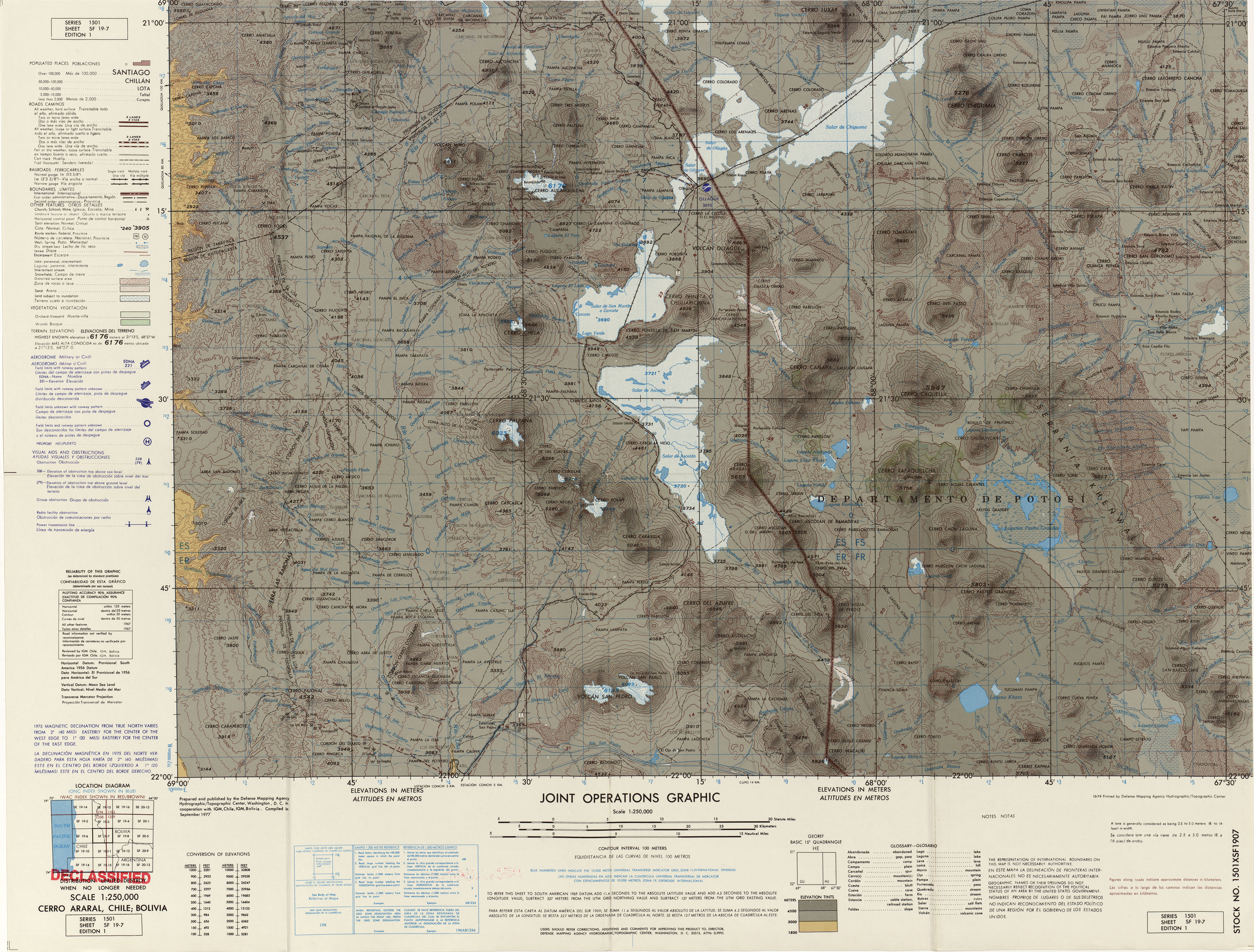
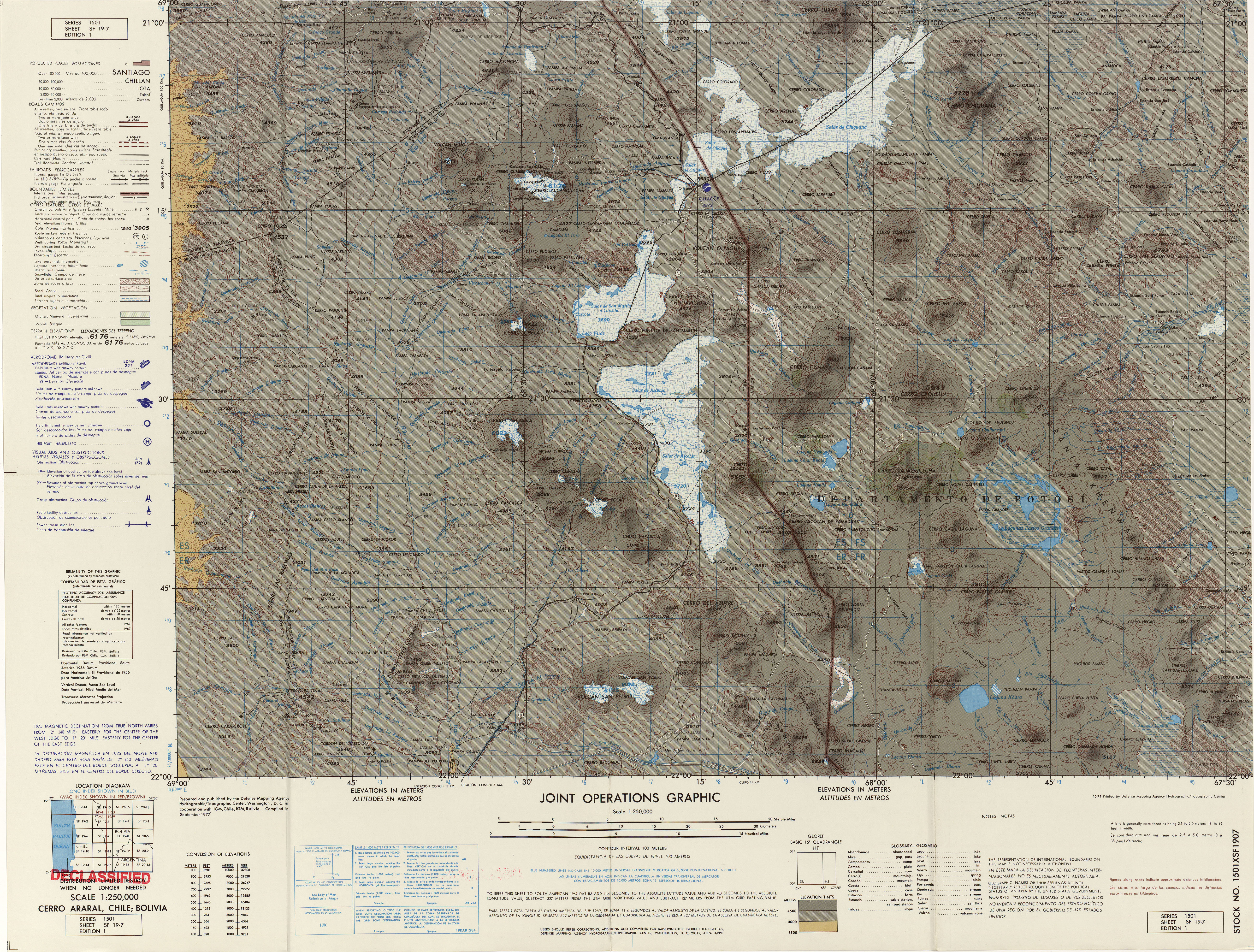
- Page Module:Citation/CS1/styles.css has no content.Defense Mapping Agency Hydrographic/Topographic Center, Washington DC (1977). Cerro Araral; Chile; Bolivia (Map) (1 ed.). 1:250000. Joint Operations Graphic (in español). Salar de Ascotan. Archived from the original (jpg) on 11 November 2010. Retrieved 6 September 2015. Alt URL Script error: No such module "webarchive".
- Page Module:Citation/CS1/styles.css has no content.Erickson, Jon (2009). Environmental Geology: Facing the Challenges of Our Changing Earth. Infobase Publishing. pp. 242–243. ISBN 978-1-4381-0963-3.
- Page Module:Citation/CS1/styles.css has no content.Ferraris, F.; Vila, T. (1990). "Volcanic Sulfur Deposits in the Andes of Northern Chile". Stratabound Ore Deposits in the Andes. pp. 691–701. doi:10.1007/978-3-642-88282-1_55. ISBN 978-3-642-88284-5.
- Page Module:Citation/CS1/styles.css has no content.Francis, P. W.; Wells, G. L. (1988). "Landsat Thematic Mapper observations of debris avalanche deposits in the Central Andes". Bulletin of Volcanology. 50 (4): 258–278. Bibcode:1988BVol...50..258F. doi:10.1007/BF01047488. ISSN 0258-8900. S2CID 128824938.
- Page Module:Citation/CS1/styles.css has no content.Fuenzalida, Nancy Yáñez; Otárola, Raúl Molina (2008). La gran minería y los derechos indígenas en el norte de Chile. LOM Ediciones. p. 63. ISBN 978-956-00-0010-1.
- Page Module:Citation/CS1/styles.css has no content.Galaz-Mandakovic, Damir; Rivera, Francisco (15 March 2023). "Bolivian migration and ethnic subsidiarity in Chilean sulphur and borax high-altitude mining (1888–1946)". History and Anthropology. 34 (2): 234–259. doi:10.1080/02757206.2020.1862106.
- Page Module:Citation/CS1/styles.css has no content.González, José Antonio (2010). "The mining industry in Antofagasta and the Bolivian immigration during the nitrate cycle. Study notes". Revista Si Somos Americanos (in español). 10 (2). Archived from the original on 2016-03-04. Retrieved 2015-09-05.
- Page Module:Citation/CS1/styles.css has no content.Gonzalez, Noberto C.; Fedde, M. Roger (6 December 2012). Oxygen Transfer from Atmosphere to Tissues. Springer Science & Business Media. pp. 10–11. ISBN 978-1-4684-5481-9.
- Page Module:Citation/CS1/styles.css has no content.Grunder, Anita L.; Klemetti, Erik W.; Feeley, Todd C.; McKee, Claire M. (2008). "Eleven million years of arc volcanism at the Aucanquilcha Volcanic Cluster, northern Chilean Andes: implications for the life span and emplacement of plutons". Transactions of the Royal Society of Edinburgh: Earth Sciences. 97 (4): 415–436. doi:10.1017/S0263593300001541. ISSN 0263-5933. S2CID 129122958.
- Page Module:Citation/CS1/styles.css has no content.Grunder, Anita L.; Miller, Jonathan; Walker Jr, Barry Alan (20 October 2014). "From Shallow to Deep: Crustal Magma Processes Based on Comparison of the Aucanquilcha Volcanic Cluster, Central Andes, and the Tuolumne Intrusive Series, Sierra Nevada". Geological Society of America Abstracts with Programs. 2014 GSA Annual Meeting in Vancouver, British Columbia. Vol. 46. Vancouver Convention Centre-West, Vancouver, British Columbia, Canada: Geological Society of America. p. 374. 147-8.
- Page Module:Citation/CS1/styles.css has no content.Gunn, B. M. (1974). "Systematic petrochemical differences in andesite suites". Bulletin Volcanologique. 38 (1): 481–490. Bibcode:1974BVol...38..481G. doi:10.1007/BF02599419. ISSN 0258-8900. S2CID 128974452.
- Page Module:Citation/CS1/styles.css has no content.Jenny, Bettina; Kammer, Klaus (1996). Climate Change in den trockenen Anden (in Deutsch). Verlag des Geographischen Institutes der Universität Bern. pp. 49–50. ISBN 3906151034.
- Page Module:Citation/CS1/styles.css has no content.Klemetti, Erik W.; Grunder, Anita L. (2007). "Volcanic evolution of Volcán Aucanquilcha: a long-lived dacite volcano in the Central Andes of northern Chile". Bulletin of Volcanology. 70 (5): 633–650. Bibcode:2008BVol...70..633K. doi:10.1007/s00445-007-0158-x. ISSN 0258-8900. S2CID 140668081.
- Page Module:Citation/CS1/styles.css has no content.Klemetti, Erik W.; Grunder, Anita L. (2–5 November 2003). "Dacitic Magmas as the Product of Upper Crustal Melting at Long-Lived Volcanic Complexes: Volcán Aucanquilcha, Central Andes of Northern Chile". Geological Society of America Abstracts with Programs. Geological Society of America Annual Meeting. Vol. 35. Seattle, Washington. p. 324.
{{cite conference}}: CS1 maint: date and year (link) - Page Module:Citation/CS1/styles.css has no content.Kull, Christoph; Grosjean, Martin (2000). "Late Pleistocene climate conditions in the north Chilean Andes drawn from a climate–glacier model". Journal of Glaciology. 46 (155): 622–632. Bibcode:2000JGlac..46..622K. doi:10.3189/172756500781832611. ISSN 0022-1430.
- Page Module:Citation/CS1/styles.css has no content.Lara, L. E.; Flores, F.; Calderón, R.; Cardona, C. (1 January 2021). "Chapter 17 - Volcano hazards and risks in Chile". Forecasting and Planning for Volcanic Hazards, Risks, and Disasters. Elsevier. p. 620. ISBN 978-0-12-818082-2.
- Page Module:Citation/CS1/styles.css has no content.Nilsson, Göran E. (28 January 2010). Respiratory Physiology of Vertebrates: Life With and Without Oxygen. Cambridge University Press. p. 268. ISBN 978-1-139-48535-7.
- Page Module:Citation/CS1/styles.css has no content.Rivera, Francisco (2 January 2020). "A Pendulum of Innovations and Challenges: Technological System and Industrial Heritage of Sulphur Mining in Northern Chile (1887–1993)". Industrial Archaeology Review. 42 (1): 48–61. doi:10.1080/03090728.2019.1709729. ISSN 0309-0728. S2CID 213428375.
- Page Module:Citation/CS1/styles.css has no content.Rivera, Francisco; González, Paula; Lorca, Rodrigo; Faundes, Wilfredo (2 January 2021). "Assessing the industrial past in the highlands of northern Chile". Journal of Community Archaeology & Heritage. 8 (1): 26–42. doi:10.1080/20518196.2020.1741119. ISSN 2051-8196. S2CID 216492401. Archived from the original on 2 December 2021. Retrieved 2 December 2021 – via ResearchGate.
- Page Module:Citation/CS1/styles.css has no content.Rothery, D. A.; Francis, P. W.; Wood, C. A. (1988). "Volcano monitoring using short wavelength infrared data from satellites". Journal of Geophysical Research. 93 (B7): 7993. Bibcode:1988JGR....93.7993R. doi:10.1029/JB093iB07p07993. ISSN 0148-0227.
- Page Module:Citation/CS1/styles.css has no content.Rouwet, Dmitri; Christenson, Bruce; Tassi, Franco; Vandemeulebrouck, Jean (2 March 2015). Volcanic Lakes. Springer. pp. 159–161. ISBN 978-3-642-36833-2.
- Page Module:Citation/CS1/styles.css has no content.Salisbury, M. J.; Jicha, B. R.; de Silva, S. L.; Singer, B. S.; Jimenez, N. C.; Ort, M. H. (2010). "40Ar/39Ar chronostratigraphy of Altiplano-Puna volcanic complex ignimbrites reveals the development of a major magmatic province". Geological Society of America Bulletin. 123 (5–6): 821–840. Bibcode:2011GSAB..123..821S. doi:10.1130/B30280.1. ISSN 0016-7606.
- Page Module:Citation/CS1/styles.css has no content.Santolaya, R.B.; Lahiri, S.; Alfaro, R.T.; Schoene, R.B. (1989). "Respiratory adaptation in the highest inhabitants and highest Sherpa mountaineers". Respiration Physiology. 77 (2): 253–262. doi:10.1016/0034-5687(89)90011-X. ISSN 0034-5687. PMID 2506621.
- Page Module:Citation/CS1/styles.css has no content.Villagrán, Carolina; Romo, Marcela; Castro, Victoria (2003). "ETNOBOTÁNICA DEL SUR DE LOS ANDES DE LA PRIMERA REGIÓN DE CHILE: UN ENLACE ENTRE LAS CULTURAS ALTIPLÁNICAS Y LAS DE QUEBRADAS ALTAS DEL LOA SUPERIOR". Chungará (Arica) (in español). 35 (1). doi:10.4067/S0717-73562003000100005. ISSN 0717-7356.
- Page Module:Citation/CS1/styles.css has no content.Walker, B. A.; Grunder, A. L.; Wooden, J. L. (2010). "Organization and thermal maturation of long-lived arc systems: Evidence from zircons at the Aucanquilcha volcanic cluster, northern Chile". Geology. 38 (11): 1007–1010. Bibcode:2010Geo....38.1007W. doi:10.1130/G31226.1. ISSN 0091-7613.
- Page Module:Citation/CS1/styles.css has no content.Walker, B. A.; Grunder, A. (December 2010). Crustal reworking during a long-lived magma pulse: 11 m.y. isotopic record from the Aucanquilcha Volcanic Cluster, central Andes. American Geophysical Union Fall Meeting 2010. San Francisco, United States: American Geophysical Union. V14A-03.
- Page Module:Citation/CS1/styles.css has no content.Walker, Barry A.; Klemetti, Erik W.; Grunder, Anita L.; Dilles, John H.; Tepley, Frank J.; Giles, Denise (2012). "Crystal reaming during the assembly, maturation, and waning of an eleven-million-year crustal magma cycle: thermobarometry of the Aucanquilcha Volcanic Cluster". Contributions to Mineralogy and Petrology. 165 (4): 663–682. Bibcode:2013CoMP..165..663W. doi:10.1007/s00410-012-0829-2. ISSN 0010-7999. S2CID 129808417.
- Page Module:Citation/CS1/styles.css has no content.Walker Jr, Barry Alan; Grunder, Anita L.; Klemetti, Erik W. (19 October 2009). "Isotopic constraint on andesite and dacite petrogenesis at the Aucanquilcha Volcanic Cluster, northern Chile: Implications for crustal growth vs. crustal recycling". Geological Society of America Abstracts with Programs. 2009 Portland GSA Annual Meeting (Poster presentation). Vol. 41. Oregon Convention Center, Portland, Oregon, USA: Geological Society of America. p. 291. 5.
- Page Module:Citation/CS1/styles.css has no content.West, J. B. (July 1987). "Alexander M. Kellas and the physiological challenge of Mt. Everest". Journal of Applied Physiology. 63 (1): 3–11. doi:10.1152/jappl.1987.63.1.3. PMID 3305469.
- Page Module:Citation/CS1/styles.css has no content.West, John B. (2002). "Highest Permanent Human Habitation". High Altitude Medicine & Biology. 3 (4): 401–407. doi:10.1089/15270290260512882. ISSN 1527-0297. PMID 12631426.
- Page Module:Citation/CS1/styles.css has no content.Wilson, Jason (4 August 2009). The Andes. Oxford University Press, USA. p. 198. ISBN 978-0-19-973107-7.
- Page Module:Citation/CS1/styles.css has no content.Wörner, Gerhard; Moorbath, Stephen; Horn, Susanne; Entenmann, Jürgen; Harmon, Russel S.; Davidson, Jon P.; Lopez-Escobar, Leopoldo (1994). "Large- and Fine-Scale Geochemical Variations Along the Andean Arc of Northern Chile (17.5°– 22°S)". Tectonics of the Southern Central Andes. pp. 77–92. doi:10.1007/978-3-642-77353-2_5. ISBN 978-3-642-77355-6.
- Page Module:Citation/CS1/styles.css has no content.Wu, Tianyi (2001). "The Qinghai–Tibetan Plateau: How High Do Tibetans Live?". High Altitude Medicine & Biology. 2 (4): 489–499. doi:10.1089/152702901753397054. ISSN 1527-0297. PMID 11809089.
- Page Module:Citation/CS1/styles.css has no content.Zeil, Werner (1964). "Die Verbreitung des jungen Vulkanismus in der Hochkordillere Nordchiles". Geologische Rundschau. 53 (2): 731–757. Bibcode:1964GeoRu..53..731Z. doi:10.1007/BF02054561. ISSN 0016-7835. S2CID 128979648.
Further reading
Page Module:Side box/styles.css has no content.Page Template:Sister project/styles.css has no content.
- Script error: No such module "Template wrapper".
- Page Module:Citation/CS1/styles.css has no content.Biggar, John (2020). The Andes: A Guide for Climbers and Skiers (5th ed.). Andes Publishing (Scotland). pp. 198 pp. ISBN 978-0-9536087-6-8.
- Page Module:Citation/CS1/styles.css has no content.González-Ferrán, Oscar (1995). Volcanes de Chile. Santiago, Chile: Instituto Geográfico Militar. pp. 640 pp. ISBN 956-202-054-1. (in Spanish; also includes volcanoes of Argentina, Bolivia, and Peru)
- Page Module:Citation/CS1/styles.css has no content.De Silva, Shanaka L.; Francis, Peter (1991). Volcanoes of the Central Andes. Springer-Verlag. pp. 216 pp. ISBN 3-540-53706-6.
- Page Module:Citation/CS1/styles.css has no content.McIntyre, Loren (April 1987). "The High Andes". National Geographic. 171 (4). National Geographic Society: 422–460. (includes description and photos of Aucanquilcha summit road and mine)
External links
- Araneda, Jose, "The world's highest inhabited place: Aucanquilcha, Chile" (1984). Thesis. Rochester Institute of Technology.
- Klemetti, Eric W. "Constraining the magmatic evolution of the Andean arc at 21⁰S using the volcanic and petrologic history of Volćán Aucanquilcha, Central Volcanic Zone, northern Chile" (2009). Thesis. Oregon State University
Lua error in package.lua at line 80: module 'Module:Navbox/configuration' not found. Lua error in mw.title.lua at line 404: bad argument #2 to 'title.new' (unrecognized namespace name 'Portal').