Djerba
Template:Short description Script error: No such module "For". Lua error in package.lua at line 80: module 'Module:Hatnote list' not found.
Page Module:Message box/ambox.css has no content.Page Template:Multiple issues/styles.css has no content.
This article has multiple issues. Please help improve it or discuss these issues on the talk page. (Learn how and when to remove these messages)
Page Module:Message box/ambox.css has no content.
|
Page Module:Infobox/styles.css has no content.Page Template:Infobox islands/styles.css has no content.
Native name: Script error: No such module "Lang". Script error: No such module "Lang". (Script error: No such module "lang".) Page Template:Nobold/styles.css has no content.Script error: No such module "Lang". (Script error: No such module "lang".) Nickname: "The Island of Dreams" | |
|---|---|
| Lua error in package.lua at line 80: module 'Module:InfoboxImage/data' not found. Satellite image of Djerba | |
| Lua error in Module:Location_map at line 526: Unable to find the specified location map definition: "Module:Location map/data/Tunisia" does not exist. | |
| Script error: No such module "Infobox mapframe". | |
| Geography | |
| Location | Gulf of Gabès, Mediterranean Sea |
| Coordinates | Lua error: callParserFunction: function "#coordinates" was not found. |
| Type | Continental |
| Area | Script error: No such module "ConvertIB". |
| Length | 27 km (16.8 mi) |
| Width | 26 km (16.2 mi) |
| Coastline | 125 km (77.7 mi) |
| Highest elevation | 20 m (70 ft) |
| Highest point | 53 Dhahret Guellala |
| Administration | |
Tunisia | |
| Governorate | Medenine |
| Largest settlement | Houmt Souk (pop. 79,000 (2023 estimate)) |
| Demographics | |
| Demonym | Djerbian, Jerbi |
| Population | 184,000 (2023 estimate) (2023) |
| Pop. density | 358/km2 (927/sq mi) |
| Languages | Arabic (official language), Tunisian Arabic (Spoken language), Berber, French |
| Ethnic groups | Tunisians (Arabs, Berbers, Jews) |
| Page Module:Infobox/styles.css has no content. | |
| Page Module:Infobox/styles.css has no content.Script error: No such module "Designation". | |
Official name | Djerba: Testimony to a settlement pattern in an island territory |
| Type | Cultural |
| Criteria | v |
| Designated | 2023 (45th session) |
| Reference no. | 1640[1] |
| Script error: No such module "Check for conflicting parameters". | |
Script error: No such module "Check for conflicting parameters".
Djerba (/ˈdʒɜːrbə, ˈdʒɛərbə/; Template:Langx, Script error: No such module "IPA".; Template:Langx; Template:Langx), also transliterated as Jerba[2] or Jarbah,[3] is a Tunisian island and the largest island of North Africa at 514 square kilometers (198 sq mi), in the Gulf of Gabès,[2] off the coast of Tunisia. Administratively, it is part of the Medenine Governorate. The island had a population of 139,544 at the 2004 census, which rose to 163,726 at the 2014 census. Citing its long and unique history, Tunisia has sought UNESCO World Heritage status protections for the island,[4] and, in 2023, Djerba was officially designated a World Heritage Site.[5]
History
Script error: No such module "Labelled list hatnote".
Page Module:Message box/ambox.css has no content.
This section is written like a personal reflection, personal essay, or argumentative essay that states a Wikipedia editor's personal feelings or presents an original argument about a topic. (June 2024) |
Template:DMCA Page Module:Message box/ambox.css has no content.
This section needs additional citations for verification. (June 2024) |
History
Djerba is the French spelling of Jerba or Jirba. The name is of Tebu origin who were the original inhabitants (autochthonous) of North Africa the coast and the Sahara, who are direct descendants of the ancient Tehenu, Temehu, Garamantes etc.[6] As noted by Haynes in his original 1947 publication, the present archaeological evidence regarding the Palaeolithic inhabitants of Tunisia and North Africa etc which confirmed that the people who lived there through all stages of the Stone Age—Palaeolithic, Mesolithic, and Neolithic—were the ancient Libyan people known as the Tehenu, who appear in the records of the Old Kingdom of Egypt.[7][6] In the Tebu language, Ji or Je means “west,” and Jer means “from the west.” The element ba means “big ones” and also carries layered meanings such as “great ones” or “men of status.” In this context, it refers to the “big ones,” so the name Jerba means “the western big ones,” understood as referring to the jutting-out lands, that is, the islands.
Djerba is speculated to have been the island of the lotus-eaters[2][8] where Odysseus was stranded on his voyage through the Mediterranean Sea. Djerba was known as the island of Lytos or Meninx in the time of the Ancient Greeks.[citation needed] It was possible to locate one of its villages from the Qantara Tower, and the name Djerba was given to the area near Houmt Souk.
Antiquity
The Berbers arrived in North Africa around 1200 BC during the Late Bronze Age as part of the well-known Sea Peoples and have lived in the Maghreb since then,[9] and they inhabited the coasts and mountains and worked in cultivating the land. Their homes are caves and houses carved or built from stones and mud, or straw and tree branches in the form of huts on top of the mountains and plateaus. Others lived a nomadic lifestyle, traveling with their livestock, and they lived under tents. Some sects of them lived by the means of plundering. Others still lived in populous cities that they built, as proven by Ibn Khaldun and others. Ibn Khaldun says in the history of Ibn Khaldun, Part One. - 8 of 258:Page Template:Blockquote/styles.css has no content.
″Ifriqiya and the Maghreb, when the Banu Hilal and Banu Sulaym crossed into it at the beginning of the fifth century (hijri) and invaded it for three hundred and fifty years, were destroyed and all of its areas returned to ruin, after the entire area between the Sudan and the Roman Sea had been built up, as evidenced by the traces of construction in it, including monuments, building statues, and evidence of villages and homes.″
Their clothing consists of striped woolen fabric and a black robe. They wear a cordon and a robe. They shave their heads and do not cover them with anything, and they cover their faces with a sham, which is still in practice today. They eat koski, speak and write Challah (specifically the Djerba dialect), and some people, especially in southern Tunisia, such as in the mountains of Matmata and Doueirat, still use this language when communicating: it is a distinct language in itself, known from ancient times and frequent until now, and it has its own popular oral literature.
Djerba was settled by different people in antiquity, first by the Greek and later by the Phoenicians in the 12th century BC. who came from Tyre and Sidon. During this period, trade flourished in Djerba, thus spreading the pottery industry and the manufacture of purple dye, which historians mentioned was comparable to, if not superior to, the purple of Tyre, and was sold at the highest prices. It seems clear that the Phoenicians were the ones who introduced the planting of olive trees, thus spreading the industry of olive pressing.
After the Phoenicians came the Romans, and the island witnessed great prosperity during the Roman era, the urban effects of which still indicate it today. In the fifth century, the Vandals, a Germanic tribe who had emigrated to the Maghreb in 429 AD and conquered the island under the leadership of its king, Gaiseric.
Middle Ages
Islamic conquest
During the Early Muslim conquests by the Arabs, Djerba was among the places included in the Arab conquest at the hands of Ruwayfi ibn Thabit al-Ansari in the year 665 during the invasion of Tunisia by Mu'awiya ibn Hudaij, in which the Ibadi sect prevailed.[10]
Then it became "Ifriqiya" after its conquest under the rule of the governors, and their reign lasted for nearly a century from 716 to 800. The state went through several disturbances until the Aghlabid state, which was in dispute with the Rustumid state in Algeria. Djerba was sometimes subordinate to the Aghlabids and sometimes to the Rustamids, but it was always semi-independent, until the establishment of the Fatimid Caliphate, which controlled the area from 909 to 972. The island then became part of the possession of emir Bulukīn ibn Zīrī al-Sanhaji, whom al-Mu'izz li-Din Allah al-Fatimi appointed as ruler of Ifriqiya after the Fatimids moved their capital to Cairo.
The Sanhaji state went through two successive stages: an era of prosperity and an era of turmoil. In the first stage, Kairouan experienced prosperity for 78 years until the arrival of the Hilalids in the year 1049. As for the second stage, Djerba suffered many calamities due to the invasions it was exposed to. Perhaps the most prominent of these was when “Rogar al-Narmandi”, conquered the stronghold in 1135 in response to repeated piracy in the Mediterranean. After its subjugation, the town's women and children were sent to Sicily, despite the violent resistance shown by the pirate lords and local folk. Djerba remained under Norman occupation from 1135 to 1159. Over two decades later however, while the Normans and their ruler William I, were primarily focused on their invasion of the Byzantine Empire in 1185, the Almohad Caliphate, with its origins in the sandy deserts of Morocco, "woke up from its slumber and remembered that its enemy was sitting on a cherished piece of its soil. It prepared a large army in a huge fleet, forced the Frankish garrison to withdraw, and the island entered the rule of the Almohads." The control of the island later passed down to the Berber Hafsid dynasty by early 13th century.
From the sixteenth to the nineteenth century
The Ottomans entered a part of Ifriqiya in 1574 and made it an Ottoman province, similar to what they did in the Central Maghreb in 1519–1520 and in Tripolitania in 1551. However, this Tunisian province, which was formed at a later date, soon developed its political system before its Algerian and Tripolitan neighbors since the late 16th century. At that time, the rule of the Dey with sole authority appeared (in the first half of the 17th century), then a semi-monarchical hereditary system during the era of the Muradid Beys (1628–1702) and then the Husseinis (after 1705). These Husseinis succeeded in building the edifice of a state firmly established in the country and enjoying broad independence from external powers (Istanbul or the Dey of Algiers), especially during the reign of Hammuda Pasha (1782–1814).
The two giant empires—the Ottoman and the Spanish—took advantage of the weakness of the Hafsid state to intervene in Tunisia from 1534 to 1535. In addition to the island of Djerba, Darguth Pasha was able to occupy Gafsa in 1556 and Kairouan (the capital of the Almoravid Emirate of Chabia) in 1557, and the Bayler Bey (Supreme Commander) "Ali Pasha" or "Alaj Ali" entered the city of Tunis. In 1569, before the Spanish evacuated him from it in 1573.
The Ottoman Sultan Selim II decided to eradicate the Spaniards from Tunisia for strategic reasons (monitoring the southern bank of the Strait of Sicily), political reasons (completed the occupation of the countries of this bank from Egypt to the borders of the Far Maghreb), and religious reasons (jihad was one of the constants of Ottoman policy). With the help of the people, the Ottomans were able to storm the huge fortress of La Goulette, then seize Tunis and eliminate the Spanish presence during the summer of 1574.
The modern era opened with a deep crisis in all Maghrebian countries, including Tunisia, which ended with the Ottomans' accession there and its transformation into an Ottoman province.
However, its political system quickly developed during the seventeenth and eighteenth centuries into an independent "semi-national monarchy" with only formal ties of loyalty to Istanbul. They control (varyingly according to the regions and groups) a specific space that is different from the space of the neighbouring provinces.
Then Tunisia fell into the trap of colonialism, as German Chancellor Bismarck declared to the French ambassador in Berlin (January 4, 1879): "The Tunisian pear has ripened and it is time for you to pick it". Indeed, since the first third of the nineteenth century, the conditions of the Tunisian province have gradually deteriorated and worsened under the pressure of the rising European expansionist powers, until the province stabilized in a comprehensive crisis that facilitated the French intervention in 1881.
During the nineteenth and twentieth centuries, the island witnessed radical transformations, and perhaps the most prominent thing that distinguishes this era is the migration of its people to engage in trade in some Islamic cities and Tunisian cities. During the period of French rule, the people of the island had an effective contribution to the Tunisian national movement. Following independence, Djerba became one of the most prominent Tunisian tourist attractions and a destination for tourists from all over the world.
Since 1881
The island was subjected to attacks by Ibrahim Pasha of Egypt. It was also damaged as a result of Yunus Bey's invasion of it in the year 1738 AD, and it was damaged by the epidemics of 1705 and 1706, 1809, 1864, and its economy was greatly damaged, then it suffered under the yoke of French colonialism in 1881 AD, until it gained its independence in 1956 AD.
Demands to become a "Tunisian Governorate"
The island of Djerba is administratively affiliated with the governorate of Medenine, but some people on the island have been demanding since the January 2011 revolution for secession from the governorate of Medenine and for Djerba to become the twenty-fifth Tunisian governorate, which did not resonate with Tunisian officials.[11][12][13]
In 2000, the film The Season of Men, directed by Moufida Tlatli and depicting women's lives on Djerba, achieved critical success.[14]
Jewish history
Page Module:Message box/ambox.css has no content.
This section may be too long or excessively detailed. (January 2019) |
Script error: No such module "Labelled list hatnote". According to their oral history, the Jewish minority has dwelled on the island continuously for more than 2,500 years, following the destruction of the Temple of Jerusalem.[15][16] The first physical evidence that historians know of comes from the 11th century, and was found in Cairo Geniza.[17] The descendants of this community still live in Houmt Souk.
This community is unique in the Jewish diaspora for its unusually high percentage of kohanim, direct patrilineal descendants of Aaron, the first high priest from Mosaic times.[17] Local tradition holds that when Nebuchadnezzar II levelled Solomon's temple and laid waste to Judah and the city of Jerusalem in the year 586 BC, the Kohenim who settled in Djerba were among the refugees who were able to avoid slavery.[18]
A key point in this oral history has been backed up by genetic tests for Cohen modal haplotype showing that the vast majority of male Jews on Djerba claiming the family status of Cohen had a common ancient male ancestor which matches that of nearly all of both historically European and Middle Eastern Jewish males with a family history of patrilineal membership in the Jewish priestly caste.[19] Thus, the island has been known by many Jews as the island of the Kohenim. According to the legend, during the destruction of the temple, the Kohenim, who were serving the temple at the time of destruction escaped from Jerusalem and found themselves on the island of Djerba.[17] The legend claims the Kohenim carried the door and some stones from the Temple in Jerusalem which they then incorporated into the "marvelous synagogue", also known as Ghriba, which still stands in Djerba.[17]
The Jewish community differs from others in Djerba in their dress, personal names and accents. The Jewish rabbinate of Djerba have established an eruv, which establishes the communal area in the city in which Jews can freely carry objects between their homes and community buildings on Shabbat.[20] Some traditions that are distinctive of the Jewish Djerba community is the kiddush prayer said on the eve of Passover and a few prophetic passages on certain Shabbats of the year.[17]
One of the community's synagogues, the El Ghriba synagogue, has been in continuous use for over 2,000 years.[21] The Jews were settled in two main communities: the Ḥara Kabira ("the big quarter"; Arabic: "الحاره الكبيرة") and the Ḥara Ṣaghira ("the small quarter"; Arabic: "الحاره الصّغيرة"). The Hara Saghira identified itself with Israel, while the Hara Kabira identified with Spain and Morocco.[22]
The next influx of Jewish people to the Island of Djerba occurred during the Spanish Inquisition, when the Iberian Jewish population was expelled.[23] The Jewish population hit its peak during the time that Tunisia was fighting for independence from France (1881–1956).[23] In 1940, there were approximately 100,000 Jewish-Tunisians or 15% of the entire population of Tunisia.[23]
In the aftermath of World War II, the Jewish population on the island declined significantly due to emigration to Israel and France. As of 2011[update], the Jewish permanent resident community on the island numbered about 1,000,[16][24] but many return annually on pilgrimage. However, once the State of Israel was established, and political unrest in the Middle East and North Africa was building up many Jewish people were expelled from Tunisia.[23] Although the Jewish community of Tunisia was on the decline, the Jewish community of Hara Kebira witnessed an increase of population due to its traditional character.[23] The community on Djerba remains one of the last remaining fully intact Jewish communities in a Muslim majority country. The most traditionally observant Jewish community is growing because of large natural families despite emigration and a new Orthodox Jewish school for girls has recently been inaugurated on the Island to serve alongside the two boys yeshiva schools. According to The Wall Street Journal, "Relations between Jews and Muslims are complex—proper and respectful, though not especially close. Jewish men work alongside Muslim merchants in the souk, for example, and enjoy amicable ties with Muslim customers."[25]
The historical conflicts between Muslims and Jewish people have been largely absent in Djerba. This is reportedly attributed due to all the people of the island being at some point Jewish, and therefore share similar practices in their ways of life.[17] Some of these Jewish practices that can be seen in Muslim households in Djerba are the lighting of candles on Friday night, and the suspending of matzot on the ceiling from one spring to the next.[17] The Jewish and Muslim communities have coexisted peacefully in Djerba despite political unrest regarding the Israeli–Palestinian conflict. The people of Djerba say that the two communities simply pray in different places, but are still able to converse.[26] A Jewish leader once stated "We live together, We visit our friends on their religious holidays. We work together. Muslims buy meat from our butchers. When we are forbidden to work or cook on the Shabbat, we buy bread and kosher food cooking by Muslims. Our children play together".[26]
On 11 April 2002, Al-Qaeda claimed responsibility for a truck bomb attack close to the famous synagogue, killing 21 people (14 German tourists, 5 Tunisians and 2 French nationals).[27]
Since the Arab Spring, the Tunisian government has extended its protection and encouraged Jewish life on the island of Djerba.[18] Citing the long and unique Jewish history on Djerba, Tunisia has sought UNESCO World Heritage status for the island.[4] There are currently 14 synagogues, 2 yeshivot and 3 kosher restaurants.[18]
A Jewish school on the island was firebombed during the national protests held in 2018, while security forces in Djerba were reduced, being preoccupied with protection efforts elsewhere.[28] This attack was among many other uprisings that were occurring throughout Tunisia at the time.[28]
On 9 May 2023, El Ghriba Synagogue was the target of a mass shooting on a large gathering of Jewish pilgrims that takes place every year at the synagogue. Five people were killed including: two Jewish cousins, a Jewish-French tourist, and two Tunisian security guards.[29]
Ecclesiastical history
Script error: No such module "Labelled list hatnote".
The city Girba in the Roman province of Tripolitania (mostly in modern Libya), which gave its name to the island, was important enough to become a suffragan bishop of its capital's archbishopric. Known Bishops of antiquity include:
- Proculus (Maximus Bishop fl.393)
- Quodvultdeus (Catholic Bishop fl.401–411) attending Council of Carthage (411)
- Euasius (Donatist Bishop fl.411) rival at Council of Carthage
- Urbanus (Catholic bishop fl.445–454)
- Faustinus (Catholic bishop fl. 484), exiled by King Huneric of the Vandal Kingdom
- Vincentius (Catholic bishop fl. 523–525)
The 1909 Catholic Encyclopedia lists only two: "At least two bishops of Girba are known, Monnulus and Vincent, who assisted at the Councils, of Carthage in 255 and 525".[30]
Climate
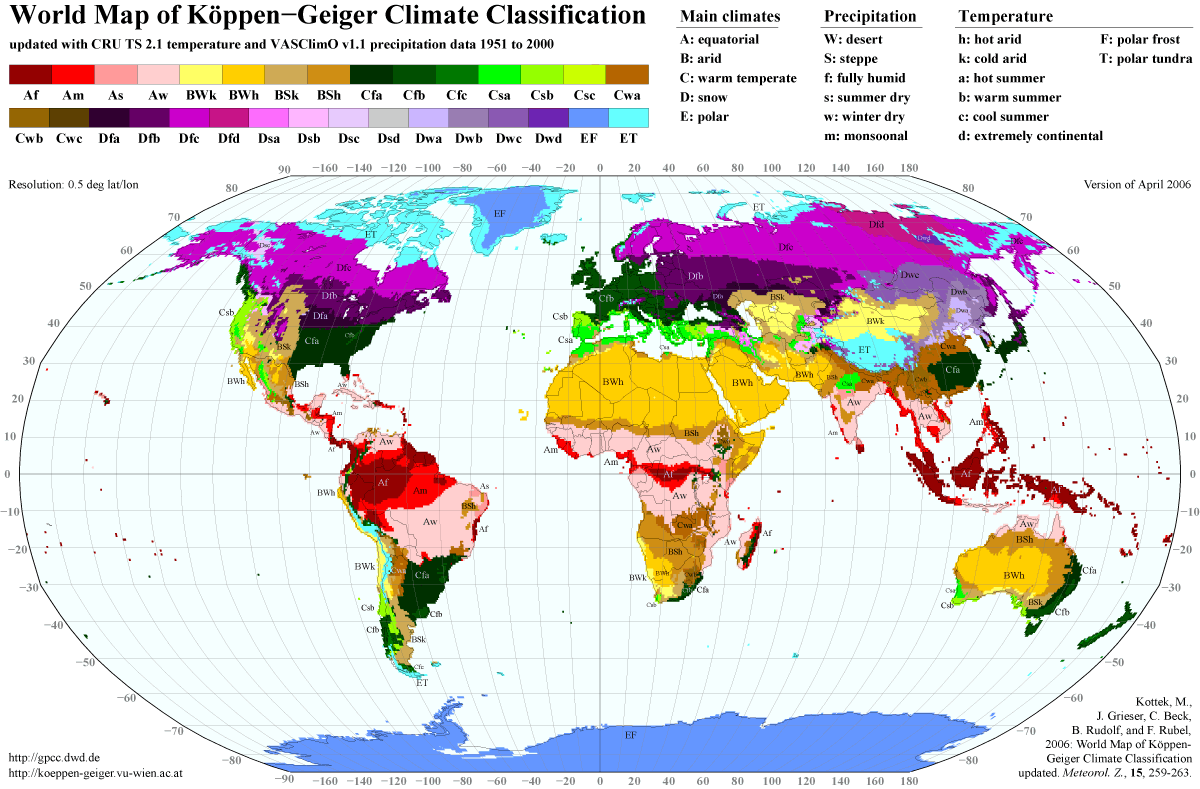
Djerba has a hot desert climate (Köppen climate classification: BWh)[31] that borders on a hot semi-arid climate (BSh).
Script error: No such module "weather box".
| Climate data for Djerba | |||||||||||||
|---|---|---|---|---|---|---|---|---|---|---|---|---|---|
| Month | Jan | Feb | Mar | Apr | May | Jun | Jul | Aug | Sep | Oct | Nov | Dec | Year |
| Average sea temperature °C (°F) | 16.0 (61.0) |
15.0 (59.0) |
16.0 (61.0) |
17.0 (63.0) |
19.0 (66.0) |
22.0 (72.0) |
26.0 (79.0) |
28.0 (82.0) |
27.0 (81.0) |
25.0 (77.0) |
22.0 (72.0) |
18.0 (64.0) |
20.9 (69.8) |
| Mean daily daylight hours | 10.0 | 11.0 | 12.0 | 13.0 | 14.0 | 14.0 | 14.0 | 13.0 | 12.0 | 11.0 | 10.0 | 10.0 | 12.0 |
| Average Ultraviolet index | 3 | 4 | 6 | 8 | 9 | 10 | 11 | 10 | 8 | 6 | 4 | 3 | 6.8 |
| Source #1: Weather2Travel (sea temperature) [39] | |||||||||||||
| Source #2: Weather Atlas [40] | |||||||||||||
Migratory bird sanctuary
Djerba Bin El Ouedian is a wetland and habitat for migratory birds. It is located at 33 ° 40 'N, 10 ° 55 'E. On 7 November 2007 the wetland was included on the list of Ramsar sites under the Ramsar Convention, due to its importance as a bird refuge.[41]
See also
Lua error in mw.title.lua at line 404: bad argument #2 to 'title.new' (unrecognized namespace name 'Portal').
- European enclaves in North Africa before 1830
- Borj El Kebir
- Menachem Mazuz, former Attorney General of Israel & supreme judge
- Yael Shelbia, Israeli model, descendant of Djerba inhabitants
- Djerba–Zarzis International Airport
- Menzel (Djerba)
Notes
Page Template:Reflist/styles.css has no content.
References
Page Template:Reflist/styles.css has no content.
- ^ Page Module:Citation/CS1/styles.css has no content."Djerba: Testimony to a settlement pattern in an island territory". UNESCO World Heritage Centre. Retrieved 24 September 2023.
- ^ a b c Script error: No such module "template wrapper".
- ^ Page Module:Citation/CS1/styles.css has no content."Converter: Arabic, ar, 'alyrbiah', العربية". www.uconv.com. Retrieved 10 May 2023.
- ^ a b Page Module:Citation/CS1/styles.css has no content.Center, UNESCO World Heritage. "Regional Workshop on the World Heritage Nomination Process". UNESCO World Heritage Center. Retrieved 6 December 2018.
- ^ Page Module:Citation/CS1/styles.css has no content.Centre, UNESCO World Heritage. "Djerba: Testimony to a settlement pattern in an island territory". UNESCO World Heritage Centre. Retrieved 24 September 2023.
- ^ a b Wahli, S. H. (2022, October 7). The Toubou Oases: Southern Barqa of Libya – The Tazer Region (Kufra). Studies and Research in History, Heritage, and Languages
- ^ Haynes, D. E. L. Ancient Tripolitania. London: Society for the Promotion of Roman Studies, 1947, p. 13.
- ^ Polybius; Strabo 1.2.17.
- ^ The General History of Africa: Studies and Documents, Libya Antiqua: Report and Papers of the Symposium Organized by UNESCO in Paris, 16–18 January 1984. Section: “Formation of the Berber Branch,” p. 69. UNESCO.
- ^ Page Module:Citation/CS1/styles.css has no content."صحابة زاروا تونس : رويفع بن ثابت الأنصاري (القائد الزاهد المتوكل على الله)". turess.com (in العربية). Retrieved 4 April 2024.
- ^ Page Module:Citation/CS1/styles.css has no content."جربة: الأهالي يطالبون بإعلان الجزيرة ولاية". shemsfm.net. 4 February 2022. Archived from the original on 4 February 2022. Retrieved 4 April 2024.
- ^ Page Module:Citation/CS1/styles.css has no content.Kefi, Ridha (4 February 2022). "المنعرج الحاسم في ملف "جربة الولاية رقم 25" - أنباء تونس". kapitalis.com (in العربية). Archived from the original on 4 February 2022. Retrieved 4 April 2024.
- ^ Page Module:Citation/CS1/styles.css has no content.Kefi, Ridha (13 August 2020). "هل من المشروع المطالبة بإحداث ولاية جربة؟ - أنباء تونس". kapitalis.com (in العربية). Archived from the original on 13 August 2020. Retrieved 4 April 2024.
- ^ Page Module:Citation/CS1/styles.css has no content.Thomson, Michael. "BBC - Films - review - La Saison des Hommes (The Season of Men)". www.bbc.co.uk. BBC. Retrieved 3 November 2018.
- ^ Page Module:Citation/CS1/styles.css has no content.Teich, Shmuel (1982). The Rishonim. Brooklyn, New York: Mesorah Publications. ISBN 978-0-89906-452-9.
- ^ a b International Religious Freedom Report 2007: Tunisia. United States Bureau of Democracy, Human Rights and Labor (14 September 2007). This article incorporates text from this source, which is in the public domain.
- ^ a b c d e f g Page Module:Citation/CS1/styles.css has no content.Udovitch, Abraham L.; Valensi, Lucette (1984). The Last Arab Jews: The Communities of Jerba, Tunisia. London, England: Harwood Academic Publishers. pp. 8–11, 24–25. ISBN 978-3-7186-0135-6.
- ^ a b c Page Module:Citation/CS1/styles.css has no content."WATCH: Candle lighting in Djerba – a Jewish community to admire – Diaspora". Jerusalem Post. 16 December 2017. Retrieved 6 December 2018.
- ^ Page Module:Citation/CS1/styles.css has no content."Tunisia's Diverse Djerba Island and Its Annual Jewish Pilgrimage". 2 June 2015. Retrieved 6 December 2018.
- ^ Page Module:Citation/CS1/styles.css has no content.Schroeter, Daniel (1985). "Review of The Last Arab Jews: The Communities of Jerba, Tunisia, (Social Orders 1.)". Middle East Studies Association Bulletin. 19 (1): 63–64. doi:10.1017/S0026318400014905. JSTOR 23057816. S2CID 164480553.
- ^ Page Module:Citation/CS1/styles.css has no content."Tunisian Cleric Says Jews are Apes". Israel National News. 7 December 2012. Retrieved 6 December 2018.
- ^ Page Module:Citation/CS1/styles.css has no content.Spector, Shmuel; Wigoder, Geoffrey (2001). The Encyclopedia of Jewish Life Before and During the Holocaust: A-J. New York: NYU Press. p. 312. ISBN 978-0-8147-9376-3.
- ^ a b c d e Page Module:Citation/CS1/styles.css has no content.Widman, Miriam (19 December 1994). "Behind The Headlines: Amid Sea of Muslim Neighbors, Tunisia Jews Observe Traditions". Jewish Telegraphic Agency.
- ^ Page Module:Citation/CS1/styles.css has no content.Ettinger, Yair (17 January 2011). "Sociologist Claude Sitbon, do the Jews of Tunisia have reason to be afraid?". Haaretz. Archived from the original on 19 January 2011. Retrieved 4 October 2012.
- ^ Page Module:Citation/CS1/styles.css has no content.Lagnado, Lucette (13 February 2015). "Tunisian Jewish Enclave Weathers Revolt, Terror; Can It Survive Girls' Education?". The Wall Street Journal. Retrieved 6 December 2018 – via www.wsj.com.
- ^ a b Page Module:Citation/CS1/styles.css has no content.Hanley, Delinda C. (December 2003). "Tunisian Jews Enjoy Religious Tolerance and Peace In Djerba". The Washington Report on Middle Eastern Affairs. Vol. 22, no. 10. pp. 46–49.
- ^ Tunisian bomb attack trial opens, BBC.co.UK; accessed 28 July 2020.
- ^ a b Page Module:Citation/CS1/styles.css has no content."Tunisian Jewish school attacked as anti-government protests rage elsewhere". Reuters. 11 January 2018.
- ^ Page Module:Citation/CS1/styles.css has no content."5 killed in shooting near Lag Ba'omer fest at ancient synagogue in Tunisia". The Jerusalem Post. 9 May 2023. ISSN 0792-822X. Retrieved 1 March 2024.
- ^ Page Module:Citation/CS1/styles.css has no content.Vailhé, S. (1909). "Girba". The Catholic Encyclopedia. New York: Robert Appleton Company.
- ^ Page Module:Citation/CS1/styles.css has no content."World map of Köppen-Geiger climate classification". koeppen-geiger.vu-wien.ac.at. Retrieved 18 August 2023.
- ^ Page Module:Citation/CS1/styles.css has no content."Les normales climatiques en Tunisie entre 1981 2010" (in français). Ministère du Transport. Archived from the original on 19 December 2019. Retrieved 20 January 2020.
- ^ Page Module:Citation/CS1/styles.css has no content."Données normales climatiques 1961–1990" (in français). Ministère du Transport. Archived from the original on 21 December 2019. Retrieved 20 January 2020.
- ^ Page Module:Citation/CS1/styles.css has no content."Les extrêmes climatiques en Tunisie" (in français). Ministère du Transport. Archived from the original on 21 December 2019. Retrieved 20 January 2020.
- ^ Page Module:Citation/CS1/styles.css has no content."Période ensoleillée 1981-2010 climatiques en Tunisie". Institut National de la Météorologie (in français). Ministère du Transport. Archived from the original on 21 December 2019. Retrieved 26 December 2019.
- ^ Page Module:Citation/CS1/styles.css has no content."Réseau des stations météorologiques synoptiques de la Tunisie" (in français). Ministère du Transport. Retrieved 20 January 2020.
- ^ Template:Cite FTP
- ^ Page Module:Citation/CS1/styles.css has no content."Station Djerba" (in français). Météo Climat. Retrieved 13 July 2017.
- ^ Page Module:Citation/CS1/styles.css has no content."Djerba Climate and Weather Averages, Tunisia". Weather2Travel. Retrieved 19 July 2014.
- ^ Page Module:Citation/CS1/styles.css has no content."Djerba, Tunisia – Climate data". Weather Atlas. Retrieved 4 April 2017.
- ^ Page Module:Citation/CS1/styles.css has no content."Tunisia – Ramsar". www.ramsar.org. Retrieved 6 December 2018.
External links
Page Module:Side box/styles.css has no content.Page Template:Sister project/styles.css has no content.
Page Module:Side box/styles.css has no content.Page Template:Sister project/styles.css has no content.
Lua error in package.lua at line 80: module 'Module:Navbox/configuration' not found. Lua error in package.lua at line 80: module 'Module:Authority control/config' not found.