Helenium autumnale
| Script error: No such module "Automated taxobox". | |
|---|---|
| Lua error in package.lua at line 80: module 'Module:InfoboxImage/data' not found. | |
Script error: No such module "Conservation status".
| |
| Scientific classification Edit this classification | |
| Script error: No such module "Taxobox ranks".: | <div style="display:inline" class="script error: no such module "taxobox ranks".">Template:Taxon infoTemplate:Taxon italics |
| Binomial name | |
| Template:Taxon infoTemplate:Taxon italics L. 1753
| |
| Lua error in package.lua at line 80: module 'Module:InfoboxImage/data' not found. | |
| Synonyms[1] | |
| |
Page Template:Taxobox/core/styles.css has no content.Template:Taxonbar/candidateTemplate:Speciesbox/parameterCheckScript error: No such module "Check for conflicting parameters".
Helenium autumnale is a North American species of flowering plants in the family Asteraceae. Common names include common sneezeweed and large-flowered sneezeweed.[3][4][5]
Description
Common sneezeweed is a perennial herb up to Page Template:Fraction/styles.css has no content.130 cm (51+1⁄3 in; 4+1⁄3 ft) tall. In late summer and fall, one plant can produce as many as 100 yellow flower heads in a branching array. Each head has yellow 11–21 ray florets surrounding sometimes as many as 800 yellow disc florets.[6][7] Leaves are dark green, alternate, and lance-shaped. The Latin specific epithet autumnale is in reference to the plant's autumn flowering.[8]
Distribution and habitat
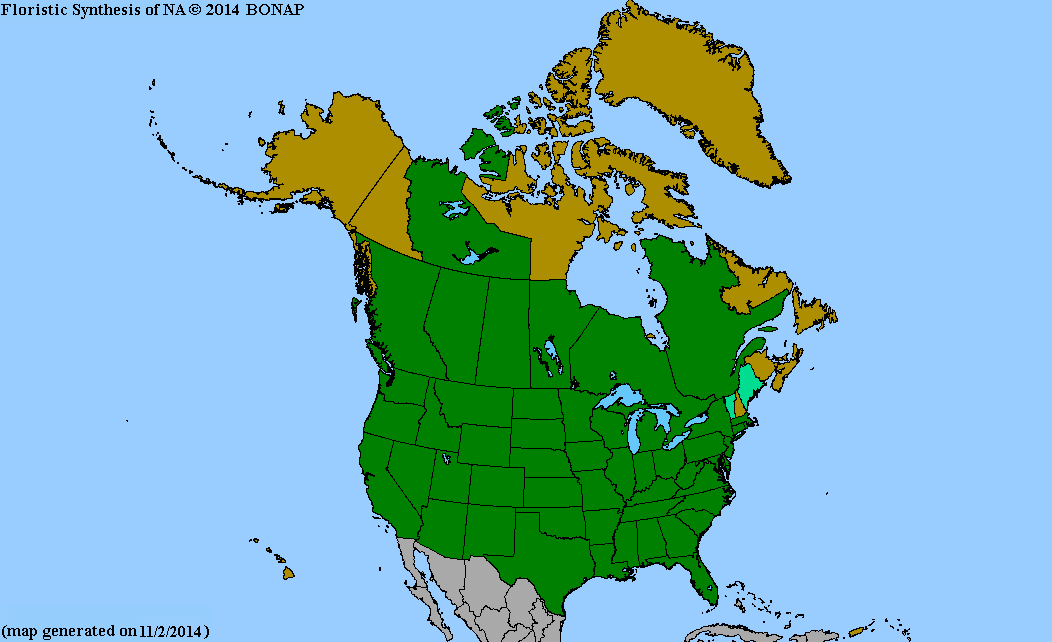
This plant is widespread across much of the United States and Canada, from Northwest Territories as far south as far northern California, Arizona, Louisiana, and Florida. It has not been found in southern or central California, nor in the four Atlantic Provinces of Canada.[9][10][11][12] It grows in moist, open areas along streams and ponds as well as wet meadows.[13]
Ecology
The flowers attract various pollinators, including bees, butterflies, and wasps. Because the plant is pollinated by insects, not wind pollinated, it does not cause seasonal allergies or sneezing, despite its common name.[7] The plant is poisonous to rumanites. [14]
Cultivation
Common sneezeweed is cultivated as a garden perennial. There are multiple named varieties varying in color and height. 'Pumilum Magnificum' is a yellow variety about two feet tall. 'Bruno', a reddish-brown cultivar, 'Kupfersprudel', which is yellow/orange, and 'Butterpat', which is golden, all grow 3 to 3.5 feet (91 to 107 centimetres) tall. 'Chippersfield Orange' is up to 0.91 metres (3 ft) tall and is orange streaked with gold.[15]
Uses
Health
Only in small amounts, the plant has some health benefits. The dried nearly mature flower heads are used in a powdered form as a snuff to treat colds and headaches. When made into a tea they are used in the treatment of intestinal worms. The powdered leaves are sternutatory. An infusion of the leaves is laxative and alterative. An infusion of the stems has been used as a wash in the treatment of fevers. The plant contains helenalin, a compound that has shown significant anti-tumour activity.[1]
Folk remedies
The plant owes its name to the use of its dried leaves in snuff, the inhaling of which causes sneezing—supposedly casting out evil spirits.[16][17]
References
Page Template:Reflist/styles.css has no content.
- ^ Script error: No such module "template wrapper". Note that this website has been superseded by World Flora Online
- ^ Page Module:Citation/CS1/styles.css has no content."NatureServe Explorer 2.0". explorer.natureserve.org.
- ^ Page Module:Citation/CS1/styles.css has no content.Wilkinson, Kathleen (1999), Wildflowers of Alberta A Guide to Common Wildflowers and Other Herbaceous Plants, Edmonton, Alberta: Lone Pine Publishing and University of Alberta, p. 112, ISBN 0-88864-298-9
- ^ Page Module:Citation/CS1/styles.css has no content.Peterson, Roger T.; McKenny, Margaret (1968), A Field Guide to Wildflowers of Northeastern and North-Central North America (9th ed.), Boston: Houghton Mifflin, ISBN 0-395-91172-9
- ^ Page Module:Citation/CS1/styles.css has no content.Vance, F R; J.R. Rowsey, J.S. Maclean and F.A. Switzer (1999), Wildflowers across the prairies: With a new section on Grasses, sedges and rushes, Vancouver, British Columbia: Western Producer Prairie Books, p. 299, ISBN 1-55054-703-8
- ^ Script error: No such module "template wrapper".
- ^ a b Page Module:Citation/CS1/styles.css has no content."Common Sneezeweed (Helenium autumnale)". www.illinoiswildflowers.info.
- ^ Page Module:Citation/CS1/styles.css has no content."Helenium autumnale - Plant Finder". www.missouribotanicalgarden.org. Retrieved 2022-01-14.
- ^ Script error: No such module "template wrapper".
- ^ Template:BONAP
- ^ Biota of North America Program 2014 state-level distribution map
- ^ Calflora taxon report, University of California, Helenium autumnale L., common sneezeweed
- ^ Page Module:Citation/CS1/styles.css has no content."Lady Bird Johnson Wildflower Center - The University of Texas at Austin". www.wildflower.org. Retrieved 2022-01-14.
- ^ Sneezeweed (Helenium hoopesii). Agricultural Research Service. Retrieved on 25 Sept. 2023
- ^ Page Module:Citation/CS1/styles.css has no content.Crockett, James U. (1972), Perennials (2 ed.), New York: Time-Life Books
- ^ Page Module:Citation/CS1/styles.css has no content.Niering, William A.; Olmstead, Nancy C. (1985) [1979]. The Audubon Society Field Guide to North American Wildflowers, Eastern Region. Knopf. p. 383. ISBN 0-394-50432-1.
- ^ Page Module:Citation/CS1/styles.css has no content.Trull, Sue. "Plant of the Week: Common sneezeweed (Helenium autumnale L. var. autumnale)". US Forestry Service. Retrieved 10 June 2024.
The common name is based on historic use of the crushed dried leaves and heads to make a form of snuff that caused sneezing. In certain cultures and times, sneezing was regarded as a desirable way to rid the body of evil spirits or a way to loosen up a head cold, so that a sneeze-producing remedy was desirable.
External links
- Jepson Manual Treatment
- Kemper Center for Home Gardening Script error: No such module "webarchive".
- Helenium autumnale in the CalPhotos photo database, University of California, Berkeley
- photo of herbarium specimen at Missouri Botanical Garden, collected in Missouri in 2002
Script error: No such module "Taxonbar".



.jpg)
.jpg)