KTM Class 81
Template:Short description Template:Refimprove
Page Module:Infobox/styles.css has no content.
| Class 81 | |
|---|---|
| Lua error in package.lua at line 80: module 'Module:InfoboxImage/data' not found. A Class 81 EMU 14 Komuter train At Persimpangan Bangsar | |
| In service | 1995–2012, 2018–present |
| ManufacturerTemplate:Pluralize from text | Ganz-Hunslet |
| DesignerTemplate:Pluralize from text | Hunslet Transportation Projects |
| Built at | Ganz Works (Jenbacher Transport) |
| Refurbished | 2018 by Woojin Industrial Systems[1] |
| Number built | 18 |
| Formation | 3 cars per unit |
| Capacity | 414 (224 seats) |
| OperatorTemplate:Pluralize from text | Keretapi Tanah Melayu |
| DepotTemplate:Pluralize from text | Page Template:Plainlist/styles.css has no content.
|
| LineTemplate:Pluralize from text served | Page Template:Plainlist/styles.css has no content. |
| Specifications | |
| Height | 3.65 m (12 ft 0 in) |
| Maximum speed | Page Template:Plainlist/styles.css has no content.
|
| Weight | 121 t (119 long tons; 133 short tons) |
| Traction system | Page Template:Plainlist/styles.css has no content. |
| Traction motors | 8 × HOLEC DMKT55/18.5 161 kW (216 hp) 3-phase AC induction motor[2] |
| Power output | 1,288 kW (1,727 hp) |
| [[Railway electrification|Electric systemTemplate:Pluralize from text]] | 25 kV 50 Hz AC overhead catenary |
| Current collection | Pantograph |
| UIC classification | Bo′Bo′+2′2′+Bo′Bo′ |
| Track gauge | 1,000 mm (Page Template:Fraction/styles.css has no content.3 ft 3+3⁄8 in) metre gauge |
Script error: No such module "Check for conflicting parameters".
The Class 81 is the first and oldest type of electric multiple unit introduced by Keretapi Tanah Melayu for its KTM Komuter service. 18 sets were designed by Hunslet Transportation Projects and built by Ganz Works in 1993-1994.[3][4]
The Class 81 currently operates in a fixed 3-car formation for its regular service.[5] The middle coach is exclusively for women and children.
The KTM Class 81 design is derived from the British Rail Class 323, with the main alteration being that it has single leaf swing-plug doors instead of a double leaf type.
Description
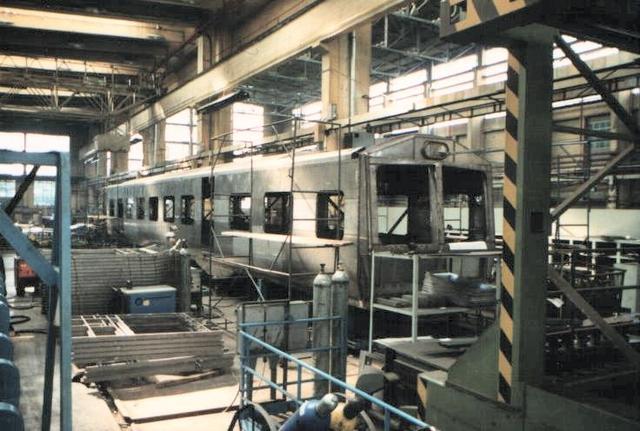
The EMUs were built from 1993 to 1994[3] and entered service on 3 August 1995. The EMUs were the first electric trains of any kind in KTM's history. They operate in multiple-unit formation. The EMUs were state-of-the-art, with remote-controlled pneumatic doors, automatic train protection (ATP), a train data recorder, wheel-slip control, GTO/IGBT traction electronics, and regenerative braking, and ran from a 25 kV 50 Hz AC overhead catenary supply. Up to the point of their introduction, no other KTM motive power used these modern train control systems.
The trains run in a 3-car formation. They were once run in 3+3 formations during rush hour, but this configuration was discontinued.
The cessation of Jenbacher’s rail operations resulted in the loss of spare parts for these trains. Over the years, their maintenance lapsed, resulting in poor reliability and premature failure. As a result, some had to be used as dummy coaches in a hybrid service. A diesel locomotive pulled the coaches, and a power generator was attached at the end. The hybrid service started in 2009 and ended in 2012, when new trains rendered this stopgap measure unnecessary.
Many trains were rendered surplus after the introduction of the Class 92 in 2012. Some were brought down to be converted to intercity sets, while others were scrapped. The refurbished sets could not be used as intercity sets in the end as regulations mandate that long distance trains have a toilet, which this class lacks.
The class disappeared from passenger service from 2012 to 2018. However, in 2018, many of the refurbished EMUs were brought back into service. They currently operate on the Batu Caves shuttle, the Northern Sector, and occasionally the Central Sector.
| Car No. | 1 | 2 | 3 |
|---|---|---|---|
| Seating capacity | 72 | 80 | 72 |
| Designation | Mc | Tp | Mc |
| Set Designation | 1 | 2 | 3 | Status |
|---|---|---|---|---|
| EMU 01 | C8101 | T8101 | C8102 | Scrapped |
| EMU 02 | C8103 | T8102 | C8104 | Abandoned |
| EMU 03 | C8105 | T8103 | C8106 | |
| EMU 04 | C8107 | T8104 | C8108 | |
| EMU 05 | C8109 | T8105 | C8110 | Refurbished[6] |
| EMU 06 | C8111 | T8106 | C8112 | |
| EMU 07 | C8113 | T8107 | C8114 | Abandoned |
| EMU 08 | C8115 | T8108 | C8116 | |
| EMU 09 | C8117 | T8109 | C8118 | Refurbished |
| EMU 10 | C8119 | T8110 | C8120 | Abandoned |
| EMU 11 | C8121 | T8111 | C8122 | |
| EMU 12 | C8123 | T8112 | C8124 | |
| EMU 13 | C8125 | T8113 | C8126 | Refurbished |
| EMU 14 | C8127 | T8114 | C8128 | |
| EMU 15 | C8129 | T8115 | C8130 | Abandoned |
| EMU 16 | C8131 | T8116 | C8132 | Abandoned at Rawang |
| EMU 17 | C8133 | T8117 | C8134 | |
| EMU 18 | C8135 | T8118 | C8136 | Abandoned |
Gallery
-
The (modified—with walls cut open and additional handle bars) interior of a Class 81 EMU train.
-
A Class 81 EMU 03 commuter train
-
Class 81 EMU 14 (left)
-
Class 81 EMU 06
-
Class 81 EMU 06
-
Class 81 EMU at Seremban railway station
References
Page Module:Side box/styles.css has no content.Page Template:Sister project/styles.css has no content.
Page Template:Reflist/styles.css has no content.
- ^ Page Module:Citation/CS1/styles.css has no content.Barrow, Keith (26 April 2018). "Woojin to upgrade Malaysian EMUs". International Railway Journal. Retrieved 7 July 2018.
- ^ Page Module:Citation/CS1/styles.css has no content."Our Business". Majestic Engineering Sdn Bhd.
- ^ a b KTM Class 81 EMU Malaysia 1993.10.07. steel body construction in Hungary
- ^ Current rail services — Klang Valley Integrated Transit System
- ^ Page Module:Citation/CS1/styles.css has no content."KOMI". ktmkomuter.com.my. KTM Komuter. Archived from the original on 29 April 2010. Retrieved 29 January 2012.
- ^ Page Module:Citation/CS1/styles.css has no content."81 Class KTM Komuter". Railtravel Station.
Lua error in package.lua at line 80: module 'Module:Navbox/configuration' not found.



.jpg)


,_Seremban.jpg)