12h 25m 24.0528s, +18° 11′ 27.888″
Messier 85
Template:DMCA Template:Short description
Page Module:Infobox/styles.css has no content.
| Messier 85 | |
|---|---|
| Lua error in package.lua at line 80: module 'Module:InfoboxImage/data' not found. Galaxy Messier 85 by Hubble Space Telescope | |
| Observation data (J2000 epoch) | |
| Constellation | Coma Berenices |
| Right ascension | Template:RA[1] |
| Declination | Template:DEC[1] |
| Redshift | 729 ± 2 km/s[1] |
| Distance | 60 ± 4 Mly (18.5 ± 1.2 Mpc)[2]Template:R/superscript |
| Apparent magnitude (V) | 9.1[3]Template:R/superscript |
| Characteristics | |
| Type | SA(s)0+ pec[1]Template:R/superscript/E2[4] |
| Size | 36.99 kiloparsecs (120,600 light-years)[1][5]Template:R/superscript (diameter; 2MASS total aperture) |
| Apparent size (V) | 7′.1 × 5′.5[1] |
| Other designations | |
| NGC 4382, UGC 7508, PGC 40515[1] | |
Messier 85 (also known as M85 or NGC 4382 or PGC 40515 or ISD 0135852) is a lenticular galaxy, or elliptical galaxy for other authors,[4]Template:R/superscript in the Coma Berenices constellation. It is 60 million light-years away, and has a diameter of about 36.99 kiloparsecs (120,600 light-years) across.[1][5]
Pierre Méchain discovered M85 in 1781. It is within the outskirts of the Virgo Cluster, and is relatively isolated.[6]Template:R/superscript
Properties
M85 is extremely poor in neutral hydrogen[7]Template:R/superscript and has a very complex outer structure with shells and ripples that are thought to have been caused by a merger with another galaxy that took place between 4 and 7 billion years ago,[7] as well as a relatively young (<3 billion years old) stellar population on its centermost region, some of it in a ring, that may have been created by a late starburst.[8]Template:R/superscript Like other massive, early-type galaxies, it has different populations of globular clusters. Aside from the typical "red" and "blue" populations, there is also a population with intermediate colors and an even redder population.[6] It is likely transitioning from being a lenticular galaxy into an elliptical galaxy.[6]
While indirect methods imply that Messier 85 should contain a central supermassive black hole of around 100 million solar masses,[9]Template:R/superscript velocity dispersion observations imply that the galaxy may entirely lack a central massive black hole.[10]Template:R/superscript
M85 is interacting with the nearby spiral galaxy NGC 4394, and a small elliptical galaxy called MCG 3-32-38.[11]Template:R/superscript
Compared to other early-type galaxies, M85 emits a relatively smaller proportion of X-rays.[6]
Novae and Supernovae
Two supernovae and one luminous red nova have been observed in M85:
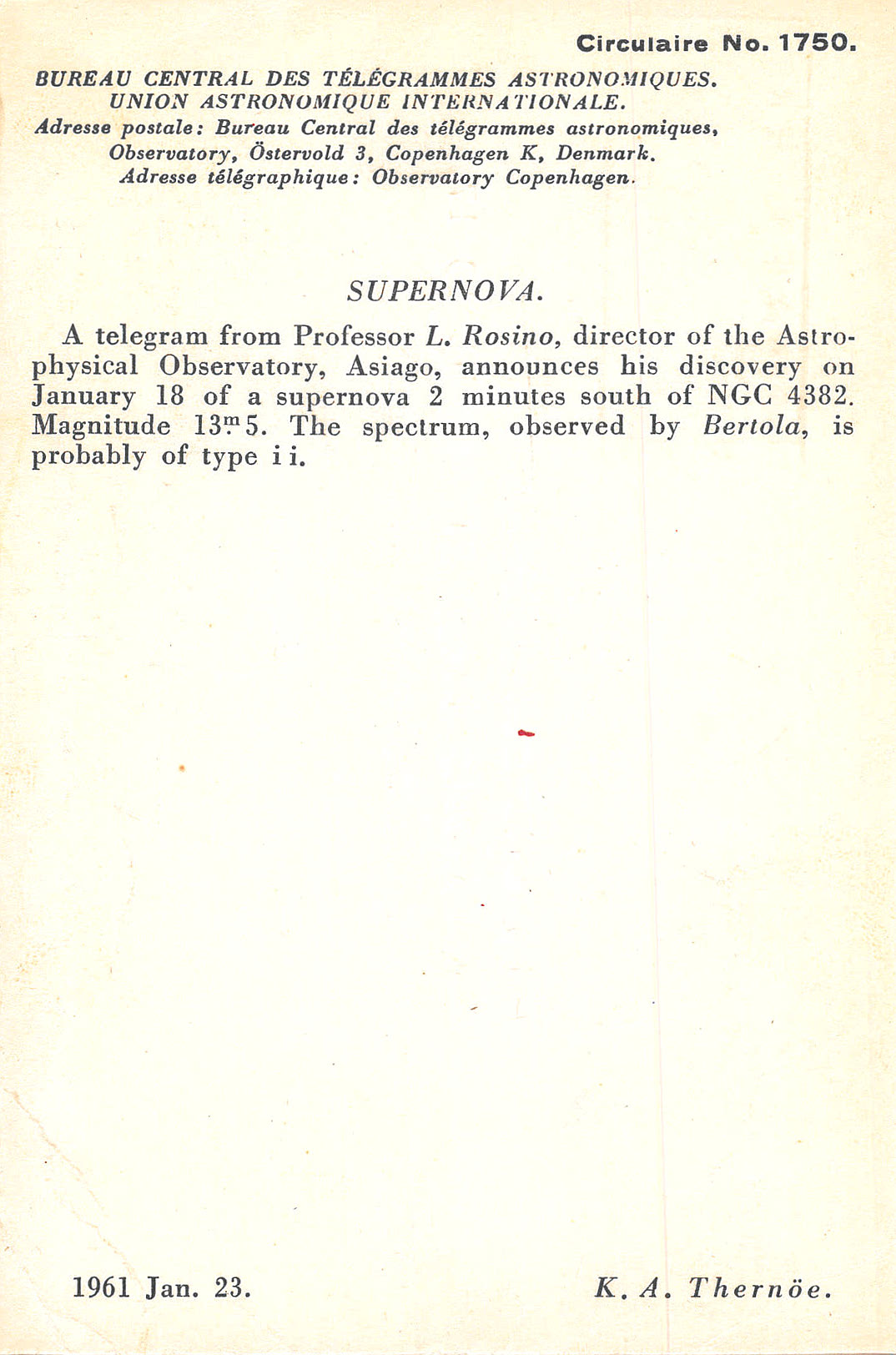
- SN 1960R (Type Ia, mag. 13.5), was discovered by Howard S. Gates on 20 December 1960,[12]Template:R/superscript and independently discovered by Leonida Rosino on 18 January 1961.[13]Template:R/superscript
- M85 OT2006-1 was discovered on the outskirts of the galaxy, by the Lick Observatory Supernova Search (LOSS) on 7 January 2006. It was classified as a luminous red nova, the first to be identified as such.[14]Template:R/superscript
- SN 2020nlb (Type Ia, mag. 17.436) was discovered by the ATLAS telescope in Hawaii on 25 June 2020.[15]Template:R/superscript[16]Template:R/superscript This supernova got as bright as magnitude 12.[17]Template:R/superscript

See also
References
- ^ a b c d e f g h Page Module:Citation/CS1/styles.css has no content."Results for Messier 85". NASA/IPAC Extragalactic Database. Retrieved 18 November 2006.
- ^ Page Module:Citation/CS1/styles.css has no content.J. L. Tonry; A.Dressler; J. P. Blakeslee; E. A. Ajhar; et al. (2001). "The SBF Survey of Galaxy Distances. IV. SBF Magnitudes, Colors, and Distances". Astrophysical Journal. 546 (2): 681–693. arXiv:astro-ph/0011223. Bibcode:2001ApJ...546..681T. doi:10.1086/318301. S2CID 17628238.
- ^ Page Module:Citation/CS1/styles.css has no content."Messier 85". SEDS Messier Catalog. Retrieved 30 April 2022.
- ^ a b Page Module:Citation/CS1/styles.css has no content.Kormendy, John; Fisher, David B.; Cornell, Mark E.; Bender, Ralf (2009). "Structure and Formation of Elliptical and Spheroidal Galaxies". Astrophysical Journal Supplement. 182 (1): 216–309. arXiv:0810.1681. Bibcode:2009ApJS..182..216K. doi:10.1088/0067-0049/182/1/216. S2CID 119273143.
- ^ a b Page Module:Citation/CS1/styles.css has no content.Jarrett, T. H.; Chester, T.; Cutri, R.; Schneider, S. E.; Huchra, J. P. (2003). "The 2MASS Large Galaxy Atlas". The Astronomical Journal. 125 (2): 525. Bibcode:2003AJ....125..525J. doi:10.1086/345794.
- ^ a b c d Page Module:Citation/CS1/styles.css has no content.Escudero, Carlos G.; Cortesi, Arianna; Faifer, Favio R.; Sesto, Leandro A.; Smith Castelli, Analía V.; Johnston, Evelyn J.; Reynaldi, Victoria; Chies-Santos, Ana L.; Salinas, Ricardo; Menéndez-Delmestre, Karín; Gonçalves, Thiago S.; Grossi, Marco; Mendes De Oliveira, Claudia (2022). "The complex globular cluster system of the S0 galaxy NGC 4382 in the outskirts of the Virgo Cluster". Monthly Notices of the Royal Astronomical Society. 511 (1): 393–412. arXiv:2201.01759. Bibcode:2022MNRAS.511..393E. doi:10.1093/mnras/stac021.
- ^ a b Page Module:Citation/CS1/styles.css has no content.Hibbard, J. E.; Sansom, A. E. (2003). "A Search for H I in Five Elliptical Galaxies with Fine Structure". The Astronomical Journal. 125 (2): 667–683. arXiv:astro-ph/0211003. Bibcode:2003AJ....125..667H. doi:10.1086/345822. S2CID 14748737.
- ^ Page Module:Citation/CS1/styles.css has no content.Fisher, David; Franx, Marijn; Illingworth, Garth (1996). "Line Strengths and Line-Strength Gradients in S0 Galaxies". Astrophysical Journal. 459 (1): 110. Bibcode:1996ApJ...459..110F. doi:10.1086/176873.
- ^ Page Module:Citation/CS1/styles.css has no content.Kormendy, John; Bender, Ralf (2009). "Correlations between Supermassive Black Holes, Velocity Dispersions, and Mass Deficits in Elliptical Galaxies with Cores". Astrophysical Journal Letters. 691 (2): L142–L146. arXiv:0901.3778. Bibcode:2009ApJ...691L.142K. doi:10.1088/0004-637X/691/2/L142. S2CID 18919128.
- ^ Page Module:Citation/CS1/styles.css has no content.Gultekin, Kayhan; Richstone, Douglas O.; et al. (2011). "Is There a Black Hole in NGC 4382?". Astrophysical Journal. 741 (1): L142–L146. arXiv:1108.1808. Bibcode:2011ApJ...741...38G. doi:10.1088/0004-637X/741/1/38. S2CID 411264.
- ^ Page Module:Citation/CS1/styles.css has no content."M85, Lenticular Galaxy". Messier's Nebulae and Star Clusters. Retrieved 29 March 2009.
- ^ Page Module:Citation/CS1/styles.css has no content.Bishop, David. "Other Supernovae images, entry for SN 1960R". Rochester Astronomy. Retrieved 30 November 2024.
- ^ Page Module:Citation/CS1/styles.css has no content.Rosino, L.; Bertola (23 January 1961). Thernöe, K. A. (ed.). "SUPERNOVA". Central Bureau for Astronomical Telegrams. 1750. IAU, Observatory Copenhagen: 1. Retrieved 30 November 2024.
- ^ Page Module:Citation/CS1/styles.css has no content.Kulkarni, S. R.; Ofek, E. O.; Rau, A.; Cenko, S. B.; et al. (2007). "An unusually brilliant transient in the galaxy M85". Nature. 447 (7143): 458–460. arXiv:0705.3668. Bibcode:2007Natur.447..458K. doi:10.1038/nature05822. PMID 17522679. S2CID 4300285.
- ^ Page Module:Citation/CS1/styles.css has no content."SN 2020nlb". Transient Name Server. IAU. Retrieved 30 November 2024.
- ^ Page Module:Citation/CS1/styles.css has no content.Townsend, A.; Smith, K. W.; Srivastav, S.; McBrien, O.; Smartt, S. J.; Gillanders, J.; Clark, P.; Fulton, M.; O'Neill, D.; Young, D. R.; McCollum, M.; Chen, T. W.; Anderson, J.; Denneau, L.; Flewelling, H.; Heinze, A.; Tonry, J.; Weiland, H.; Stalder, B.; Rest, A.; Wright, D. E. (2020). "ATLAS20qoq (AT2020nlb): Discovery of a candidate SN in MESSIER 85 (17 MPC)". Transient Name Server Astronote. 126: 1. Bibcode:2020TNSAN.126....1T.
- ^ Page Module:Citation/CS1/styles.css has no content.Bishop, David. "Supernova 2020nlb in M85". Rochester Astronomy. Retrieved 30 November 2024.
External links
Page Module:Side box/styles.css has no content.Page Template:Sister project/styles.css has no content.
- Template:WikiSky
- SEDS Lenticular Galaxy M85
- Page Module:Citation/CS1/styles.css has no content.Merrifield, Michael. "M85 – Lenticular Galaxy". Deep Sky Videos. Brady Haran.
Lua error in mw.title.lua at line 404: bad argument #2 to 'title.new' (unrecognized namespace name 'Portal').
Lua error in package.lua at line 80: module 'Module:Navbox/configuration' not found.
Template:Ngc45
Template:Constellation navbox