Mount Osore
Page Module:Infobox/styles.css has no content.
| Osore-zan Bodai-ji | |
|---|---|
恐山 菩提寺 | |
| Lua error in package.lua at line 80: module 'Module:InfoboxImage/data' not found. Grounds of Bodai-ji | |
| Religion | |
| Affiliation | Buddhism |
| Sect | Sōtō Zen |
| Deity | Jizō Bosatsu |
| Location | |
| Location | 3-2 Tanabu Usoriyama, Mutsu-shi, Aomori-ken |
| Country | Japan |
| Lua error in Module:Location_map at line 526: Unable to find the specified location map definition: "Module:Location map/data/Japan Aomori Prefecture" does not exist. | |
| Script error: No such module "Infobox mapframe". | |
| Coordinates | Lua error: callParserFunction: function "#coordinates" was not found. |
| Architecture | |
| Founder | Ennin |
| Established | 862 |
Script error: No such module "Nihongo". is the name of a Buddhist temple and folk religion pilgrimage destination in the center of remote Shimokita Peninsula of Aomori Prefecture, in the northern Tōhoku region of northern Japan. The temple is located in the caldera of an active volcano and is believed in Japanese mythology to be one of the gates to the underworld.
Etymology
The name originally comes from the Ainu language, with the form later phonetically changed when borrowed into the Japanese language to match the Japanese word osore (Script error: No such module "Lang".), meaning "dread", likely due to the desolation of the volcanic landscape.[1] The Ainu name for the area may have been usori[1] (of indeterminate meaning), or ushoro ("gulf, large bay", possibly in reference to Mutsu Bay)[2][3] or possibly even usat oro nupuri ("mountain in cinders", a name recorded in some of the stories about Ennin).[2][4][5][6]
Osorezan volcano
The Script error: No such module "Nihongo". is a series of eight somma volcanos ranging from east to west in the centre of Shimokita Peninsula. Mt. Kamafuse, the highest mountain in the range, has a height of 878 metres (2,881 ft). Although the Osorezan volcano`s last magma eruption took place over 10,000 years ago,[7] the area has many fumaroles emitting steam and volcanic gases (especially sulfur dioxide), indicating that it is still an active volcano. Lake Usori is a caldera lake at the center of the volcanic range, with highly acidic waters.[8]
During the Meiji period, sulphur deposits in the area were exploited, partly to meet the demand for gunpowder production by the growing Japanese military; however the deposits were not economical to mine due to the remoteness of the site and the increasing availability of sulphur as a byproduct of petroleum refining.
Bodai-ji temple and pilgrimage location
The mountain is the location of a Sōtō Zen Buddhist temple, Script error: No such module "Nihongo"., which claims to have been founded in 862 AD by the famed monk Ennin, with Jizō Bosatsu as its main image. The temple was abandoned in 1457 and restored back to use in 1530.[9] In popular folk religion, the otherworldly setting of Mount Osore, with its charred landscape of blasted rocks filled with bubbling pits noted for unearthly hues and noxious fumes came to be one of several places in Japan identified to be an entrance to the Underworld. A small brook running to the neighboring Lake Usori was equated to the Sanzu River, a river that deceased souls need to cross on their way to the afterlife.
A unique feature of Bodai-ji is the presence of mediums known as itako who claim to summon the souls of the dead and deliver messages in their voices. These mediums were traditionally blind and had to receive extensive spiritual training and purification rituals; however, in modern times, their number has dwindled and not all are blind. The temple has a twice-yearly Itako Taisai festival held in summer and autumn.
The temple also maintains a hot spring resort for use by pilgrims and tourists.
In modern culture
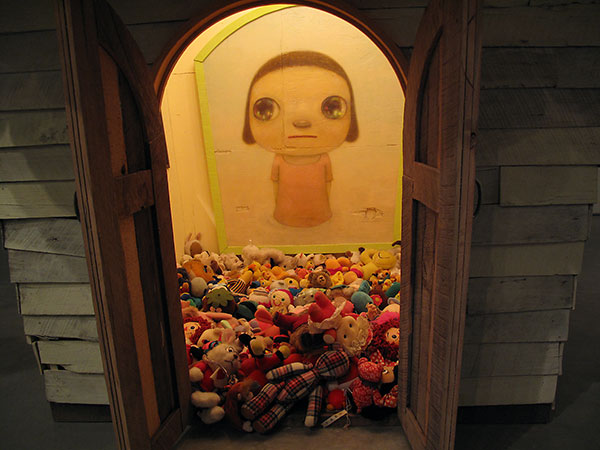
The work of contemporary artist Nara Yoshitomo, who is a native of Aomori Prefecture, is believed to be influenced, at least subconsciously, by Mount Osore (Ivy, 2010). For instance, his piece entitled “Not Everything But/ Green House” depicts a small female child standing over a pile of discarded dolls of varying characteristics and eras much like those observed at Mount Osore.[10]
As part of a collection of fictional fungi, artist Takeshi Yamada created the Oh-dokuro-dake (or “skull mushroom”) and the story surrounding their presence on Mount Osore for his "center for medical mycology" art project.[11]
Gallery
-
Sōmon gate of Bodai-ji
-
Sammon gate of Bodai-ji
-
Lake Usori
-
Effigy of a child
Notes
Page Template:Reflist/styles.css has no content.
- ^ a b Page Module:Citation/CS1/styles.css has no content.Chris Bamforth (22 December 2006). "Mountain of dread". The Japan Times. Retrieved 10 February 2020.
- ^ a b Page Module:Citation/CS1/styles.css has no content."恐山 (Osore-san)". Nihon Jiten (in 日本語). 2017. Retrieved 21 August 2024.
- ^ Page Module:Citation/CS1/styles.css has no content.John Batchelor (1905). "ush-oro". An Ainu-English-Japanese dictionary (including a grammar of the Ainu language). Retrieved 21 August 2024.
- ^ Page Module:Citation/CS1/styles.css has no content.John Batchelor (1905). "usat". An Ainu-English-Japanese dictionary (including a grammar of the Ainu language). Retrieved 21 August 2024.
- ^ Page Module:Citation/CS1/styles.css has no content.John Batchelor (1905). "oro". An Ainu-English-Japanese dictionary (including a grammar of the Ainu language). Retrieved 21 August 2024.
- ^ Page Module:Citation/CS1/styles.css has no content.John Batchelor (1905). "nupuri". An Ainu-English-Japanese dictionary (including a grammar of the Ainu language). Retrieved 21 August 2024.
- ^ The Smithsonian Museum of Natural History states that an eruption occurred in 1787, but this is not corroborated by Japanese sources
- ^ Page Module:Citation/CS1/styles.css has no content."Osore Zan". Geological Survey of Japan. Retrieved 6 June 2020.
- ^ Page Module:Citation/CS1/styles.css has no content."About Mount Osore - Aomori Travel Guide | Planetyze". Planetyze. Retrieved 2017-11-08.
- ^ A picture of this piece while at the Marianne Boesky Gallery in March 2009 may be seen here.
- ^ Page Module:Citation/CS1/styles.css has no content.Takeshi Yamada. "Center for Medical Mycology". Archived from the original on 2015-06-26. Retrieved 2015-06-26.
References
- Fackler, M. (2009, August 20). As Japan's mediums die, ancient tradition fades. The New York Times, p. 8, Retrieved from https://www.nytimes.com
- Global Volcanism Program. (n.d.). Osore-yama. Retrieved from http://www.volcano.si.edu/world/volcano.cfm?vnum=0803-29=
- Ivy, M. (2010). The art of cute little things: Nara Yoshitomo's parapolitics. Mechademia, 5(1), 3-29. doi:10.1353/mec.2010.0020
- Wonderland Japan WAttention. (n.d.). Mt. Osore. Retrieved from https://www.webcitation.org/6Bp5xzjwO?url=http://www.wattention.com/archives/mt-osore
- Yamada, T. (2011, June). Skull mushroom. Retrieved from https://www.flickr.com/photos/museumofworldwonders2/5725108088
External links
Page Module:Side box/styles.css has no content.Page Template:Sister project/styles.css has no content.
Page Module:Side box/styles.css has no content.Page Template:Sister project/styles.css has no content.
Lua error in package.lua at line 80: module 'Module:Authority control/config' not found.