Multi-Object Spectrometer
A multi-object spectrometer is a type of optical spectrometer capable of simultaneously acquiring the spectra of multiple separate objects in its field of view.[1] It is used in astronomical spectroscopy and is related to long-slit spectroscopy.[2] This technique became available in the 1980s.[3]
Description
The term multi-object spectrograph is commonly used for spectrographs using a bundle of fibers to image part of the field. The entrance of the fibers is at the focal plane of the imaging instrument. The bundle is then reshaped; the individual fibers are aligned at the entrance slit of a spectrometer, dispersing the light on a detector.[1]
This technique is closely related to integral field spectrography (IFS), more specifically to fiber-IFS. It is a form of snapshot hyperspectral imaging, itself a part of imaging spectroscopy.
Apertures
Page Module:Infobox/styles.css has no content.
| External image | |
|---|---|
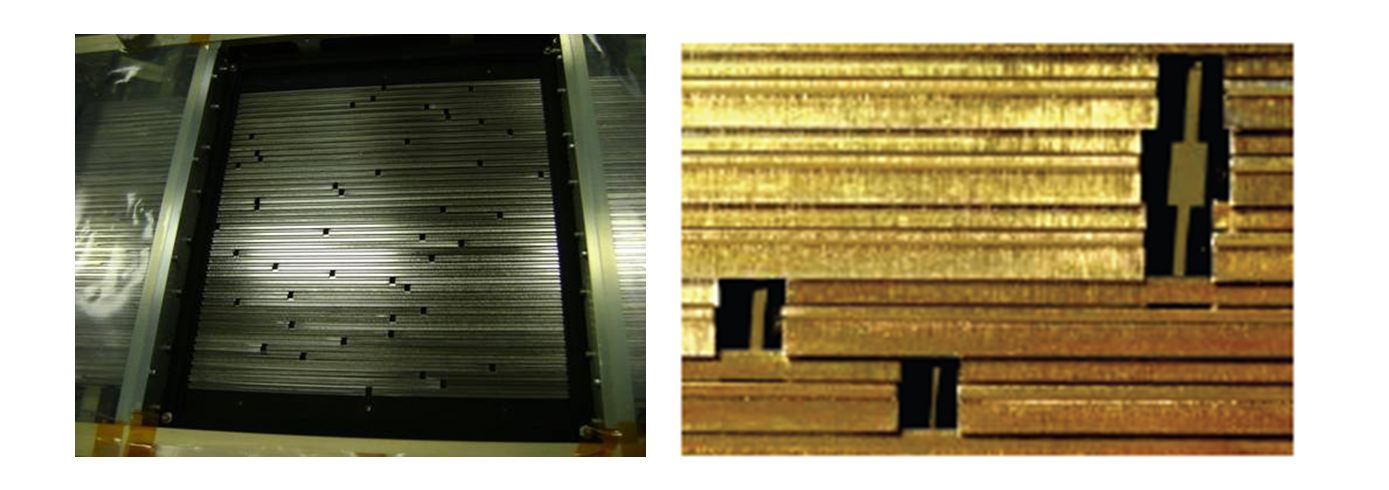
| image icon Photographs of the Configurable Slit Unit on MOSFIRE Left: full picture, in a configuration for imaging. Right: close-up on the knife-edge slits.[4][5] |
Typically, the apertures of multi-object spectrographs can be modified to fit the needs of the given observation.[6]
For example, the MOSFIRE (Multi-Object Spectrometer for Infra-Red Exploration )[7] instrument on the W. M. Keck Observatory contains the Configurable Slit Unit (CSU)[8] allowing arbitrary positioning of up to forty-six 18 cm slits by moving opposable bars.[5]
Some fiber-fed spectroscopes, such as the Large Sky Area Multi-Object Fibre Spectroscopic Telescope (LAMOST) can move the fibers to desired position. The LAMOST moves its 4000 fibers separately within designated areas for the requirements of a measurement, and can correct positioning errors in real time.[9]
The James Webb Space Telescope uses a fixed Micro-Shutter Assembly (MSA), an array of nearly 250000 5.1 mm by 11.7 mm shutters that can independently be opened or closed to change the location of the open slits on the device.[10]
Uses in telescopes
Ground-based instruments
Instruments with multi-object spectrometry capabilities are available on most 8-10 meter-class ground-based observatories.[6] For example, the Large Binocular Telescope,[11] W. M. Keck Observatory,[12] Gran Telescopio Canarias,[13] Gemini Observatory,[14] New Technology Telescope,[15] William Herschel Telescope,[16] UK Schmidt Telescope[17] and LAMOST[3] include such system.
Four instruments in the Very Large Telescope, including the KMOS (K-band multi-object spectrograph)[18] and the VIMOS (Visible Multi Object Spectrograph)[19] instruments, have multi-object spectroscopic capabilities.
Space-based instruments
The Hubble Space Telescope has been operating the NICMOS (Near Infrared Camera and Multi-Object Spectrometer)[20] from 1997 to 1999 and from 2002 to 2008.
The James Webb Space Telescope's NIRSpec (Near-Infrared Spectrograph) instrument is a multi-object spectrometer.[21]
References
Page Template:Reflist/styles.css has no content.
- ^ a b Page Module:Citation/CS1/styles.css has no content."multi-object spectrograph". astro.vaporia.com. Retrieved 2023-08-07.
- ^ Page Module:Citation/CS1/styles.css has no content."Multi Object Spectroscopy (decommissioned)". eso.org. European Southern Observatory. Retrieved 2023-08-07.
- ^ a b Page Module:Citation/CS1/styles.css has no content.Chu, Yaoquan. The Large Sky Area Multi-Object Fibre Spectroscopy Telescope ( LAMOST) Project. Conference of the Working Group of IAU Commission 9 on “Wide-Field Imaging” held in Athens, Greece, May 20–25, 1996. Springer Dordrecht. doi:10.1007/978-94-011-5722-3_9.
- ^ Page Module:Citation/CS1/styles.css has no content.Goodrich, Bob; Adkins, Sean (2011). "The Imminent Arrival of MOSFIRE, Keck's New Infrared, Multi-Object, Imaging Spectrograph". Keck Observers' Newsletter (10).
- ^ a b Page Module:Citation/CS1/styles.css has no content.McLean, Ian S.; Steidel, Charles C.; Harland, Epps; Matthews, Keith; Adkins, Sean; Konidaris, Nicholas; Weber, Bob; Aliado, Ted; Brims, George; Canfield, John; Cromer, John; Fucik, Jason; Kulas, Kristin; Mace, Greg; Magnone, Ken; Rodriguez, Hector; Wang, Eric; Weiss, Jason (2010-07-20). McLean, Ian S.; Ramsay, Suzanne K.; Takami, Hideki (eds.). "Design and development of MOSFIRE: the multi-object spectrometer for infrared exploration at the Keck Observatory" (PDF). SPIE Conference Proceedings. Ground-based and Airborne Instrumentation for Astronomy III. 7735. SPIE: 77351E. Bibcode:2010SPIE.7735E..1EM. doi:10.1117/12.856715. S2CID 122823326.
- ^ a b Page Module:Citation/CS1/styles.css has no content."JWST Multi-Object Spectroscopy". JWST User Documentation. 2022-10-17. Retrieved 2023-08-07.
- ^ Page Module:Citation/CS1/styles.css has no content."MOSFIRE Home Page". www2.keck.hawaii.edu. 2020-10-07. Retrieved 2023-08-07.
- ^ Page Module:Citation/CS1/styles.css has no content."Multi-Object Spectrometer for Infra-Red Exploration First Light Obtained: April 4, 2012". irlab.astro.ucla.edu. Retrieved 2023-08-07.
- ^ Page Module:Citation/CS1/styles.css has no content."Fiber positioning". lamost.org. 2012-08-14. Retrieved 2023-08-07.
- ^ Page Module:Citation/CS1/styles.css has no content."NIRSpec Micro-Shutter Assembly". jwst-docs.stsci.edu. 2023-04-24. Retrieved 2023-08-07.
- ^ Page Module:Citation/CS1/styles.css has no content."Instruments - an overview". Large Binocular Telescope Observatory. Retrieved 2023-08-07.
- ^ Page Module:Citation/CS1/styles.css has no content."Keck I And Keck II Telescopes". W. M. Keck Observatory. Retrieved 2023-08-07.
- ^ Page Module:Citation/CS1/styles.css has no content."MEGARA". Gran Telescopio CANARIAS. 2023-05-08. Retrieved 2023-08-07.
- ^ Page Module:Citation/CS1/styles.css has no content."The GMOS (Gemini Multi-Object Spectrograph) project at the ATC". 2003-09-12. Retrieved 2023-08-07.
- ^ Page Module:Citation/CS1/styles.css has no content."EFOSC Overview". eso.org. European Southern Observatory. Retrieved 2023-08-07.
- ^ Page Module:Citation/CS1/styles.css has no content."WEAVE - instrumental overview". ing.iac.es. 2023-07-05. Retrieved 2023-08-07.
- ^ Page Module:Citation/CS1/styles.css has no content."The UK Schmidt Telescope". aat.anu.edu.au. 21 May 2014. Retrieved 2023-08-07.
- ^ Page Module:Citation/CS1/styles.css has no content."KMOS - K-band Multi Object Spectrograph". eso.org. European Southern Observatory. Retrieved 2023-08-07.
- ^ Page Module:Citation/CS1/styles.css has no content."VIMOS - VIsible MultiObject Spectrograph". eso.org. European Southern Observatory. Retrieved 2023-08-07.
- ^ Page Module:Citation/CS1/styles.css has no content."Hubble's Instruments: NICMOS - Near Infrared Camera and Multi-Object Spectrometer". esahubble.org. Retrieved 2023-08-07.
- ^ Page Module:Citation/CS1/styles.css has no content."NIRSpec Multi-Object Spectroscopy". JWST User Documentation. 2023-04-24. Retrieved 2023-08-07.