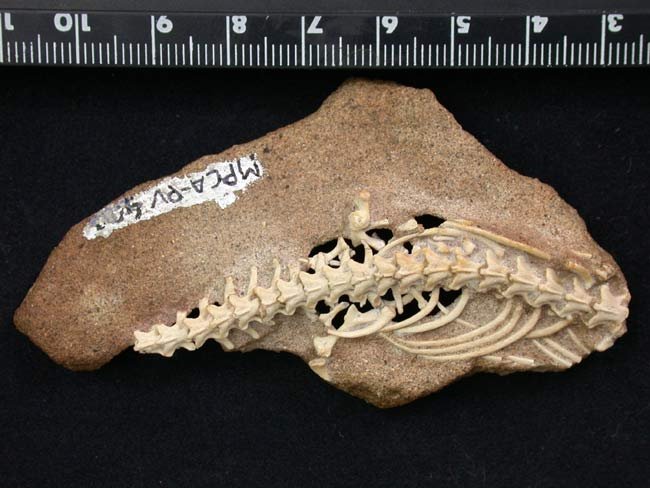
Najash
Template:Short description Script error: No such module "Automated taxobox".
Najash is an extinct genus of basal snake from the Late Cretaceous Candeleros Formation of Patagonia.[1] Like a number of other Cretaceous and living snakes it retained hindlimbs, but Najash is unusual in having well-developed legs that extend outside the rib cage, and a pelvis connected to the spine.
Discovery and description
Fossils of Najash were found in the terrestrial Candeleros Formation, in Rio Negro Province, Argentina, and date to roughly 90 million years ago. The skull and spine of Najash show primitive features that resemble other Cretaceous snakes, such as Dinilysia patagonica and Madtsoiidae.[2] Also, several characteristics of the neck and tail of Najash and Dinilysia patagonica show how the body plan of snakes evolved from a lizard-like ancestor.[3]
Najash had not lost its sacrum, the pelvic bone composed of several fused vertebrae, nor its pelvic girdle, which are absent in modern snakes, and in all other known fossil snakes as well.[4] Nearly all phylogenetic analyses place Najash as an early offshoot of the snake tree, outside of all living snakes.[1][2][3][5]
Ecology
The cranial morphology of Najash suggests that it had only limited unilateral movements of the mandibles, and lacked the attributes of macrostomatan snakes to ingest large prey, Apesteguía suggests, presumably based on the associated fauna, that this snake preyed on a variety of small vertebrates, such as ‘lizards’, micro-mammals and dinosaur hatchlings. This assumption is well supported by the snake body size.[6]
References
Page Template:Reflist/styles.css has no content.
- ^ a b Page Module:Citation/CS1/styles.css has no content.Apesteguía, S.; Zaher, H. (2006). "A Cretaceous terrestrial snake with robust hindlimbs and a sacrum". Nature. 440 (7087): 1037–1040. Bibcode:2006Natur.440.1037A. doi:10.1038/nature04413. PMID 16625194. S2CID 4417196.
- ^ a b Page Module:Citation/CS1/styles.css has no content.Garberoglio, Fernando F.; Gómez, Raúl O.; Apesteguía, Sebastián; Caldwell, Michael W.; Sánchez, María L.; Veiga, Gonzalo (2019-02-04). "A new specimen with skull and vertebrae of Najash rionegrina (Lepidosauria: Ophidia) from the early Late Cretaceous of Patagonia". Journal of Systematic Palaeontology. 17 (18): 1313–1330. Bibcode:2019JSPal..17.1533G. doi:10.1080/14772019.2018.1534288. ISSN 1477-2019. S2CID 91780191.
- ^ a b Page Module:Citation/CS1/styles.css has no content.Garberoglio, Fernando F.; Gómez, Raúl O.; Simões, Tiago R.; Caldwell, Michael W.; Apesteguía, Sebastián (2019). "The evolution of the axial skeleton intercentrum system in snakes revealed by new data from the Cretaceous snakes Dinilysia and Najash". Scientific Reports. 9 (1): 1276. Bibcode:2019NatSR...9.1276G. doi:10.1038/s41598-018-36979-9. ISSN 2045-2322. PMC 6362196. PMID 30718525.
- ^ Other known fossil snakes with developed hindlimbs, Haasiophis, Pachyrhachis and Eupodophis—all found in marine environments—all lack a sacral region.
- ^ Page Module:Citation/CS1/styles.css has no content.Longrich, N. R.; Bhullar, B.-A. S.; et al. (2012). "A transitional snake from the Late Cretaceous period of North America" (PDF). Nature. 488 (7410): 205–208. Bibcode:2012Natur.488..205L. doi:10.1038/nature11227. PMID 22832579. S2CID 4411744.
- ^ Page Module:Citation/CS1/styles.css has no content.Adriana M. Albino (2011). "Evolution of Squmata Reptiles in Patagonia based on the fossil record". Biological Journal of the Linnean Society. 103 (2): 441–457. doi:10.1111/j.1095-8312.2011.01691.x.
External links
Lua error in package.lua at line 80: module 'Module:Navbox/configuration' not found.
Script error: No such module "Taxonbar". Lua error in mw.title.lua at line 404: bad argument #2 to 'title.new' (unrecognized namespace name 'Portal').