Pinball Wizard
Template:Short description Template:For multi Template:DMCA Template:DMCA
Page Template:Hlist/styles.css has no content.Page Template:Plainlist/styles.css has no content.Page Module:Infobox/styles.css has no content.
| "Pinball Wizard" | ||||
|---|---|---|---|---|
| Lua error in package.lua at line 80: module 'Module:InfoboxImage/data' not found. Continental European picture sleeve | ||||
| Template:Infobox song/link by the Who | ||||
| from the album Tommy | ||||
| B-side | "Dogs Part Two" | |||
| Released | Script error: No such module "Date time". | |||
| Recorded | 7 February 1969 | |||
| Studio | Morgan, London | |||
| Genre | ||||
| Length | Script error: No such module "hms". | |||
| Label | Track (UK) Decca (US) | |||
| [[Songwriter|SongwriterTemplate:Pluralize from text]] | Pete Townshend | |||
| [[Record producer|ProducerTemplate:Pluralize from text]] | Kit Lambert | |||
| Lua error in package.lua at line 80: module 'Module:GetParameters' not found. singles chronology | ||||
| ||||
| Script error: No such module "Unsubst-infobox".
Script error: No such module "Unsubst-infobox". Page Module:Infobox/styles.css has no content. | ||||
| Alternative release | ||||
| Page Module:Infobox/styles.css has no content. | ||||
| Lua error in package.lua at line 80: module 'Module:InfoboxImage/data' not found. Side A of the UK single | ||||
Script error: No such module "Check for conflicting parameters".
"Pinball Wizard" is a song by the English rock band the Who, written by guitarist and primary songwriter Pete Townshend and featured on their 1969 rock opera album Tommy. The original recording was released as a single in 1969 and reached No. 4 in the UK charts and No. 19 on the U.S. Billboard Hot 100.
The B-side of the "Pinball Wizard" single is an instrumental credited to Keith Moon, titled "Dogs Part Two". Despite the title, it has no musical connection to the Who's 1968 UK single "Dogs".
Story
The lyrics are written from the perspective of a pinball champion, called "Local Lad" in the Tommy libretto book, astounded by the skills of the opera's eponymous main character, Tommy Walker: "He ain't got no distractions / Can't hear those buzzers and bells / Don't see no lights a flashin' / Plays by sense of smell / Always gets a replay / Never seen him fall / That deaf dumb and blind kid / Sure plays a mean pinball.",[3] and "I thought I was the Bally table king, but I just handed my pinball crown to him".
Townshend once called it "the most clumsy piece of writing [he'd] ever done".[4] Nevertheless, the song was a commercial success and remains one of the most recognised tunes from the opera. It was a perpetual concert favourite for Who fans due to its pop sound and familiarity.
Position on the album
In late 1968 or early 1969, when the Who played a rough assembly of their new album to critic Nik Cohn, Cohn gave a lukewarm reaction to it. Following this, Townshend, as TommyTemplate:'s principal composer, discussed the album with Cohn and concluded that, to lighten the load of the rock opera's heavy spiritual overtones (Townshend had recently become deeply interested in the teachings of Meher Baba), the title character, a "deaf, dumb, and blind" boy, should also be particularly good at a certain game. Knowing Cohn was an avid pinball fan, Townshend suggested that Tommy would play pinball, and Cohn immediately declared Tommy to be a masterpiece.[5] The song "Pinball Wizard" was written and recorded almost immediately. The single version was slightly sped up and runs to 2:57, whilst the natural length album version runs to 3:04.
Reception
Cash Box said "Pinball Wizard" was "sensational", saying "Retaining the joyful exaltation of early pop rock, the Who add a proficiency and modernization that clicks with the accuracy of a Beatles-gone-heavy."[6] Billboard described the single as "a solid beat rocker".[7] Record World described it as an "exciting side".[8]
Live performances
This song is one of the band's most famous live songs, being played at almost every Who concert since its debut live performance on 2 May 1969. The live performances rarely deviated from the album arrangement, save for an occasional jam at the end sometimes leading to another song. Bootleg recordings show that this song has been known to last as long as eight minutes (at a concert at the Rainbow Theatre in London on 3 February 1981), although live versions lasting as long as that are extremely rare. Pinball Wizard was also played during the Super Bowl XLIV Halftime Show on 7 February 2010.
Personnel
- Roger Daltrey – lead vocals
- Pete Townshend – backing vocals, co-lead vocals, acoustic guitar, electric guitar
- John Entwistle – bass guitar
- Keith Moon – drums
Charts and certifications
Page Module:Message box/ambox.css has no content.
This section needs additional citations for verification. (December 2017) |
Page Template:Column/styles.css has no content.
Weekly charts
| Chart (1969) | Peak position |
|---|---|
| Australia Kent Music Report | 45 |
| Canada RPM Top Singles[9] | 6 |
| Finland (Soumen Virallinen)[10] | 32 |
| France | 89 |
| Germany | 25 |
| Ireland | 14 |
| Netherlands | 12 |
| New Zealand (Listener) [11] | 8 |
| South Africa (Springbok)[12] | 6 |
| Switzerland | 15 |
| UK Singles Chart[13] | 4 |
| US Billboard Hot 100[14] | 19 |
| US Cash Box Top 100[15] | 15 |
Year-end charts
| Chart (1969) | Rank |
|---|---|
| UK[16] | 47 |
Certifications
| Region | Certification | Certified units/sales |
|---|---|---|
| United Kingdom (BPI)[17] | Gold | 400,000 |
|
‡ Sales+streaming figures based on certification alone. | ||
Elton John version
Page Template:Hlist/styles.css has no content.Page Template:Plainlist/styles.css has no content.Page Module:Infobox/styles.css has no content.
| "Pinball Wizard" | ||||
|---|---|---|---|---|
| Lua error in package.lua at line 80: module 'Module:InfoboxImage/data' not found. Side A of the Philippine single | ||||
| Template:Infobox song/link by Elton John | ||||
| from the album Tommy soundtrack | ||||
| B-side | "Harmony" | |||
| Released | 12 March 1976 | |||
| Recorded | 19 April 1974 | |||
| Studio | Ramport, London | |||
| Genre | ||||
| Length | Script error: No such module "hms". | |||
| Label | ||||
| [[Songwriter|SongwriterTemplate:Pluralize from text]] | Pete Townshend | |||
| [[Record producer|ProducerTemplate:Pluralize from text]] | Gus Dudgeon | |||
| Lua error in package.lua at line 80: module 'Module:GetParameters' not found. singles chronology | ||||
| ||||
| Script error: No such module "Unsubst-infobox". Script error: No such module "Unsubst-infobox". | ||||
Script error: No such module "Check for conflicting parameters".
The song was performed by English musician Elton John in Ken Russell's 1975 film adaptation of Tommy. This version was released in 1975 as a promotional single only in the US, and in 1976 in the UK, where it reached number seven. Because it was not released as a commercial single in the US, it was ineligible to be listed on the Billboard Hot 100 chart, but did make the US Radio & Records airplay chart, where it reached number nine.
John's version uses a piano as the song's centerpiece in place of the acoustic guitar in the original. In the film, John's character, a pinball champion with extraordinarily large shoes, is shown playing his pinball machine via a small piano keyboard. He acknowledges that Tommy is a threat, but initially believes he will not be able to beat him for the championship. As the match progresses, he is soon proven wrong, and concedes defeat when Tommy maxes the score counter. His adaptation also features additional lyrics specially written by Townshend for the movie version, as well as a subtle inclusion of musical phrases from the Who's 1960s hit "I Can't Explain" during the outro. Similarly, the Who's later cover of John's "Saturday Night's Alright for Fighting" included parts of "Take Me to the Pilot". Unlike most of the soundtrack's music, which featured various combinations of the Who and some of the era's best session players, John used his own band and producer Gus Dudgeon for the track. John has performed the song as part of his Las Vegas Red Piano Show, as well as on various tours. To date, it is the only cover of a Who song to reach the top 10.[18]
John performed the song with an extended closing jam during his 1975 tour. This version appears on the 2-CD 30th Anniversary release of Captain Fantastic and the Brown Dirt Cowboy, with the live disc of the June 21, 1975 concert from Wembley Stadium.
John opened his 'Final UK Show' at the Glastonbury Festival in 2023 playing the song.
The song has subsequently been performed by Taron Egerton who portrayed John in the film Rocketman (2019).
Personnel
- Elton John – lead vocals, piano
- Davey Johnstone – acoustic and electric guitars, backing vocals
- Dee Murray – bass, backing vocals
- Nigel Olsson – drums, backing vocals
- Ray Cooper – tambourine, congas
Chart performance
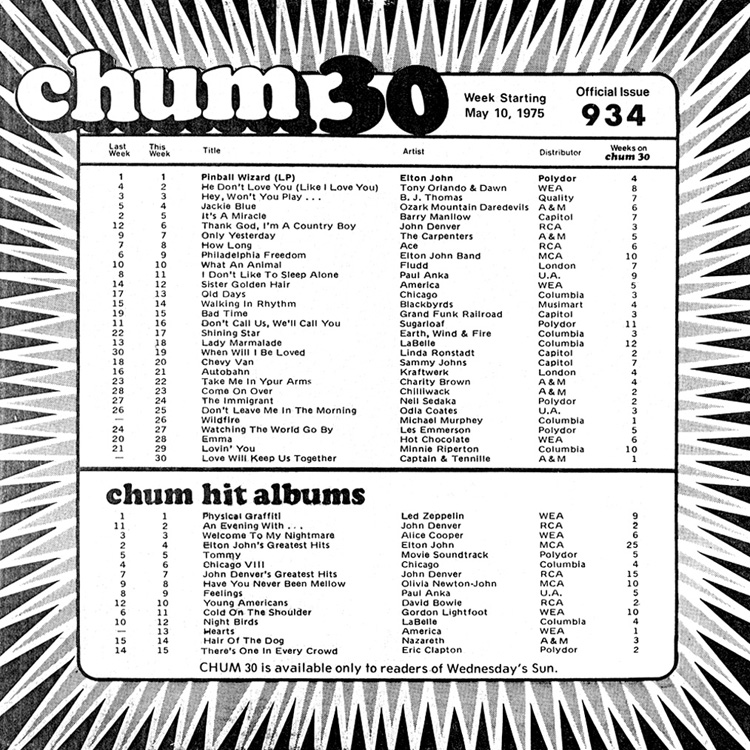
In Toronto, "Pinball Wizard" spent two weeks at number one on the CHUM survey.[19] In Chicago, "Pinball Wizard" remained on the WLS Musicradio Survey as an "extra" for five and a half months, from mid-April to late September as an album track in heavy rotation.[20]
| Chart (1976) | Peak position |
|---|---|
| Australia[21] | 88 |
| Template:Singlechart | |
| UK[22] | 7 |
| US Radio & Records[23] | 9 |
Other cover versions
- The song was featured in a medley with another song from Tommy ("See Me, Feel Me") in a recording by the British pop group the New Seekers in 1973. This version reached No.4 on the New Zealand Listener charts[24], No. 16 on the UK charts and in Australia, No. 28 in Canada,[25] and No. 29 on the U.S. Hot 100.[26]
- In 1977, Barry Williams performed the song during a "Songs from Movies" medley on an episode of The Brady Bunch Variety Hour.[27]
- Tenacious D also regularly perform the song as a part of a medley of songs from Tommy[28]
- British rock band McFly have also covered this song that was used in a promo for Two and a Half Men on Paramount Comedy in 2005.
Legacy
Bruce Springsteen makes a reference to the song in his song "4th of July, Asbury Park (Sandy)", in the album The Wild, the Innocent, & the E Street Shuffle, with the lyric "And the wizards play down on Pinball Way".[29] The track is also featured on the video games Rock Band 2, Rock Band Unplugged and Karaoke Revolution: American Idol Encore 2.[citation needed]
Using the phrase "pinball wizard" to describe a high-quality pinball player is common, both in works of media and among the general public. Several pinball tables feature a "wizard mode", a state of play which is meant to be reached only by skilled players. Within the pinball community, the phrase's use is sometimes controversial: this is primarily due to its ubiquity, with many players having become tired of hearing it.[5]
Several pinball machines have been produced with a "Pinball Wizard" theme. Two of these, produced at the time of the Tommy feature film's release, have only an oblique relation to the song: Wizard was wholly unlicensed, only taking inspiration from the song and film, while Capt. Fantastic and the Brown Dirt Cowboy, a table ostensibly with an Elton John licence, used the singer's likeness as he appeared in the film, where he played the "Pinball Wizard". Both of these machines were produced in the mid-1970s by Bally Manufacturing. Two decades later, Data East Pinball also produced The Who's Tommy Pinball Wizard, a licensed machine capitalising on the album's stage adaptation.[5]
References
Page Template:Reflist/styles.css has no content.
- ^ Page Module:Citation/CS1/styles.css has no content.Bosso, Joe (11 May 2016). "The 25 Greatest Acoustic Songs in Hard Rock". Guitar Player. NewBay Media. Retrieved 5 August 2016.
- ^ Page Module:Citation/CS1/styles.css has no content.Stanley, Bob (13 September 2013). Yeah Yeah Yeah: The Story of Modern Pop. Faber & Faber. p. 348. ISBN 978-0-571-28198-5.
- ^ Page Module:Citation/CS1/styles.css has no content."Pinball Wizard Lyrics". lyrics.com.
- ^ Remaster Liner Notes to Tommy "Deaf, Dumb and Blind kid" by Richard Barnes
- ^ a b c Page Module:Citation/CS1/styles.css has no content.Alsheimer, Colin. "Are You a Pinball Wizard? Everything You Ever Wanted to Know About a Pinhead's Least Favorite Phrase". Kineticist.
- ^ Page Module:Citation/CS1/styles.css has no content."CashBox Record Reviews" (PDF). Cash Box. 22 March 1969. p. 18. Retrieved 9 May 2023.
- ^ Page Module:Citation/CS1/styles.css has no content."Spotlight Singles" (PDF). Billboard. 22 March 1969. p. 71. Retrieved 20 February 2021.
- ^ Page Module:Citation/CS1/styles.css has no content."Single Picks of the Week" (PDF). Record World. 22 March 1969. p. 1. Retrieved 9 May 2023.
- ^ Page Module:Citation/CS1/styles.css has no content."Item Display – RPM – Library and Archives Canada". Collectionscanada.gc.ca. 26 May 1969. Retrieved 1 July 2019.
- ^ Page Module:Citation/CS1/styles.css has no content.Nyman, Jake (2005). Suomi soi 4: Suuri suomalainen listakirja (in suomi) (1st ed.). Helsinki: Tammi. p. 135. ISBN 951-31-2503-3.
- ^ Page Module:Citation/CS1/styles.css has no content."Flavour of New Zealand - search listener". Flavourofnz.co.nz. Retrieved 5 December 2025.
- ^ Page Module:Citation/CS1/styles.css has no content."SA Charts 1965 – March 1989". Retrieved 5 September 2018.
- ^ Page Module:Citation/CS1/styles.css has no content."Official Singles Chart on 23/4/1969". Official Charts. 12 November 2021. Retrieved 28 January 2026.
- ^ [Joel Whitburn's Top Pop Singles 1955–2002]
- ^ Page Module:Citation/CS1/styles.css has no content."Cash Box Top 100 5/31/69". Cashboxmagazine.com. 30 June 2016.
- ^ Page Module:Citation/CS1/styles.css has no content."Sixties City – Pop Music Charts – Every Week of the Sixties". Sixtiescity.net.
- ^ Script error: No such module "cite". Select singles in the Formats field. Type Pinball Wizard Who in the "Search:" field.
- ^ Page Module:Citation/CS1/styles.css has no content.Sexton, Paul (20 March 2018). "Elton John Sure Played A Mean Cover Of 'Pinball Wizard'".
- ^ Page Module:Citation/CS1/styles.css has no content."CHUM Hit Parade". Chumtribute.com. 10 May 1975. Retrieved 27 May 2026.
- ^ Page Module:Citation/CS1/styles.css has no content."wls092775". Oldiesloon.com. Retrieved 27 May 2026.
- ^ Page Module:Citation/CS1/styles.css has no content.Kent, David (1993). Australian Chart Book 1970–1992 (doc). Australian Chart Book, St Ives, N.S.W. ISBN 0-646-11917-6.
- ^ Page Module:Citation/CS1/styles.css has no content."pinball+wizard – full Official Chart History – Official Charts Company". Official Charts Company.
- ^ Page Module:Citation/CS1/styles.css has no content.Whitburn, Joel (2019). Radio & Records Top Pop Hits 1973–2009. Sheridan Books. p. 70. ISBN 978-0-89820-231-1.
- ^ Page Module:Citation/CS1/styles.css has no content."Flavour of New Zealand - search listener". Flavourofnz.co.nz. Retrieved 4 December 2025.
- ^ Page Module:Citation/CS1/styles.css has no content."RPM Top 100 Singles – May 5, 1973" (PDF).
- ^ Page Module:Citation/CS1/styles.css has no content.Whitburn, Joel (2013). Joel Whitburn's Top Pop Singles, 14th Edition: 1955-2012. Record Research. p. 611.
- ^ Page Module:Citation/CS1/styles.css has no content.Nichelson, Ted (2009). Love to Love You Bradys: The Bizarre Story of the Brady Bunch Variety Hour. ECW Press. p. 291. ISBN 9781550228885.
- ^ Page Module:Citation/CS1/styles.css has no content."Tenacious D Dig Into Who Catalog for Concert Medley". Ultimate Classic Rock. 30 June 2012.
- ^ Page Module:Citation/CS1/styles.css has no content."Bruce Springsteen Lyrics database : 4th of July, Asbury Park (Sandy)". brucespringsteen.it. Retrieved 29 November 2016.
External links
Lua error in package.lua at line 80: module 'Module:Navbox/configuration' not found. Lua error in package.lua at line 80: module 'Module:Navbox/configuration' not found. Lua error in package.lua at line 80: module 'Module:Navbox/configuration' not found. Lua error in package.lua at line 80: module 'Module:Authority control/config' not found.