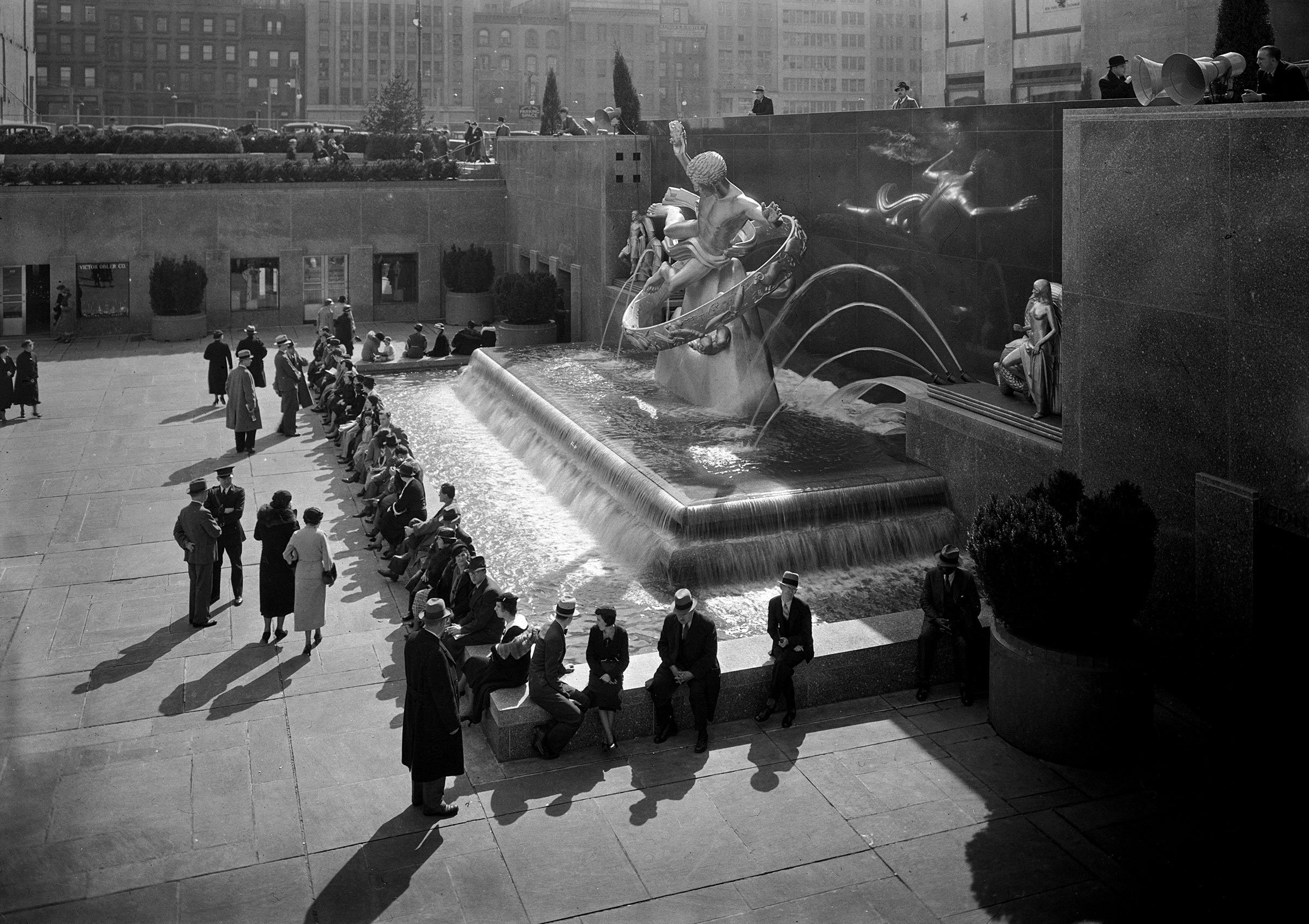
Prometheus (Manship)
Template:Short description Template:DMCA
Page Module:Infobox/styles.css has no content.
| Prometheus | |
|---|---|
| Lua error in package.lua at line 80: module 'Module:InfoboxImage/data' not found. The sculpture in 2013 | |
| Script error: No such module "Infobox mapframe". | |
| Artist | Paul Manship |
| Year | Script error: No such module "Date time". |
| Type | Sculpture |
| Medium | Bronze |
| Dimensions | 5.5 m (18 ft) |
| Location | New York City, New York, United States |
| Coordinates | Lua error: callParserFunction: function "#coordinates" was not found. |
Script error: No such module "Check for conflicting parameters".
Prometheus is a 1934 gilded, cast bronze sculpture by Paul Manship, located above the lower plaza at Rockefeller Center in Manhattan, New York City.[1]
It was created by the Roman Bronze Works, a subsidiary of the General Bronze Corporation in Corona, Queens.[2][3][4][5][6][7] The Roman Bronze Works had long been a sub-contractor to Louis Comfort Tiffany's Tiffany Studios[8] which was then bought out by the General Bronze Corporation in 1928.[2][9][10] Under the ownership of General Bronze, the Roman Bronze Works produced some of its finest bronze artwork from sculptors like Paul Manship, Rene Chambellan, Gaston Lachaise and Lee Lawrie.[11][10][9]
The "Prometheus" is set against the west wall of a sunken plaza in front of 30 Rockefeller Plaza, and what was once the RCA Building. It is visible from Fifth Avenue. The "Prometheus Fountain," with its attendant restaurants, ice skating rink (winter), has become one of the most visited and photographed places in New York City, and certainly Rockefeller Center's most photographed, especially around Christmas time with the lighting of its Christmas Tree.[12]
The statue is Template:Cvt tall and weighs 8 tons.[13] It depicts the Greek legend of the Titan Prometheus, who was the son of the Titan Iapetus and the Oceanid Clymene, brought fire to mankind by stealing it from the Chariot of the Sun, which resulted in Zeus chaining Prometheus and sending an eagle to prey upon his continually regenerating liver.[14]
Description
The recumbent figure is in a 60-by-16-foot (18.3 by 4.9 m) fountain basin in front of a gray, rectangular wall in the Lower Plaza,[15] at the middle of Rockefeller Center.[16][17] Prometheus falls through a ring – representing the heavens, and inscribed with the signs of the zodiac - toward the earth (the mountain) and the sea (the pool).[18] The inscription – a paraphrase from Aeschylus – on the granite wall behind, reads: "Prometheus, teacher in every art, brought the fire that hath proved to mortals a means to mighty ends."[15][1]Template:Rp
Prometheus is considered the main artwork of Rockefeller Center, and is one of the complex's more well-known works. The seasonal Rockefeller Center Christmas Tree is erected above the statue every winter. During the rest of the year, Prometheus serves as the main aesthetic draw in the lower plaza's outdoor restaurant.[1]Template:Rp
Associated artworks
The statue was initially flanked by Manship's Youth and Maiden - the "Mankind Figures" - which occupied the granite shelves to the rear.[19] They were relocated to Palazzo d'Italia from 1939 to 1984 because Manship thought they did not fit visually.[15][1]Template:Rp Originally gilded, they were given a brown patina when restored. They were moved to the staircase above the skating rink in 2001, as if they are "announcing Prometheus".[20] Today their original locations are covered with plants. Four Prometheus maquettes exist: one at the Smithsonian Institution's Smithsonian American Art Museum,[21] one at the Minnesota Museum of Art, and two in private collections.[22] A full-scale replica existed at Jakarta's Grand Indonesia Shopping Town in the Entertainment District's Fountain Atrium, but it has been removed in late 2019 due to the new LED Screen display.
History
Manship's early passion for Ancient Greece's mythological heroes, most notably Heracles, can be attributed to his apprenticeships of two Danish-American brothers — Gutzon and Solon Borglum — and later to Isidore Konti.[23] It was these masters who taught Manship the classical "archaic Greek figurative sculpture which is so much more abstract than Hellenistic or Roman art, and particularly impressed Manship," according to Harry Rand.[23]
Throughout his travels to Italy and Greece during the early 1900s, Manship's drawings from that time period illustrate how he was inspired with "archaic Greek" fundamentals. He was the "first American sculptor to exalt such principles over the classical art of Phidias and Polykleitos."[23] Manship was transfixed by the archaic style and simplicity as seen in the Artemision Bronze, a statue of either Zeus or Poseidon, on display at the National Archaeological Museum in Athens, Greece.[23] Manship's "Spear Thrower"[24] and his "Atalanta," exhibit these same graceful, sublime curves, as seen in the Artemision Bronze.[23]
When he was notified by the Rockefeller Center architects that he was chosen over countless others, he wasn't surprised. It was a moment Manship had prepared himself for all his life. According to Rand, "the Rockefeller Center architects knew that he alone was the only sculptor that they could count on."[23] What had been marvelous in his "archaic" apprenticeships became magical in his Prometheus.[23]
Page Template:Quote box/styles.css has no content.
"Manship produced truly derivative work; he had studied the sculptors of other ages firsthand, and the distillate of his observations formed the elements of his style. The process Manship went through was the same "as any Greek artist who had been taught to accept the canons of art formulated by the Masters""
The sculpture was regilded in 2025.[25][26]
Models
The model for the full-scale Prometheus sculpture was Leonardo Nole (c. 1907–1998), an Italian-American lifeguard from New Rochelle who modeled for college art classes. He spent three months posing for this assignment in the spring of 1933. After World War II, he became a postal worker.[27] Manship's assistant Angelo Colombo did most of the detail work when Nole was posing. Henry Kreis, another assistant, sculpted the hair.[N 1] Artist's model Ray Van Cleef evidently posed for the original small-scale rendering that the full-scale sculpture was based on.[30]
Gallery
-
Regilding in 2011
-
Prometheus, 1934, Rockefeller Center, New York City
-
Wearing a mask during the COVID-19 pandemic in New York City
See also
Lua error in mw.title.lua at line 404: bad argument #2 to 'title.new' (unrecognized namespace name 'Portal').
References
Page Template:Reflist/styles.css has no content.
Page Template:Reflist/styles.css has no content.
- ^ a b c d Page Module:Citation/CS1/styles.css has no content.Roussel, Christine (2006). The Art of Rockefeller Center. New York: W.W. Norton & Co. pp. 101, 105. ISBN 978-0-393-06082-9.
- ^ a b Page Module:Citation/CS1/styles.css has no content."BRONZE CORPORATION BUYS TIFFANY STUDIOS; John Polachek Again in Control of Metal Working Plant Which He Once Managed". No. Business & Finance. The New York Times Publishing. The New York Times. January 31, 1928. Retrieved December 29, 2023.
- ^ Page Module:Citation/CS1/styles.css has no content."John Polachek, An Industrialist" (PDF). The New York Times. Obituaries. April 18, 1955. p. 22. Retrieved December 18, 2023.
In 1903, he became a supervisor of bronze manufacturing for Tiffany Studios. Founder of General Bronze Corporation Dies – Products Adorn Leading Buildings
- ^ Page Module:Citation/CS1/styles.css has no content.Eidelberg, Martin; McClelland, Nany (2001). Behind the Scenes of Tiffany Glassmaking: the Nash Notebooks (1st ed.). St. Martin's Press. pp. 2–10. ISBN 978-0-312-28265-3.
- ^ Page Module:Citation/CS1/styles.css has no content."A Chronology of Louis C. Tiffany and Tiffany Studios". Tiffany Studios. Retrieved December 17, 2023.
- ^ Page Module:Citation/CS1/styles.css has no content."Tiffany Studios". The Charles Hosmer Morse Museum of American Art. Retrieved December 17, 2023.
- ^ Page Module:Citation/CS1/styles.css has no content."Museum Archivist" (PDF). Archivists.org. Fort Worth, TX: Amon Carter Museum of American Art. June 2005. Retrieved December 23, 2023.
- ^ Page Module:Citation/CS1/styles.css has no content.Gray, Christopher (December 27, 1987). "Streetscapes: Tiffany Studios; In Queens, a Remembrance of a Luminous Legend". The New York Times. Retrieved September 25, 2008.
- ^ a b Page Module:Citation/CS1/styles.css has no content.Erler, Diana (August 19, 1928). "Creating a New Bronze Age". The Brooklyn Daily Eagle. p. 75. Retrieved December 28, 2023.
- ^ a b Page Module:Citation/CS1/styles.css has no content.Rosenfeld, Lucy (2002). A Century of American Sculpture: The Roman Bronze Works Foundry (1st ed.). Schiffer Publishing. p. 11. ISBN 978-0-7643-1519-0.
- ^ Page Module:Citation/CS1/styles.css has no content.General Bronze Corporation (1946). "The General Bronze Corporation and Rene Paul Chambellan". Internet Archive, Columbia University. General Bronze Corporation. Retrieved December 17, 2023.
- ^ Page Module:Citation/CS1/styles.css has no content."Rockefeller Center Christmas Tree Lighting Ceremony: Street Closures & Related Information". nyc.gov. November 27, 2018. Retrieved January 4, 2024.
- ^ Page Module:Citation/CS1/styles.css has no content."Statue in Center Plaza: Giant Figure of Prometheus Set at Rockefeller Fountain" (PDF). New York Times. 1934. ISSN 0362-4331. Retrieved November 11, 2017.
- ^ Page Module:Citation/CS1/styles.css has no content."Prometheus". Rockefeller Center. Archived from the original on April 28, 2014. Retrieved June 2, 2014.
- ^ a b c Page Module:Citation/CS1/styles.css has no content.Adams, Janet (1985). "Rockefeller Center Designation Report" (PDF). City of New York; New York City Landmarks Preservation Commission. p. 168. Archived from the original (PDF) on November 7, 2017. Retrieved December 6, 2017.
- ^ Page Module:Citation/CS1/styles.css has no content.Federal Writers' Project (1939). New York City Guide. New York: Random House. p. 336. (Reprinted by Scholarly Press, 1976, Template:ISBN; often referred to as WPA Guide to New York City.)
- ^ Page Module:Citation/CS1/styles.css has no content.Krinsky, Carol H. (1978). Rockefeller Center. Oxford University Press. p. 64. ISBN 978-0-19-502404-3.
- ^ Page Module:Citation/CS1/styles.css has no content."The story of Prometheus". Rock History.
- ^ Page Module:Citation/CS1/styles.css has no content."Photo showing the original setup". 1934. Archived from the original on June 12, 2019.
- ^ Page Module:Citation/CS1/styles.css has no content."Mankind Figures (Maiden and Youth)". Art Exhibits of NYC: Rockefeller Center. Archived from the original on July 20, 2020. Retrieved June 12, 2019.
- ^ Page Module:Citation/CS1/styles.css has no content."Prometheus". Smithsonian American Art Museum. Retrieved January 23, 2020.
- ^ Page Module:Citation/CS1/styles.css has no content."Prometheus". Shining Collection. Retrieved June 2, 2014.
- ^ a b c d e f g Page Module:Citation/CS1/styles.css has no content.Rand, Harry (1989). Paul Manship. Washington, DC: Smithsonian Institution Publishing. pp. 1–56. ISBN 0-87474-807-0. Retrieved January 4, 2024.
- ^ Page Module:Citation/CS1/styles.css has no content."Paul Manship - Javelin Thrower, 1921". nga.gov. Washington, DC: National Gallery of Art. Retrieved January 5, 2024.
Corcoran Collection (Gift of Mrs. Jefferson Patterson)
- ^ Page Module:Citation/CS1/styles.css has no content.Barron, James (October 27, 2025). "A Glistening Makeover for a Rockefeller Center Icon". The New York Times. Retrieved October 28, 2025.
- ^ Page Module:Citation/CS1/styles.css has no content.Cox, Robert (October 27, 2025). "Prometheus Shines Again: Iconic Statue with New Rochelle Connection Regilded for Rockefeller Christmas". Talk of the Sound. Retrieved October 28, 2025.
- ^ a b Page Module:Citation/CS1/styles.css has no content.Thomas, Robert McG. Jr. (February 27, 1998). "Leonardo Nole, 91, Prometheus Statue's Model". The New York Times. Retrieved January 11, 2019.
- ^ Page Module:Citation/CS1/styles.css has no content.Paul Manship: Changing Taste in America. Minnesota Museum of Art. 1985. p. 133. ISBN 978-0-934251-00-6.
He employed a number of assistants (some were to become well-known – Henry Kreis, Albert Stewart and Carl Schmitz in particular). [emphasis added]
- ^ Page Module:Citation/CS1/styles.css has no content.The New York Times Biographical Service. New York Times & Arno Press. 1998.
Most of the detail work was done by an assistant, Angelo Colombo, and another assistant, Henry Krist [sic], sculptured the hair. [A reprint of the obituary]
- ^ Page Module:Citation/CS1/styles.css has no content.Deal, Martha (May 2000). "Who Posed for the Statue of Prometheus?" (PDF). Iron Game History. Vol. 6, no. 3. pp. 34–35. Retrieved January 11, 2019 – via H.J. Lutcher Stark Center for Physical Culture and Sports.
External links
- Page Template:Sister-inline/styles.css has no content.Script error: No such module "Sister project logo". Media related to Script error: No such module "Commons link". at Wikimedia Commons
Template:Paul Manship Template:Public art in Manhattan Template:Rockefeller Center