Rubus lasiococcus
| Script error: No such module "Automated taxobox". | |
|---|---|
| Lua error in package.lua at line 80: module 'Module:InfoboxImage/data' not found. | |
| Scientific classification Edit this classification | |
| Script error: No such module "Taxobox ranks".: | <div style="display:inline" class="script error: no such module "taxobox ranks".">Template:Taxon infoTemplate:Taxon italics |
| Binomial name | |
| Template:Taxon infoTemplate:Taxon italics A.Gray 1882
| |
| Lua error in package.lua at line 80: module 'Module:InfoboxImage/data' not found. | |
| Synonyms[1] | |
| |
Page Template:Taxobox/core/styles.css has no content.Template:Taxonbar/candidateTemplate:Speciesbox/parameterCheckScript error: No such module "Check for conflicting parameters".
Rubus lasiococcus is a North American species of wild blackberry known by the common names roughfruit berry and dwarf bramble.
Description
Rubus lasiococcus is a tangling, prostrate shrub with very slender stolons spreading along the ground and rooting where their nodes come in contact with moist substrate, forming a mat. Some stems grow erect to bear flowers. The leaves are Page Template:Fraction/styles.css has no content.2.5–6.5 centimetres (1–2+1⁄2 in) wide, each deeply divided into three lobes,[2] or compound into three toothed leaflets, borne on a petiole a few cm long. The inflorescence is a solitary flower or a pair of flowers with five reflexed sepals and five white petals each up to Page Template:Fraction/styles.css has no content.1 cm (3⁄8 in) long.[2] The fruit is a densely hairy red aggregate about Page Template:Fraction/styles.css has no content.1.3 cm (1⁄2 in) across.[3][2]
Lua error in package.lua at line 80: module 'Module:Plain text' not found.
Distribution and habitat
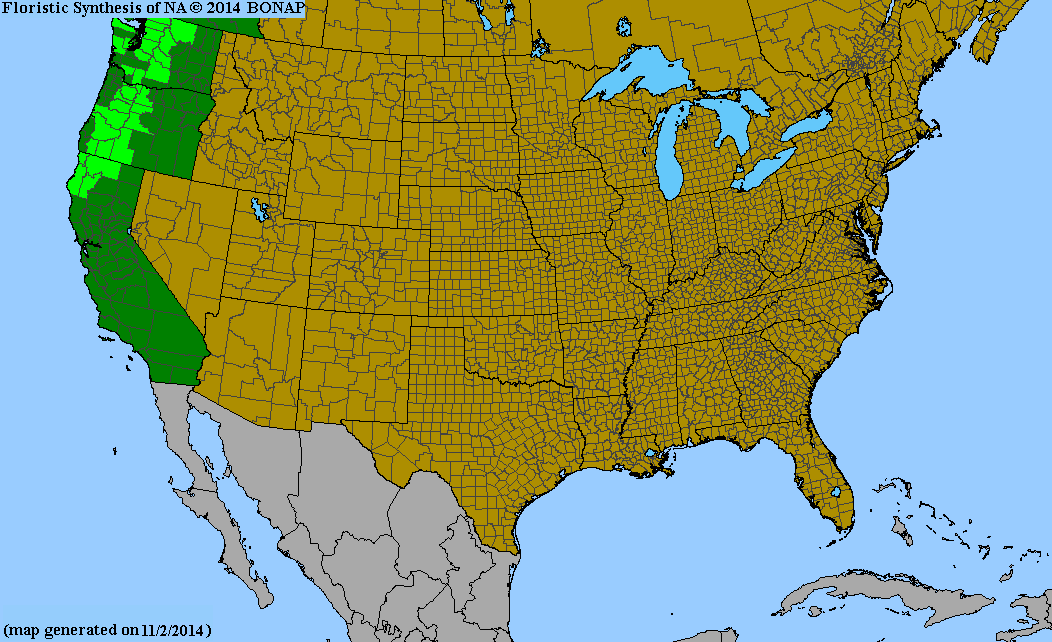
It is native to western North America from British Columbia to northern California, where it grows in mountain forests.[4][5][6] In the southern half of its range the plant is commonly found in a plant community in the understory of mountain hemlock (Tsuga mertensiana) and Shasta red fir (Abies magnifica var. shastensis).[7]
Uses
The berry is edible.[2]
References
Page Template:Reflist/styles.css has no content.
- ^ The Plant List, Rubus lasiococcus A.Gray
- ^ a b c d Page Module:Citation/CS1/styles.css has no content.Turner, Mark; Kuhlmann, Ellen (2014). Trees & Shrubs of the Pacific Northwest (1st ed.). Portland, OR: Timber Press. p. 256. ISBN 978-1-60469-263-1.
- ^ Flora of North America, Rubus lasiococcus A. Gray, 1882. Roughfruit berry
- ^ Biota of North America Program 2014 county distribution map
- ^ Calflora taxon report, University of California, Rubus lasiococcus A. Gray, rough fruit berry, roughfruit berry
- ^ Turner Photographics, Rubus lasiococcus - Wildflowers of the Pacific Northwest includes description, photos, distribution map
- ^ US Forest Service Plant Communities
External links
- Page Template:Sister-inline/styles.css has no content.Script error: No such module "Sister project logo". Media related to Script error: No such module "Commons link". at Wikimedia Commons
- Template:Wikispecies-inline
- Rubus lasiococcus in the CalPhotos photo database, University of California, Berkeley
- Template:Calflora
- Jepson Manual Treatment
- University of Washington, Seattle, Burke Museum
Script error: No such module "Taxonbar".