Solidago odora
| Script error: No such module "Automated taxobox". | |
|---|---|
| Lua error in package.lua at line 80: module 'Module:InfoboxImage/data' not found. | |
Script error: No such module "Conservation status".
| |
| Scientific classification Edit this classification | |
| Script error: No such module "Taxobox ranks".: | <div style="display:inline" class="script error: no such module "taxobox ranks".">Template:Taxon infoTemplate:Taxon italics |
| Binomial name | |
| Template:Taxon infoTemplate:Taxon italics | |
| Lua error in package.lua at line 80: module 'Module:InfoboxImage/data' not found. | |
| Synonyms[1] | |
|
Synonymy
| |
Page Template:Taxobox/core/styles.css has no content.Template:Taxonbar/candidateTemplate:Speciesbox/parameterCheckScript error: No such module "Check for conflicting parameters".
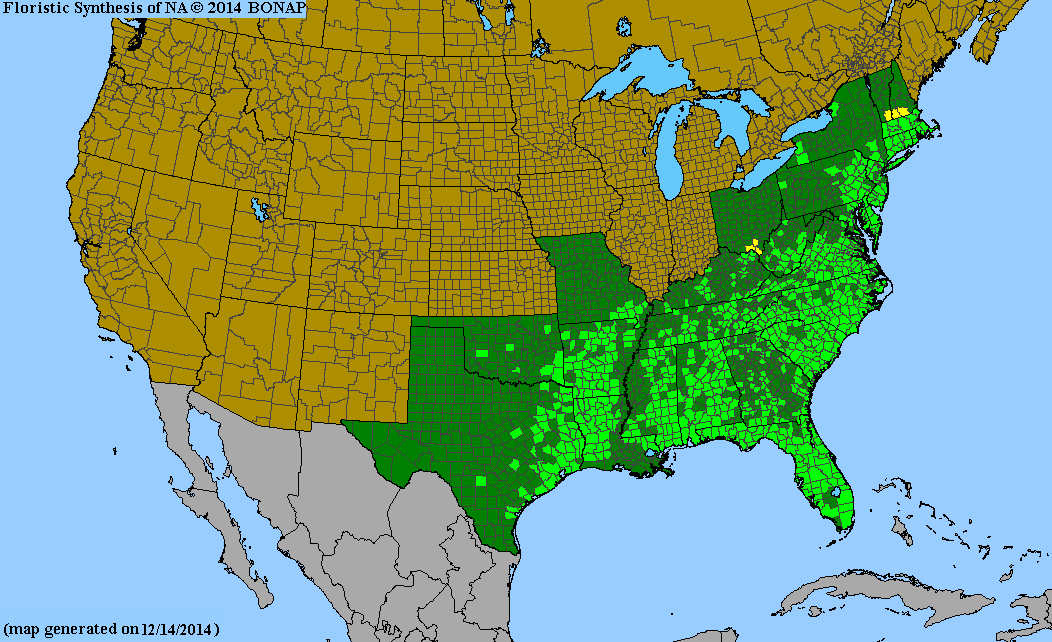
Solidago odora, the sweet goldenrod, anisescented goldenrod or fragrant goldenrod, is a North American species of goldenrod within the family Asteraceae.[3] The plant is native to the United States and Mexico, found in every coastal state from Veracruz to New Hampshire and as far inland as Ohio, Missouri, and Oklahoma.[4] It flowers from July through October.
It can be found in habitats such as live oak woodlands, loblolly pine-sweetgum stands, and slashpine savannas.[5]
- Solidago odora subsp. odora - most of species range
- Solidago odora subsp. chapmanii (Gray) Semple - Florida and Southern Georgia only
As a traditional medicine, Solidago odora has a variety of ethnobotanical uses, especially by the Cherokee.[9]
The leaves, which smell of licorice when crushed, can be made into a tea.[10]
Galls
This species is host to the following insect-induced galls:
- Eurosta lateralis (Wiedemann, 1830)
- Procecidochares atra (Loew, 1862) (summer and autumn generations)
- Calycomyza solidaginis Kaltenbach, 1869[11]
References
Page Template:Reflist/styles.css has no content.
- ^ The Plant List, Solidago odora Aiton
- ^ a b Page Module:Citation/CS1/styles.css has no content."Solidago odora". NatureServe Explorer. Retrieved 7 June 2025.
- ^ Script error: No such module "template wrapper".
- ^ Biota of North America Program 2014 county distribution map
- ^ Florida State University Robert K. Godfrey Herbarium database. URL: http://herbarium.bio.fsu.edu. Last accessed: July 2015. Collectors: Travis MacClendon, Karen MacClendon, B. Boothe, M. Boothe, Bian Tan, Brenda Herring, Jame Amoroso, Loran C. Anderson, Gwynn W. Ramsey, R.K. Godfrey, R. S. Mitchell, Paul L. Redfearn, Jr., Angus Gholson, George R. Cooley, Richard J. Eaton, James D. Ray, Jr., R L Lazor, V. I. Sullivan, A. F. Clewell, R. Kral, H. E. Grelen, Gary R. Knight, R. A. Norris, R. Komarek, Cecil R Slaughter, S. W. Leonard, R. E. Perdue, Jr., Richard D. Houk, James D. Ray, Jr., Olga Lakela, Jackie Patman, Melanie R. Darst. States and Counties: Florida: Alachua, Calhoun, Clay, Columbia, Dixie, Escambia, Franklin, Gadsden, Gulf, Hernando, Highland, Hillsborough, Jackson, Jefferson, Leon, Liberty, Marion, Martin, Okaloosa, Osceola, Pasco, Pinellas, Polk, Santa Roasa, Seminole, St. Johns, St. Lucie, Suwannee, Taylor, Wakulla, Walton, Washington. Georgia: Camden, Grady, Thomas.
- ^ Flora of North America, Solidago odora Aiton, 1789. Anise-scented or fragrant or sweet goldenrod
- ^ Integrated Taxonomy Information System ITIS Accessed Sept 28, 2014.
- ^ Script error: No such module "template wrapper".
- ^ Page Module:Citation/CS1/styles.css has no content.Hamel, Paul B. and Mary U. Chiltoske (1975). Cherokee Plants and Their Uses —A 400 Year History. Sylva, NC: Herald Publishing Co. p. 36.
- ^ Page Module:Citation/CS1/styles.css has no content.Niering, William A.; Olmstead, Nancy C. (1985) [1979]. The Audubon Society Field Guide to North American Wildflowers, Eastern Region. Knopf. p. 404. ISBN 0-394-50432-1.
- ^ Page Module:Citation/CS1/styles.css has no content.Kaltenbach, J.H. (1869). "Die deutschen Phytophagen aus der Klasse der Insekten [concl.]". Verh. Naturh. Ver. Preuss. Rheinl. 26 (3, 6): 106–224.
External links
Script error: No such module "Taxonbar". Lua error in package.lua at line 80: module 'Module:Authority control/config' not found.