Ticodendron
| Script error: No such module "Automated taxobox". | |
|---|---|
| Lua error in package.lua at line 80: module 'Module:InfoboxImage/data' not found. | |
Script error: No such module "Conservation status".
| |
Scientific classification 
| |
| Script error: No such module "Taxobox ranks".: | <div style="display:inline" class="script error: no such module "taxobox ranks".">Template:Taxon infoTemplate:Taxon italics |
| Binomial name | |
| Template:Taxon infoTemplate:Taxon italics Gómez-Laur. & L.D.Gómez
| |
| Lua error in package.lua at line 80: module 'Module:InfoboxImage/data' not found. | |
| Lua error in package.lua at line 80: module 'Module:InfoboxImage/data' not found. | |
Page Template:Taxobox/core/styles.css has no content.Template:Taxonbar/candidateTemplate:Speciesbox/parameterCheckScript error: No such module "Check for conflicting parameters".
Ticodendron incognitum is the only species of Ticodendron, and the only member of the family Ticodendraceae. It is most closely related to the family Betulaceae.
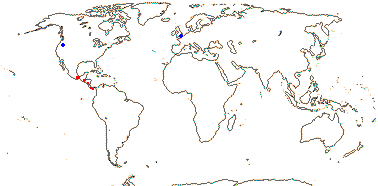
It was discovered only in 1989 in Costa Rica, having been overlooked previously due to its habitat in poorly researched cloud forests and its very 'ordinary' appearance; further research showed its range extends from southern Mexico (Veracruz, Oaxaca, Chiapas), south through Central America to Panama.[3][4][5][6]
It is a tree, 20–30 m tall, superficially resembling an alder in appearance, with alternate, simple leaves 5–12 cm long with a serrated margin. It is generally dioecious, with separate male and female plants.[7]
Fossil record
†Ferrignocarpus bivalvis fossil fruits, from the Middle Eocene of Oregon and the Early Eocene London Clay flora of southern England, correspond closely in morphology and anatomy to fruits of extant Ticodendron.[8]
References
Page Template:Reflist/styles.css has no content.
- ^ Template:Cite iucn
- ^ Page Module:Citation/CS1/styles.css has no content.Angiosperm Phylogeny Group (2009). "An update of the Angiosperm Phylogeny Group classification for the orders and families of flowering plants: APG III". Botanical Journal of the Linnean Society. 161 (2): 105–121. doi:10.1111/j.1095-8339.2009.00996.x. hdl:10654/18083.
- ^ Kew Checklist of Selected Plant Families
- ^ Nelson Sutherland, C.H. (2008). Catálogo de las plantes vasculares de Honduras. Espermatofitas: 1-1576. SERNA/Guaymuras, Tegucigalpa, Honduras.
- ^ Gómez-Laurito, Jorge & Gómez P., Luis Diego 1989. Ticodendron: A new tree from Central America. Annals of Missouri Botanical Garden 76(4): 1148–1151
- ^ Ulloa Ulloa, C. 2001. Ticodendraceae. En: Stevens, W.D., C. Ulloa, A. Pool & O.M. Montiel (eds.). Flora de Nicaragua. Monographs in systematic botany from the Missouri Botanical Garden 85(3): 2452
- ^ Page Module:Citation/CS1/styles.css has no content.Kubitzki, K. (1993). "Ticodendraceae". Flowering Plants · Dicotyledons. pp. 594–596. doi:10.1007/978-3-662-02899-5_72. ISBN 978-3-642-08141-5.
- ^ Page Module:Citation/CS1/styles.css has no content.Manchester, Steven R. (November 2011). "Fruits of Ticodendraceae (Fagales) from the Eocene of Europe and North America". International Journal of Plant Sciences. 172 (9): 1179–87. doi:10.1086/662135. S2CID 84609421.
External links
- Photo of leaves and fruit Script error: No such module "webarchive".
- Photo of herbarium specimen Script error: No such module "webarchive".
- Distribution map
- Neotropical Plant Families Database @ www.lacistemataceae.org/NPFD Script error: No such module "webarchive".
Template:Angiosperm families Script error: No such module "Taxonbar".