VT tank
Page Module:Infobox/styles.css has no content.
| Versuchsträger 1–2 | |
|---|---|
| Lua error in package.lua at line 80: module 'Module:InfoboxImage/data' not found. The GVT 04 tank | |
| Type | Tank destroyer, medium tank |
| Place of origin | West Germany |
| Production history | |
| Designer | MaK[1] |
| Designed | 1970s |
| Manufacturer | MaK |
| Produced | 1974 and 1975 (VT 1-1 and VT 1–2) |
| No. built | 2 VTs and 5 GVTs |
| Variants | VT 1-1, VT 1–2, GVTs |
| Specifications | |
| Mass | 43.5 tonnes (42.8 long tons; 48.0 short tons) |
| Length | 9.06 m |
| Width | 3.54 m |
| Height | 2.04 m |
| Crew | 3 (commander, driver, gunner) |
Main armament | 2 x 105 mm guns or 2 x Rh120 L/44 guns |
| Engine | MTU MB803 Ra-500 1,500 PS (sustained )(1,100 kW) 2,400 PS (short time)(1765 kW)[2] |
| Power/weight | 34.5 PS/t(sustained)(25.3 kW/t) 55 PS/t (short time)(40.5 kW/t) |
| Suspension | hydropneumatic |
| Page Template:Tooltip/styles.css has no content.Template:Encodefirst | 70 kilometres per hour (43 mph) 40 kilometres per hour (25 mph) offroad |


The Script error: No such module "Lang". 1–2 (abbreviated: VT, meaning 'test-beds' or 'experiment carrier') were two German prototype twin gun turretless main battle tanks. Since the early 1970s a number of West German companies have been working on conceptual designs for a successor to the Leopard 1. This project had the name Script error: No such module "Lang". 3 (KPz 3). The KPz 3 project was temporarily a British-German joint project, until the UK withdrew because they wanted a turreted tank.[3] The Germans had already developed the Leopard 2 and therefore didn't see the need for another conventional tank.[3] One of the companies involved was MaK, developing the VT 1-1 and VT 1–2. The test programme ended proving that a twin-gunned turretless tank could be created with enough technical effort, but had drawbacks in both practical and tactical use.[4]
History
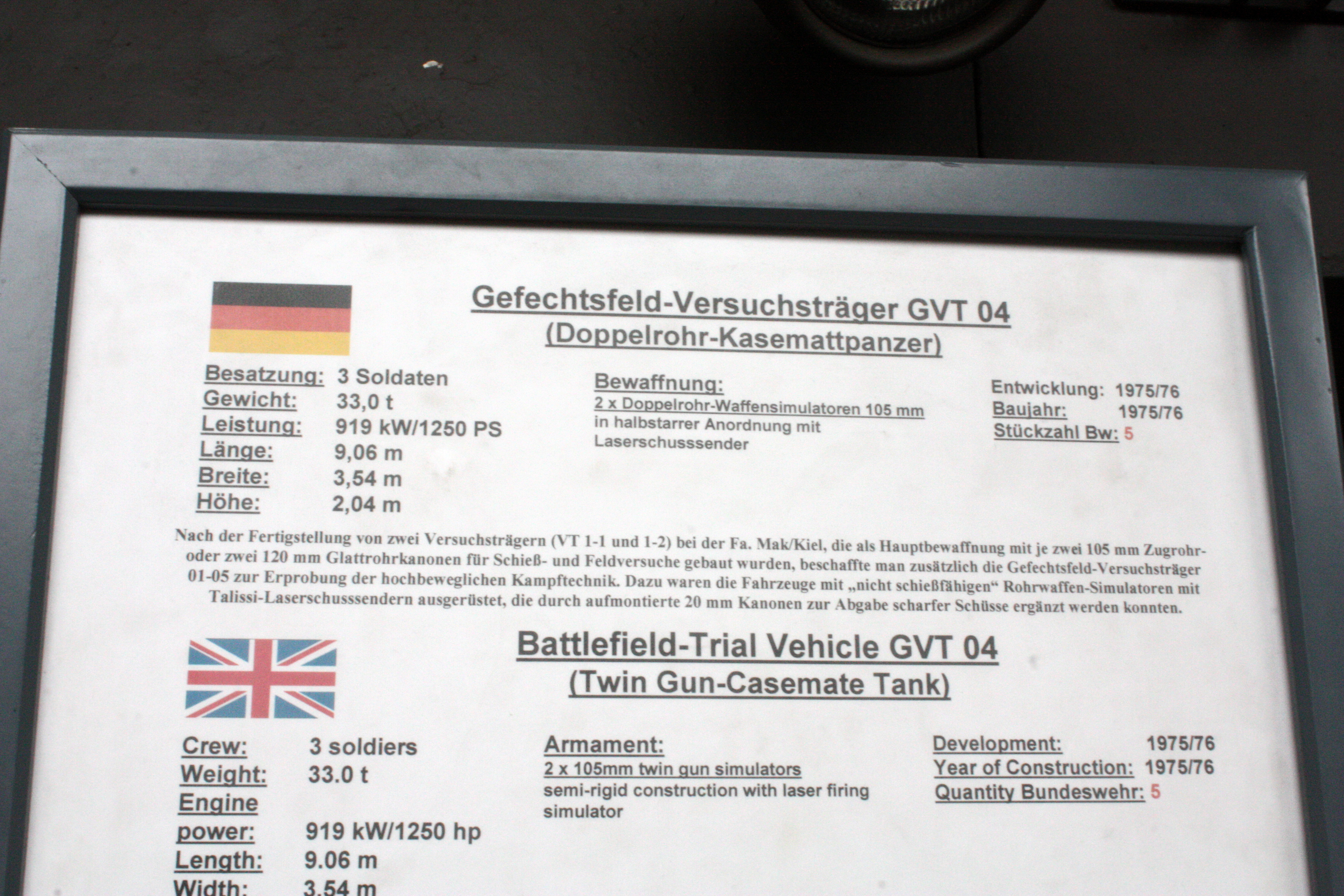
The first VT tank, VT 1-1, was built in 1974 by Maschinenbau Kiel (MaK). One year later they produced the second VT tank, the VT 1–2. For further testing of the mobility and the concept of a tank with two main guns, five Script error: No such module "Lang". (GVT, 'battlefield test-beds') were designed and built in 1975 and 1976.[5]
Design
The VT 1-1 was based on the shortened chassis of the cancelled MBT-70 tank. Since the tank had no autoloaders, a crew of four was needed to operate it. All VT tanks followed in some extent the traditional design of German Jagdpanzers, like the post-war Kanonenjagdpanzer.
The VT 1–2 featured a turbocharged engine, which was capable of 1,500 PS sustained and 2,400 PS for short periods of time. The tank had a three-man crew seated at the front, with driver between commander and gunner. A comparison with the Leopard 2 was held, which proved that the VT 1–2 tank wouldn't have any significant advantages over the Leopard 2. The engine of the Leopard 2 was not defining the concept and could therefore be replaced by the more powerful 12-cylinder engine of the VT 1–2 if required.[2] The Leopard 2 also had a high first round hit probability, due to its advanced fire control system, which corresponds to or even surpass the calculated first round hit probability of the twin guns.[2]
The VT tanks were designed to:[4]
- reach a higher weapon efficiency through short reaction times, higher hit probability and higher kill probability by using twin guns in a casemate structure.
- be more mobile by using a stronger engine and a new suspension while saving weight through the absence of a turret.
- have a higher level of survivability by reducing the crew compartment, using heavy frontal armour and a much lower silhouette.
The idea was that the tank would close in on the enemy on a zig-zag course[6] (Script error: No such module "Lang"., much like a skier wedeling downhill). The target would be locked into the aiming computer, the gunner would hold the trigger and the gun would fire automatically in the moment when the muzzle was on the target during the next change of direction.
The VT 1-1 was armed with two 105 mm rifled guns, which were loaded manually. The VT 1–2 carried two 120 mm smoothbore guns equipped with 6-round automatic loaders. The GVTs were not fitted with guns, instead they mounted two gun simulators. For combat simulations they used Talissi laser fire simulators. The propellant gases were created with a 20 mm cannon mounted on the roof.[5]
Variants
- VT 1-1 – 105 mm rifled guns with manual loading, based on the German–American KPz 70/MBT-70.[7]
- VT 1–2 – 120 mm smoothbore guns with an automatic loader and an engine upgrade.
- GVT 01 – GVT 05
See also
- M50 Ontos – tank destroyer with six M40 recoilless rifles
- Type 60 self-propelled 106 mm recoilless rifle – tank destroyer armed with two 105 mm recoilless rifles
- Stridsvagn 103 – turret-less main battle tank of the same era
References
Page Module:Side box/styles.css has no content.Page Template:Sister project/styles.css has no content.
- Notes
Page Template:Reflist/styles.css has no content.
- ^ Page Module:Citation/CS1/styles.css has no content."Versuchsträger VT 1-2". WaffenHQ. 7 September 2007. Archived from the original on 2020-11-08.
- ^ a b c Krapke, p.25
- ^ a b Page Module:Citation/CS1/styles.css has no content.Hilmes, Rolf (January–February 2001). "Modern German Tank Development, 1956–2000" (PDF). ARMOR. pp. 16–21. Archived from the original (PDF) on 2016-03-27.
- ^ a b Page Module:Citation/CS1/styles.css has no content."Bundesamt für Wehrtechnik und Beschaffung". Archived from the original on 2012-03-03. Retrieved 2010-10-09.
- ^ a b Sign in the Panzermuseum Munster
- ^ Page Module:Citation/CS1/styles.css has no content.Ogorkiewicz, Richard (2015). Tanks:100 Years of Evolution. Osprey Publishing. p. 196. ISBN 978-1-4728-0670-3.
- ^ Page Module:Citation/CS1/styles.css has no content.Foss, Christopher F., ed. (1982). Jane's Armour and Artillery 1982–83 (3rd ed.). London: Jane's Publishing Company. p. 14. ISBN 0-7106-0747-4.
- Bibliography
- Page Module:Citation/CS1/styles.css has no content.Krapke, Paul-Werner (2004). Leopard 2 sein Werden und seine Leistung (in German). BoD – Books on Demand. ISBN 3-8334-1425-1.
{{cite book}}: CS1 maint: unrecognized language (link)
Script error: No such module "Military navigation". Script error: No such module "Military navigation".