White Room
Script error: No such module "other uses". Template:DMCA
Page Template:Hlist/styles.css has no content.Page Template:Plainlist/styles.css has no content.Page Module:Infobox/styles.css has no content.
| "White Room" | ||||
|---|---|---|---|---|
| Lua error in package.lua at line 80: module 'Module:InfoboxImage/data' not found. Italian single picture sleeve | ||||
| Template:Infobox song/link by Cream | ||||
| from the album Wheels of Fire | ||||
| B-side | "Those Were the Days" | |||
| Released |
| |||
| Recorded | July 1967 – April 1968 | |||
| Studio | Atlantic, New York City | |||
| Genre | ||||
| Length | Script error: No such module "hms". | |||
| Label | ||||
| [[Composer|ComposerTemplate:Pluralize from text]] | Jack Bruce | |||
| [[Lyricist|LyricistTemplate:Pluralize from text]] | Pete Brown | |||
| [[Record producer|ProducerTemplate:Pluralize from text]] | Felix Pappalardi | |||
| Cream US singles chronology | ||||
| ||||
| Script error: No such module "Unsubst-infobox". Script error: No such module "Unsubst-infobox". | ||||
Script error: No such module "Check for conflicting parameters".
"White Room" is a song by British rock band Cream, composed by bassist Jack Bruce with lyrics by poet Pete Brown.[2] They recorded it for the studio half of the 1968 double album Wheels of Fire. In September, a shorter US single edit (without the third verse) was released for AM radio stations,[3] although album-oriented FM radio stations played the full album version. The subsequent UK single release in January 1969 used the full-length album version of the track.
Recording and composition
Lyricist Pete Brown's original idea for the song revolved around a hippie girl titled "Cinderella's Last Goodnight", but when that did not work, he dipped into an earlier eight page poem he had written about a new apartment he had moved into with white walls and bare furnishings, where he gave up drinking and drugs.[4] The personal demons he battled while living in the white room spawned the imagery of the poem, which was eventually whittled down to a few verses for the song lyric.
In July 1967, at the initial sessions for Cream's third album (then still unnamed), recording for "White Room" began in London. In October and December work continued at Atlantic Studios in New York City and was completed during three sessions in February, April and June 1968, also at Atlantic.[5][6]
Jack Bruce sang and played bass on the song, Eric Clapton overdubbed guitar parts, Ginger Baker played drums and timpani, and Felix Pappalardi – the group's producer – contributed violas.[7] Clapton played his guitar through a wah-wah pedal to achieve a "talking-effect".[8] The song has an identical chord progression to Cream's previous recording "Tales of Brave Ulysses".[9] Both Bruce and Baker claimed to have added the distinctive 5
4 or quintuple metre opening to what had been a 4
4 or common time composition.[10] Bruce later revealed that the 5
4 opening had made the record company wary that it would do well commercially.[4]
Credits
- Jack Bruce – lead vocals, bass, songwriter
- Eric Clapton – lead and rhythm guitars
- Ginger Baker – drums, timpani
- Felix Pappalardi – violas, producer
- Pete Brown – songwriter
Recognition and other recordings
Page Module:Message box/ambox.css has no content.
This section needs additional citations for verification. (July 2018) |
Rolling Stone ranked "White Room" at number 376 on its list of the "500 Greatest Songs of All Time". A live recording appears on the group's Live Cream Volume II album (1972). Clapton, along with Phil Collins, began his act at Live Aid in 1985 with the song. In 1990, Clapton performed the song at his Royal Albert Hall concert series and in 1999 with Sheryl Crow at Crow's Sheryl Crow and Friends: Live from Central Park concert. In 2005, the reunited Cream played the song at the Royal Albert Hall, which was released on their Royal Albert Hall London May 2-3-5-6, 2005 album.
In a song review for AllMusic, Stephen Thomas Erlewine noted that the song has been "covered frequently, and by a bizarre group of artists: Broadway star Joel Grey, the Finnish symphonic metal band Apocalyptica, fusion guitarist Frank Gambale, the Bluegrass-inspired Cache Valley Drifters, and heavy metal band Helloween. That wildly eclectic list proves that 'White Room' is a multi-faceted song, containing equal parts dramatic spectacle, intricate musicality, and hard rock menace. Other artists emphasize different elements in their interpretations, but the original Cream version wrapped it all up in one startling package".[1]
Billboard described the single as a "solid, driving rocker".[11]
Charts
Weekly charts
| Chart (1968–2019) | Peak position |
|---|---|
| Australia (Go-Set)[12] | 1 |
| Canada (RPM Top 100)[13] | 2 |
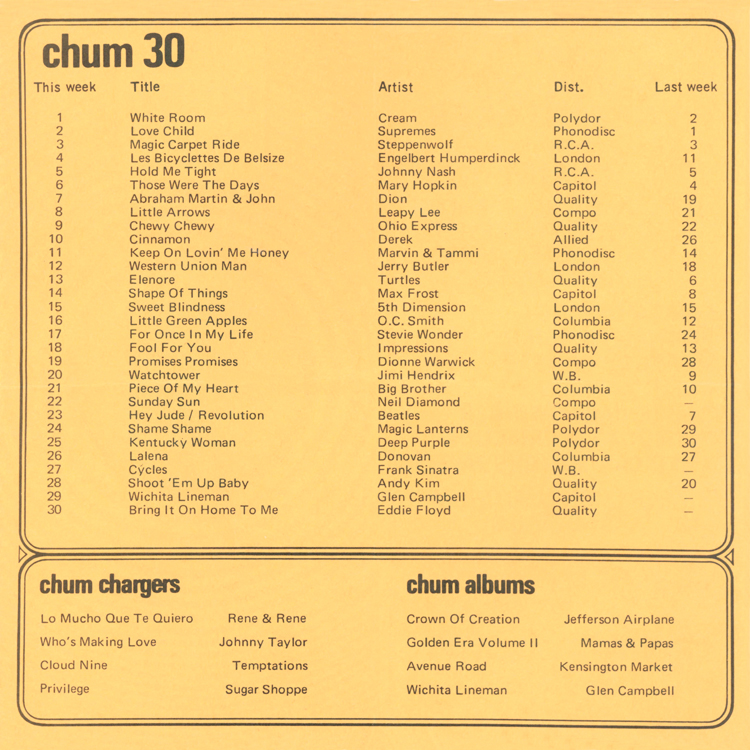
| Canada (CHUM Chart)[14] | 1 |
| Finland (Suomen Virallinen)[15] | 10 |
| France (IFOP)[16] | 73 |
| Malaysia (RTM)[17] | 1 |
| New Zealand (Listener)[18] | 2 |
| Spain (AFYVE)[19] | 15 |
| US Cashbox Top Singles[20] | 5 |
Year-end charts
| Chart (1968) | Rank |
|---|---|
| Canada[21] | 39 |
| Netherlands (Dutch Top 40)[22] | 51 |
| US Billboard Hot 100[23] | 81 |
| US Cash Box[24] | 48 |
Certifications
| Region | Certification | Certified units/sales |
|---|---|---|
| United Kingdom (BPI)[25] | Silver | 200,000 |
|
‡ Sales+streaming figures based on certification alone. | ||
Deep Purple version
A version of the track was featured on Deep Purple's 2021 covers album Turning to Crime.[26]
Personnel
- Ian Gillan – lead and backing vocals
- Roger Glover – bass
- Ian Paice – drums
- Steve Morse – guitar
- Don Airey – keyboards
References
Page Template:Reflist/styles.css has no content.
- ^ a b c Page Module:Citation/CS1/styles.css has no content.Erlewine, Stephen Thomas. "Cream: White Room – Review". AllMusic. Retrieved 4 March 2020.
- ^ Page Module:Citation/CS1/styles.css has no content.Gilliland, John (1969). "Show 53 - String Man. : UNT Digital Library" (audio). Pop Chronicles. University of North Texas Libraries.
- ^ Page Module:Citation/CS1/styles.css has no content."Spotlight Singles". Billboard. Cincinnati, Ohio. 21 September 1968. p. 72.
- ^ a b Page Module:Citation/CS1/styles.css has no content.Hopper, Alex (23 August 2023). "Meaning Behind the Jimi Hendrix-Inspired White Room by Cream". American Songwriter. Retrieved 10 September 2024.
- ^ Page Module:Citation/CS1/styles.css has no content.Hjort, Christopher (2007). Strange Brew: Eric Clapton & the British Blues Boom, 1965-1970. London, UK: Jawbone Press. pp. g. 126, 148, 159, 181. ISBN 978-1-906002-00-8.
- ^ Felix Pappalardi interview, Hit Parader # 55, February 1969
- ^ Page Module:Citation/CS1/styles.css has no content.Wheels of Fire (CD liner). Cream. Polydor Records. 1997. 531 812-2.
{{cite AV media notes}}: CS1 maint: others in cite AV media (notes) (link) - ^ Page Module:Citation/CS1/styles.css has no content.Bacon, Tony (1990). "Guitar Madness". The Marshall Cavendish Illustrated History of Popular Music. Vol. 11 (Reference ed.). Marshall Cavendish. p. 1079. ISBN 978-1-8543-5015-2.
- ^ Page Module:Citation/CS1/styles.css has no content.Greenwald, Matthew. "Tales of Brave Ulysses - Cream". AllMusic.com. Retrieved 6 May 2021.
- ^ Page Module:Citation/CS1/styles.css has no content."Classic Rock Magazine, March 2010". Archived from the original on 13 November 2013.
- ^ Page Module:Citation/CS1/styles.css has no content."Spotlight Singles" (PDF). Billboard. 21 September 1968. p. 72. Retrieved 22 February 2021.
- ^ Page Module:Citation/CS1/styles.css has no content."Go-Set Australian Charts – 1 January 1969". gosetcharts.com. Retrieved 28 April 2023.
- ^ Page Module:Citation/CS1/styles.css has no content."RPM Top 100 Singles - November 18, 1968" (PDF).
- ^ Page Module:Citation/CS1/styles.css has no content."CHUM 30 - November 9, 1968".
- ^ Page Module:Citation/CS1/styles.css has no content.Nyman, Jake (2005). Suomi soi 4: Suuri suomalainen listakirja (in suomi) (1st ed.). Helsinki: Tammi. p. 100. ISBN 951-31-2503-3.
- ^ Page Module:Citation/CS1/styles.css has no content."Accès direct à ces Artistes" (in français). Institut français d'opinion publique. Retrieved 28 April 2023.
- ^ Page Module:Citation/CS1/styles.css has no content."Billboard Hits of the World" (PDF). worldradiohistory.com. 15 March 1969. p. 67. Retrieved 28 April 2023.
- ^ Page Module:Citation/CS1/styles.css has no content."NZ Listener Chart Summary: Cream". flavourofnz.co.nz. Retrieved 28 April 2023.
- ^ Page Module:Citation/CS1/styles.css has no content.Salaverri, Fernando (September 2005). Sólo éxitos: año a año, 1959–2002 (in español) (3rd ed.). Spain: Fundación Autor-SGAE. ISBN 84-8048-639-2.
- ^ Page Module:Citation/CS1/styles.css has no content.Hoffmann, Frank (1983). The Cash Box Singles Charts, 1950-1981. Metuchen, NJ & London: The Scarecrow Press, Inc. p. 135.
- ^ Page Module:Citation/CS1/styles.css has no content."Item Display - RPM - Library and Archives Canada". collectionscanada.gc.ca.
- ^ Page Module:Citation/CS1/styles.css has no content."Top 100–Jaaroverzicht van 1968". Dutch Top 40. Retrieved 12 December 2023.
- ^ Page Module:Citation/CS1/styles.css has no content."Top 100 Hits of 1968/Top 100 Songs of 1968". www.musicoutfitters.com. Archived from the original on 7 June 2023. Retrieved 29 May 2019.
- ^ Page Module:Citation/CS1/styles.css has no content."Cash Box YE Pop Singles - 1968". tropicalglen.com.
- ^ Script error: No such module "cite". Select singles in the Formats field. Type White Room Cream in the "Search:" field.
- ^ Deep Purple announce new covers album, Turning To Crime, premiere hard-rocking version of Love's 7 and 7 Is. Guitar World. 6 October 2021. Retrieved 30 July 2022.
Lua error in package.lua at line 80: module 'Module:Navbox/configuration' not found. Lua error in package.lua at line 80: module 'Module:Authority control/config' not found.