Williams Cone
Template:Short description Template:DMCA Template:DMCA Template:Infobox mountain
Williams Cone is a cinder cone on the northeastern flank of Mount Edziza in Cassiar Land District of northwestern British Columbia, Canada. It has an elevation of 2,100 metres (6,900 feet) and is one of several volcanic cones in the Desolation Lava Field at the northern end of the Big Raven Plateau. Situated southeast of the community of Telegraph Creek, it lies in Mount Edziza Provincial Park, one of the largest provincial parks in British Columbia. A roughly 13-kilometre-long (8.1-mile) lava flow travelled down the northern side of the Big Raven Plateau from Williams Cone around 630 CE and temporarily dammed the Klastline River. Ejecta from an eruption column was blown eastward by a strong westerly wind, some of which deposited on the eastern flank of the cone.
Williams Cone is part of the Mount Edziza volcanic complex, which consists of diverse landforms such as shield volcanoes, stratovolcanoes, lava domes and cinder cones. A large, steep-sided feature on the western side of Williams Cone resembles an amphitheatre and contains a smaller, nested cinder cone. Tsecha Creek originates adjacent to Williams Cone and is part of the Stikine River watershed. Surrounding Williams Cone are a number of other volcanic features. Among them are the Eve, Moraine, Sidas, Sleet, Storm, Twin and Triplex cones, all of which are also part of the Desolation Lava Field. Access is via horse trails from Telegraph Creek and Iskut, although landing on Buckley Lake with float-equipped aircraft is also promoted to reach Williams Cone.
Name and etymology
The name of the cinder cone became official on January 2, 1980.Lua error in package.lua at line 80: module 'Module:Footnotes/anchor_id_list' not found.Lua error in package.lua at line 80: module 'Module:Footnotes/anchor_id_list' not found. It was adopted on the National Topographic System map 104G/15 after being submitted to the BC Geographical Names office by the Geological Survey of Canada.Lua error in package.lua at line 80: module 'Module:Footnotes/anchor_id_list' not found. In his 1992 report The Late Cenozoic Mount Edziza Volcanic Complex, British Columbia, Jack Souther gave Williams Cone the numeronym DLF-10.Lua error in package.lua at line 80: module 'Module:Footnotes/anchor_id_list' not found. DLF is an acronym for the Desolation Lava Field whereas 10 refers to Williams Cone being the tenth youngest eruptive centre in the Desolation Lava Field.Lua error in package.lua at line 80: module 'Module:Footnotes/anchor_id_list' not found.
Williams Cone is named after a man named Hank Williams who was killed in an avalanche near the cone along with Johnny Edzerza in or before 1974.Lua error in package.lua at line 80: module 'Module:Footnotes/anchor_id_list' not found.Lua error in package.lua at line 80: module 'Module:Footnotes/anchor_id_list' not found. The avalanche occurred during a vicious snowstorm that had blown in from the north as Hank Williams, Johnny Edzerza and his wife Eve Edzerza were dog sledding to Iskut from Telegraph Creek 72 km (45 mi) to the west. Eve Edzerza was the only survivor and directed a rescue team to the site of the accident.Lua error in package.lua at line 80: module 'Module:Footnotes/anchor_id_list' not found. Hank Williams and the Edzerzas were Tahltans, the local First Nations people whose traditional territory covers an area of more than 93,500 km2 (36,100 mi2).Lua error in package.lua at line 80: module 'Module:Footnotes/anchor_id_list' not found.Lua error in package.lua at line 80: module 'Module:Footnotes/anchor_id_list' not found.
Geography
Williams Cone is located in Cassiar Land District of northwestern British Columbia, Canada, about 20 km (12 mi) southeast of Buckley Lake on the northeastern flank of Mount Edziza.Lua error in package.lua at line 80: module 'Module:Footnotes/anchor_id_list' not found.Lua error in package.lua at line 80: module 'Module:Footnotes/anchor_id_list' not found.Lua error in package.lua at line 80: module 'Module:Footnotes/anchor_id_list' not found. It has an elevation of 2,100 m (6,900 ft) and is one of several volcanic cones in the Desolation Lava Field.Lua error in package.lua at line 80: module 'Module:Footnotes/anchor_id_list' not found.Lua error in package.lua at line 80: module 'Module:Footnotes/anchor_id_list' not found. This more than 150 km2 (58 mi2) lava field is one of the largest areas of Holocene lava flows of the Mount Edziza volcanic complex (MEVC).Lua error in package.lua at line 80: module 'Module:Footnotes/anchor_id_list' not found.Lua error in package.lua at line 80: module 'Module:Footnotes/anchor_id_list' not found. The MEVC consists of a group of overlapping shield volcanoes, stratovolcanoes, lava domes and cinder cones that have formed over the last 7.5 million years.Lua error in package.lua at line 80: module 'Module:Footnotes/anchor_id_list' not found.
Williams Cone rises more than 275 m (902 ft) above the surrounding terrain.Lua error in package.lua at line 80: module 'Module:Footnotes/anchor_id_list' not found. It has a basal width of 1.2 km (0.75 mi), making it the largest cinder cone in the Desolation Lava Field.Lua error in package.lua at line 80: module 'Module:Footnotes/anchor_id_list' not found.Lua error in package.lua at line 80: module 'Module:Footnotes/anchor_id_list' not found. A large, steep-sided feature on its western side resembles an amphitheatre and contains a smaller cinder cone.Lua error in package.lua at line 80: module 'Module:Footnotes/anchor_id_list' not found. Adjacent to Williams Cone is the head of Tsecha Creek, which is covered with loose ejecta from the cone.Lua error in package.lua at line 80: module 'Module:Footnotes/anchor_id_list' not found.Lua error in package.lua at line 80: module 'Module:Footnotes/anchor_id_list' not found. Tsecha Creek is a tributary of Kakiddi Creek.Lua error in package.lua at line 80: module 'Module:Footnotes/anchor_id_list' not found. This north-flowing stream enters the Klastline River, which flows into the Stikine River.Lua error in package.lua at line 80: module 'Module:Footnotes/anchor_id_list' not found.Lua error in package.lua at line 80: module 'Module:Footnotes/anchor_id_list' not found. Williams Cone is therefore within the Stikine River watershed along with the rest of the MEVC.Lua error in package.lua at line 80: module 'Module:Footnotes/anchor_id_list' not found.
Apart from Mount Edziza itself, which is a 2,786 m (9,140 ft) high stratovolcano, Williams Cone is surrounded by a number of other volcanic features.Lua error in package.lua at line 80: module 'Module:Footnotes/anchor_id_list' not found. Extending about 6 km (3.7 mi) to the northwest is a linear group of four volcanic cones. Eve Cone lies at the northwesternmost end of this line whereas the three Triplex Cones are between the Eve and Williams cones.Lua error in package.lua at line 80: module 'Module:Footnotes/anchor_id_list' not found. The Sleet, Storm and Moraine cones are about 3 km (1.9 mi) east, southwest and south-southwest of Williams Cone, respectively. About 5 km (3.1 mi) to the northeast is Twin Cone whereas Sidas Cone is about 9 km (5.6 mi) north of Williams Cone.Lua error in package.lua at line 80: module 'Module:Footnotes/anchor_id_list' not found.Lua error in package.lua at line 80: module 'Module:Footnotes/anchor_id_list' not found. About 3 km (1.9 mi) southeast of Williams Cone is The Pyramid on the northeastern flank of Mount Edziza.Lua error in package.lua at line 80: module 'Module:Footnotes/anchor_id_list' not found.Lua error in package.lua at line 80: module 'Module:Footnotes/anchor_id_list' not found. All of these features are part of the Desolation Lava Field at the northern end of the Big Raven Plateau with the exception of The Pyramid, which is separated from its surroundings by a thick apron of active talus.Lua error in package.lua at line 80: module 'Module:Footnotes/anchor_id_list' not found.Lua error in package.lua at line 80: module 'Module:Footnotes/anchor_id_list' not found.
Williams Cone lies in Mount Edziza Provincial Park southeast of the community of Telegraph Creek.Lua error in package.lua at line 80: module 'Module:Footnotes/anchor_id_list' not found. With an area of 266,180 hectares (657,700 acres), it is one of the largest provincial parks in British Columbia.Lua error in package.lua at line 80: module 'Module:Footnotes/anchor_id_list' not found.Lua error in package.lua at line 80: module 'Module:Footnotes/anchor_id_list' not found. Mount Edziza Provincial Park was established in 1972 to preserve the volcanic landscape.Lua error in package.lua at line 80: module 'Module:Footnotes/anchor_id_list' not found. It includes not only the Mount Edziza area but also the Spectrum Range to the south, both of which are separated by Raspberry Pass.Lua error in package.lua at line 80: module 'Module:Footnotes/anchor_id_list' not found.Lua error in package.lua at line 80: module 'Module:Footnotes/anchor_id_list' not found. Mount Edziza Provincial Park is in the Tahltan Highland, a southeast-trending upland area extending along the western side of the Stikine Plateau.Lua error in package.lua at line 80: module 'Module:Footnotes/anchor_id_list' not found.Lua error in package.lua at line 80: module 'Module:Footnotes/anchor_id_list' not found.
Geology
Background
As a part of the MEVC, Williams Cone lies within a broad area of volcanoes called the Northern Cordilleran Volcanic Province, which extends from northwestern British Columbia northwards through Yukon into easternmost Alaska.Lua error in package.lua at line 80: module 'Module:Footnotes/anchor_id_list' not found.Lua error in package.lua at line 80: module 'Module:Footnotes/anchor_id_list' not found. The dominant rocks comprising these volcanoes are alkali basalts and hawaiites, but nephelinite, basanite and peralkaline[a] phonolite, trachyte and comendite are locally abundant. These rocks were deposited by volcanic eruptions from 20 million years ago to as recently as a few hundred years ago. Volcanism in the Northern Cordilleran Volcanic Province is thought to be due to rifting of the North American Cordillera, driven by changes in relative plate motion between the North American and Pacific plates.Lua error in package.lua at line 80: module 'Module:Footnotes/anchor_id_list' not found.
Formation
Williams Cone was formed by a volcanic eruption that involved the build up of lava bombs and spatter around several vents.Lua error in package.lua at line 80: module 'Module:Footnotes/anchor_id_list' not found. An eruption column was blown eastward by a strong westerly wind, which resulted in the deposition of cinders and ash on the eastern flank of the cone.Lua error in package.lua at line 80: module 'Module:Footnotes/anchor_id_list' not found. The ejecta from this eruption column extends 9.5 km (5.9 mi) east across the Big Raven Plateau to the valley of Kakiddi Creek. In Kakiddi Valley, the ejecta is in the form of 1-to-3-millimetre-wide (0.039-to-0.118-inch) particles.Lua error in package.lua at line 80: module 'Module:Footnotes/anchor_id_list' not found.Lua error in package.lua at line 80: module 'Module:Footnotes/anchor_id_list' not found. It increases in both grain size and thickness towards Williams Cone where 5–20 mm (0.20–0.79 in) wide cinders form beds up to 4.5 m (15 ft) thick. Small streams northeast of Williams Cone have exposed former soil underlying ejecta from the volcano.Lua error in package.lua at line 80: module 'Module:Footnotes/anchor_id_list' not found.
The formation of Williams Cone was followed by collapse of its western flank near the end of the eruption to form the steep-sided amphitheatre. Some of the debris from this collapse accumulated in mounds west of the amphitheatre, but most of it was rafted away by lava.Lua error in package.lua at line 80: module 'Module:Footnotes/anchor_id_list' not found. The lava issued from the breached central crater of Williams Cone, as well as from vents around the base of the cone. Streams of lava from these vents merged to form an approximately 1.5 km (0.93 mi) wide and 13 km (8.1 mi) long compound flow.Lua error in package.lua at line 80: module 'Module:Footnotes/anchor_id_list' not found. This lava flow is one of the largest in the Desolation Lava Field.Lua error in package.lua at line 80: module 'Module:Footnotes/anchor_id_list' not found. It travelled northeast down the northern side of the Big Raven Plateau into the Klastline Valley where it formed a temporary lava dam.Lua error in package.lua at line 80: module 'Module:Footnotes/anchor_id_list' not found.Lua error in package.lua at line 80: module 'Module:Footnotes/anchor_id_list' not found.
Williams Cone and its eruptive products consist mainly of hawaiite.Lua error in package.lua at line 80: module 'Module:Footnotes/anchor_id_list' not found. They are part of the Big Raven Formation and are the most recent additions to the Desolation Lava Field.Lua error in package.lua at line 80: module 'Module:Footnotes/anchor_id_list' not found.Lua error in package.lua at line 80: module 'Module:Footnotes/anchor_id_list' not found. Radiocarbon dating of charred alpine willow twigs preserved in ejecta suggests that the Williams Cone eruption occurred sometime around 630 CE.Lua error in package.lua at line 80: module 'Module:Footnotes/anchor_id_list' not found.Lua error in package.lua at line 80: module 'Module:Footnotes/anchor_id_list' not found. The cone is the youngest in the Desolation Lava Field, but it may not be the youngest feature of the entire MEVC; The Ash Pit on the southern side of the Kitsu Plateau may be younger.Lua error in package.lua at line 80: module 'Module:Footnotes/anchor_id_list' not found.Lua error in package.lua at line 80: module 'Module:Footnotes/anchor_id_list' not found. The eruption that formed Williams Cone was also followed by at least two younger eruptions of the MEVC that remain undated.Lua error in package.lua at line 80: module 'Module:Footnotes/anchor_id_list' not found. Future eruptions from the cone are unlikely because it is a monogenetic volcano; such volcanoes experience only a single eruptive phase and are short-lived.Lua error in package.lua at line 80: module 'Module:Footnotes/anchor_id_list' not found.Lua error in package.lua at line 80: module 'Module:Footnotes/anchor_id_list' not found.Lua error in package.lua at line 80: module 'Module:Footnotes/anchor_id_list' not found. Monogenetic volcanoes can remain active from days to years but are fed by a relatively small amount of magma.Lua error in package.lua at line 80: module 'Module:Footnotes/anchor_id_list' not found.
Basement
Williams Cone overlies the Edziza, Ice Peak, Nido and Raspberry formations, all of which are older geological formations of the MEVC. The Edziza Formation is the youngest; it consists mainly of Pleistocene trachyte that is in the form of pyroclastic breccia, lahar and ash flow deposits. Underlying the Edziza Formation is Pleistocene alkali basalt of the Ice Peak Formation, which is in the form of subaerial lava flows. This formation is underlain by alkali basalt flows of the Tenchen Member of the Nido Formation; they were erupted from multiple volcanoes during the Pliocene. The oldest MEVC formation underlying the cone is the Raspberry Formation, which consists of Miocene alkali basalt and minor hawaiite and mugearite. These volcanic rocks are mainly in the form of lava flows, flow breccias and agglutinate.Lua error in package.lua at line 80: module 'Module:Footnotes/anchor_id_list' not found.Lua error in package.lua at line 80: module 'Module:Footnotes/anchor_id_list' not found. Underlying the Raspberry Formation are sedimentary, volcanic or metamorphic rocks of the Stikinia terrane, which are Paleozoic and Mesozoic in age.Lua error in package.lua at line 80: module 'Module:Footnotes/anchor_id_list' not found.Lua error in package.lua at line 80: module 'Module:Footnotes/anchor_id_list' not found.Lua error in package.lua at line 80: module 'Module:Footnotes/anchor_id_list' not found.
Accessibility
Williams Cone is in a remote location with no established road access. The closest roads are the Stewart–Cassiar Highway to the east and the Telegraph Creek Road to the northwest; both come within 40 km (25 mi) of the cone.Lua error in package.lua at line 80: module 'Module:Footnotes/anchor_id_list' not found.Lua error in package.lua at line 80: module 'Module:Footnotes/anchor_id_list' not found.Lua error in package.lua at line 80: module 'Module:Footnotes/anchor_id_list' not found. Extending from these roads are horse trails that provide access to the MEVC.Lua error in package.lua at line 80: module 'Module:Footnotes/anchor_id_list' not found. From Telegraph Creek, the Buckley Lake Trail extends about 15 km (9.3 mi) southeast along Mess Creek and Three Mile Lake. It then traverses about 15 km (9.3 mi) northeast along Dagaichess Creek and Stinking Lake to the northeastern end of Buckley Lake. Here, it meets with the Klastline River Trail and the Buckley Lake to Mowdade Lake Route, the latter of which ascends onto the gently sloping northern side of the plateau.Lua error in package.lua at line 80: module 'Module:Footnotes/anchor_id_list' not found.
To the east, the roughly 50 km (31 mi) long Klastline River Trail begins at the community of Iskut on the Stewart–Cassiar Highway; it extends northwest and west along the Klastline River for much of its length.Lua error in package.lua at line 80: module 'Module:Footnotes/anchor_id_list' not found. The trail enters Mount Edziza Provincial Park at about 25 km (16 mi) where Kakiddi Creek drains into the Klastline River.Lua error in package.lua at line 80: module 'Module:Footnotes/anchor_id_list' not found. After entering Mount Edziza Provincial Park, it traverses northwest along the Klastline River for about 10 km (6.2 mi) and then crosses the river north of the Big Raven Plateau.Lua error in package.lua at line 80: module 'Module:Footnotes/anchor_id_list' not found. From there, it traverses west for about 5 km (3.1 mi) to the northeastern end of Buckley Lake where it meets with the Buckley Lake Trail and the Buckley Lake to Mowdade Lake Route.Lua error in package.lua at line 80: module 'Module:Footnotes/anchor_id_list' not found.
The Buckley Lake to Mowdade Lake Route traverses south from Buckley Lake along Buckley Creek and gradually climbs onto the northern end of the Big Raven Plateau where Williams Cone is located.Lua error in package.lua at line 80: module 'Module:Footnotes/anchor_id_list' not found.Lua error in package.lua at line 80: module 'Module:Footnotes/anchor_id_list' not found. Buckley Lake northwest of Williams Cone is large enough to be used by float-equipped aircraft.Lua error in package.lua at line 80: module 'Module:Footnotes/anchor_id_list' not found.Lua error in package.lua at line 80: module 'Module:Footnotes/anchor_id_list' not found. However, landing on this lake with a private aircraft requires a letter of authorization from the BC Parks Stikine Senior Park Ranger. As of 2023, Alpine Lakes Air and BC Yukon Air are the only air charter companies permitted to provide access to this area via aircraft.Lua error in package.lua at line 80: module 'Module:Footnotes/anchor_id_list' not found.
See also
Lua error in mw.title.lua at line 404: bad argument #2 to 'title.new' (unrecognized namespace name 'Portal').
- List of Northern Cordilleran volcanoes
- List of volcanoes in Canada
- Volcanism of the Mount Edziza volcanic complex
Notes
Page Template:Reflist/styles.css has no content.
- ^ Peralkaline rocks are magmatic rocks that have a higher ratio of sodium and potassium to aluminum.Lua error in package.lua at line 80: module 'Module:Footnotes/anchor_id_list' not found.
References
Page Template:Reflist/styles.css has no content.
Sources
Page Template:Refbegin/styles.css has no content.

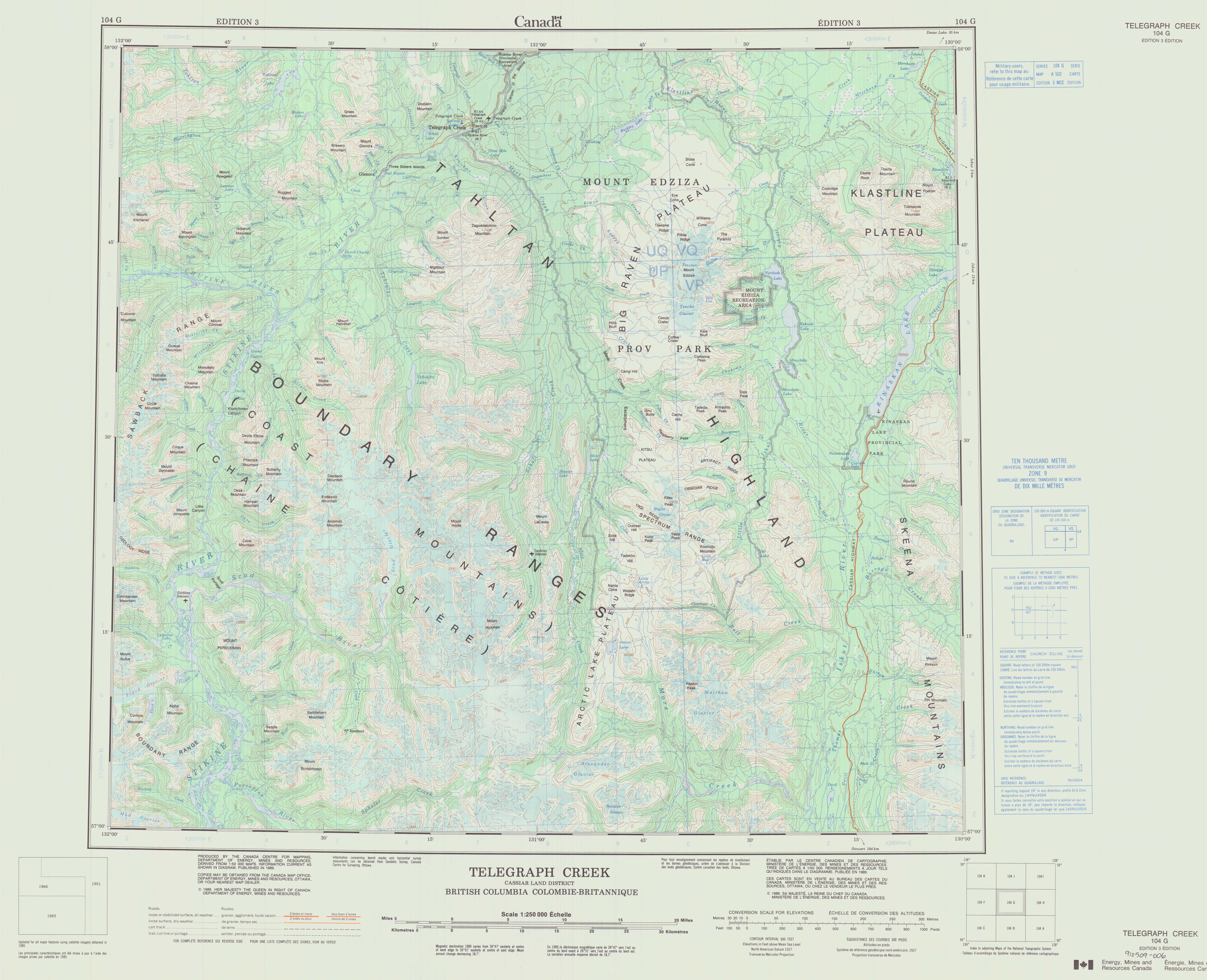
- Page Module:Citation/CS1/styles.css has no content."A 502" (Topographic map). Telegraph Creek, Cassiar Land District, British Columbia (3 ed.). 1:250,000. 104 G (in English and français). Department of Energy, Mines and Resources. 1989. Archived from the original on May 2, 2021.
- Script error: No such module "Template wrapper".
- Page Module:Citation/CS1/styles.css has no content.Dictionary of Geology and Mineralogy. McGraw Hill. 2003. ISBN 0-07-141044-9.
- Page Module:Citation/CS1/styles.css has no content.Edwards, Benjamin R.; Russell, James K. (2000). "Distribution, Nature, and Origin of Neogene–Quaternary Magmatism in the Northern Cordilleran Volcanic Province, Canada". Geological Society of America Bulletin. 112 (8). Geological Society of America: 1280–1295. Bibcode:2000GSAB..112.1280E. doi:10.1130/0016-7606(2000)112<1280:dnaoon>2.0.co;2. ISSN 0016-7606.
- Script error: No such module "Template wrapper".
- Script error: No such module "Template wrapper".
- Page Module:Citation/CS1/styles.css has no content.Foote, April; Handley, Heather; Németh, Károly; Didonna, Rosa; McGee, Lucy; Griffis, Rebecca; Clerke, Liam (2023). "The Role of Phreatomagmatism in the Formation of Complex Monogenetic Volcanic Systems in a Low-lying Coastal Plain". Journal of Volcanology and Geothermal Research. 442 107899. Elsevier: 1–21. Bibcode:2023JVGR..44207899F. doi:10.1016/j.jvolgeores.2023.107899. ISSN 0377-0273.
- Page Module:Citation/CS1/styles.css has no content."Geographical Names Board of Canada". Government of Canada. Archived from the original on May 24, 2024.
- Page Module:Citation/CS1/styles.css has no content.Hencz, Mátyás; Biró, Tamás; Németh, Károly; Porkoláb, Kristóf; Kovács, István János; Spránitz, Tamás; Cloetingh, Sierd; Szabó, Csaba; Berkesi, Márta (2023). "Tectonically-determined Distribution of Monogenetic Volcanoes in a Compressive Tectonic Regime: An Example from the Pannonian Continental Back-arc System (Central Europe)". Journal of Volcanology and Geothermal Research. 444 107940. Elsevier: 1–18. Bibcode:2023JVGR..44407940H. doi:10.1016/j.jvolgeores.2023.107940. ISSN 0377-0273.
- Page Module:Citation/CS1/styles.css has no content.Holland, Stuart S. (1976). Landforms of British Columbia: A Physiographic Outline (PDF) (Report). Vol. 48. Government of British Columbia. ASIN B0006EB676. OCLC 601782234. Archived from the original (PDF) on November 14, 2018.
- Script error: No such module "Template wrapper".
- Script error: No such module "Template wrapper".
- Page Module:Citation/CS1/styles.css has no content.Markey, Sean; Halseth, Greg; Manson, Don (2012). Investing in Place: Economic Renewal in Northern British Columbia. University of British Columbia Press. ISBN 978-0-7748-2293-0.
- Page Module:Citation/CS1/styles.css has no content."Mount Edziza Provincial Park". BC Parks. Archived from the original on January 23, 2023.
- Page Module:Citation/CS1/styles.css has no content.Mussio, Russell, ed. (2018). Northern BC Backroad Mapbook. Mussio Ventures. ISBN 978-1-926806-87-7.
- Page Module:Citation/CS1/styles.css has no content.Souther, J. G. (1988). "1623A" (Geological map). Geology, Mount Edziza Volcanic Complex, British Columbia. 1:50,000. Cartography by M. Sigouin, Geological Survey of Canada. Energy, Mines and Resources Canada. doi:10.4095/133498.
- Page Module:Citation/CS1/styles.css has no content.Souther, J. G. (1988). Diagrammatic Cross-sections A-B-C, D-E, F-G-H-I, J-K-L, M-N-O, P-Q-R to Accompany Map 1623A, Mount Edziza Volcanic Complex (PDF) (Diagrammatic cross sections). 1:50,000. Cartography by M. Sigouin, Geological Survey of Canada. Energy, Mines and Resources Canada. Archived from the original (PDF) on July 6, 2024.
- Page Module:Citation/CS1/styles.css has no content.Souther, J. G. (1992). The Late Cenozoic Mount Edziza Volcanic Complex, British Columbia. Geological Survey of Canada (Report). Memoir 420. Canada Communication Group. doi:10.4095/133497. ISBN 0-660-14407-7.
- Page Module:Citation/CS1/styles.css has no content.Souther, J. (February 27, 2009). "History Surrounds Mount Edziza". Pique Newsmagazine. Glacier Media. Archived from the original on August 5, 2020.
- Page Module:Citation/CS1/styles.css has no content.Souther, J. G. (1990). Wood, Charles A.; Kienle, Jürgen (eds.). Volcanoes of North America: United States and Canada. Cambridge University Press. ISBN 0-521-43811-X.
- Script error: No such module "Template wrapper".
- Script error: No such module "Template wrapper".
- Script error: No such module "Template wrapper".
- Page Module:Citation/CS1/styles.css has no content."Williams Cone". Catalogue of Canadian Volcanoes. Natural Resources Canada. August 19, 2005. Archived from the original on February 19, 2006.
- Script error: No such module "Template wrapper".
External links
- Script error: No such module "Template wrapper".
- Page Template:Sister-inline/styles.css has no content.Script error: No such module "Sister project logo". Media related to Script error: No such module "Commons link". at Wikimedia Commons
Template:Mount Edziza volcanic complex Lua error in package.lua at line 80: module 'Module:Navbox/configuration' not found.