Yucatan jay
| Script error: No such module "Automated taxobox". | |
|---|---|
| Lua error in package.lua at line 80: module 'Module:InfoboxImage/data' not found. | |
| Adult in Mexico | |
Script error: No such module "Conservation status".
| |
| Scientific classification Edit this classification | |
| Script error: No such module "Taxobox ranks".: | <div style="display:inline" class="script error: no such module "taxobox ranks".">Template:Taxon infoTemplate:Taxon italics |
| Binomial name | |
| Template:Taxon infoTemplate:Taxon italics (Dubois, 1875)
| |
| Lua error in package.lua at line 80: module 'Module:InfoboxImage/data' not found. | |
| Page Template:Legend/styles.css has no content. Range (year-round)
| |
| Lua error in package.lua at line 80: module 'Module:InfoboxImage/data' not found. | |
Page Template:Taxobox/core/styles.css has no content.Template:Taxonbar/candidateTemplate:Speciesbox/parameterCheckScript error: No such module "Check for conflicting parameters".
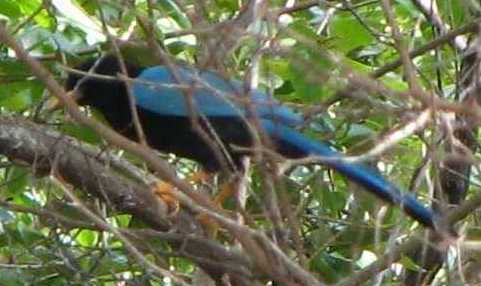
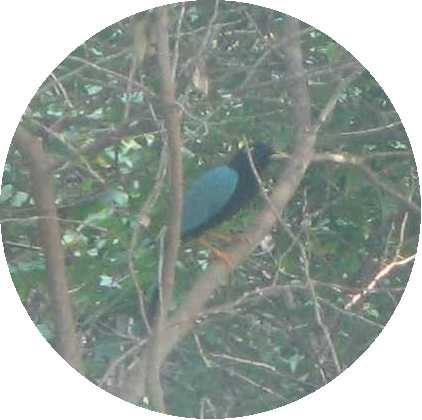
The Yucatan jay (Cyanocorax yucatanicus) is a species of bird in the family Corvidae, the crows and their allies. It is native to the Yucatán Peninsula where its habitats are subtropical or tropical dry forest, plantations and cleared areas at altitudes up to 250 m (820 ft). Adults are about 30 cm (12 in) long, black, with blue wings, mantle, and tail, black bills, yellow eye rings and legs. Immature birds have yellow bills. This is a common species of jay with a wide range and the International Union for Conservation of Nature has rated its conservation status as being of "least concern".
Taxonomy
The Yucatan jay was first described by the naturalist Alphonse Dubois in 1875. It originally places in the genus Cyanocitta, and was given the scientific name Cyanocitta yucatanica.Lua error in package.lua at line 80: module 'Module:Footnotes/anchor_id_list' not found. It is now placed by the genus Cyanocorax, which was introduced by the German zoologist Friedrich Boie in 1826, as Cyanocorax yucatanicus.Lua error in package.lua at line 80: module 'Module:Footnotes/anchor_id_list' not found.Lua error in package.lua at line 80: module 'Module:Footnotes/anchor_id_list' not found. In 1934, ornithologist Carl Eduard Hellmayr reorganized the genus Cyanocorax and split it into four subgenera. The Yucatan jay was placed into the subgenus Cissilopha as Cissilopha yucatanica.Lua error in package.lua at line 80: module 'Module:Footnotes/anchor_id_list' not found. This is now considered a synonym for the Yucatan jay.Lua error in package.lua at line 80: module 'Module:Footnotes/anchor_id_list' not found.
When Hellmayr created the subgenus Cissilopha, he placed the bushy-crested jay, the San Blas jay, and the purplish-backed jay into it along with the Yucatan jay based on their similar plumage.Lua error in package.lua at line 80: module 'Module:Footnotes/anchor_id_list' not found. This relationship was confirmed by a 2010 mitochondrial DNA study, which showed that these four species were closely related. The Yucatan jay is basal to a sister group formed by the San Blas jay and the Purplish-backed jay.Lua error in package.lua at line 80: module 'Module:Footnotes/anchor_id_list' not found.
The following cladogram (simplified from the 2010 study) shows the relationship between species in the genus Cyanocorax.Lua error in package.lua at line 80: module 'Module:Footnotes/anchor_id_list' not found.
Script error: No such module "Clade".
The Yucatan jay has two recognized subspecies.Lua error in package.lua at line 80: module 'Module:Footnotes/anchor_id_list' not found.
- C. yucataniucs yucatanicus: Found in Yucatán, Quintana Roo, and Campeche (except the southwest portion) in southeastern Mexico; Petén in northern Guatemala; and northern Belize.Lua error in package.lua at line 80: module 'Module:Footnotes/anchor_id_list' not found.
- C. yucatanicus rivularis: Found in Tabasco and southwestern Campeche in southeastern Mexico.Lua error in package.lua at line 80: module 'Module:Footnotes/anchor_id_list' not found. Somewhat larger, and with a silvery tinge to the blue Template:Birdgloss.Lua error in package.lua at line 80: module 'Module:Footnotes/anchor_id_list' not found.
Description
The adult Yucatan jay has a black head, Template:Birdgloss, and Template:Birdgloss. The back, wings, and tail are a sharp blue colour. It has black irises, black eye rings, a black beak, and yellow legs and feet. There is no difference between the sexes.Lua error in package.lua at line 80: module 'Module:Footnotes/anchor_id_list' not found.
Moults
The Yucatan jay has several distinct plumages throughout its life cycle. Juvenile Yucatan jays have a white head, body, and tail tip. The back is a soft blue, and the wings and tail are a soft grey, aside from the outer rectrices which are white. The beak, legs, and feet are a soft yellow tinged with pink. The inside of the beak is white and the irises are dark brown.Lua error in package.lua at line 80: module 'Module:Footnotes/anchor_id_list' not found. These features start to fade a few weeks after they fledge.Lua error in package.lua at line 80: module 'Module:Footnotes/anchor_id_list' not found. At this point, the legs, feet, beak, and eye ring become more distinctly yellow. The prebasic moult also begins at this point, with the white head and body feathers being replaced with black ones.Lua error in package.lua at line 80: module 'Module:Footnotes/anchor_id_list' not found.
During the first year, the Yucatan jay has an entirely black head and body. The legs, feet, and eye rings remain yellow. The inside of the beak remains white, but takes on a glaucous tone. The wings become bluer, and the tail becomes a purplish blue colour. The back and tail turn a deeper grey, and the rectrices are tipped with white. In June or August, the bill may start to develop dark patches, while remaining overall yellow. In September, the dark patches expand further.Lua error in package.lua at line 80: module 'Module:Footnotes/anchor_id_list' not found.
In its second year, the Yucatan jay's plumage is the same as that of the adult. The beak is still mottled, and by March it is primarily black with only some yellow marks, becoming entirely black within the second year. The legs and feet remain yellow. The eye ring is still distinctive of age, with some black marks appearing on the otherwise yellow flesh. By the third year, this eye ring is almost entirely black. The darkening of the beak and eye ring usually progress at the same rate. The inside of the beak starts to darken at this point as well. Any trace of yellow on both the beak and eye rings are gone by January of the third year. In the fourth year and later, the Yucatan jay has reached its full adult plumage.Lua error in package.lua at line 80: module 'Module:Footnotes/anchor_id_list' not found.
Measurements
The Yucatan jay is a medium sized jay, averaging Template:Cvt long.Lua error in package.lua at line 80: module 'Module:Footnotes/anchor_id_list' not found. There is some variation in size between the sexes. The average wing length for adults is Template:Cvt for males and Template:Cvt for females, and the average tail length is Template:Cvt for males and Template:Cvt for females. Both sexes have an average beak length of Template:Cvt, an average beak depth of Template:Cvt, and average tarsus length of Template:Cvt, and an average middle toe length of Template:Cvt.Lua error in package.lua at line 80: module 'Module:Footnotes/anchor_id_list' not found. The male is also slightly heavier, weighing Template:Cvt compared to the female who weighs Template:Cvt.Lua error in package.lua at line 80: module 'Module:Footnotes/anchor_id_list' not found.
Similar species
The Yucatan jay is visually unique within its range, with no similar species. Outside of its range, it is similar to the San Blas jay, the purplish-backed jay, and the bushy-crested jay. All three have a yellow iris whereas the Yucatan jay has a black iris, and are a brighter shade of blue on their upperparts.Lua error in package.lua at line 80: module 'Module:Footnotes/anchor_id_list' not found.Lua error in package.lua at line 80: module 'Module:Footnotes/anchor_id_list' not found.
Range and habitat
The Yucatan jay is found primarily in the Yucatán Peninsula, which comprises the northern part of the nation of Belize; Guatemala's northern El Petén Department; and the Mexican states of Yucatán, Quintana Roo, and Campeche. It is also present in parts of the neighbouring states of Chiapas and Tabasco.Lua error in package.lua at line 80: module 'Module:Footnotes/anchor_id_list' not found.
The habitats of the Yucatan Jay vary slightly depending on the subspecies. The nominate species (C. y. yucatanicus) is found most often in both humid and scrubby forests, but can also be found in coastal scrub. C. y. rivularis, found in the southwest portion of the Yucatan peninsula, can be found in almost any type of forest. It can also be found in pine forests and swamps, however it is not common in these areas. Both subspecies can be found at elevations up to Template:Cvt.Lua error in package.lua at line 80: module 'Module:Footnotes/anchor_id_list' not found.Lua error in package.lua at line 80: module 'Module:Footnotes/anchor_id_list' not found. The Yucatan jay is non-migratory.Lua error in package.lua at line 80: module 'Module:Footnotes/anchor_id_list' not found.
Status
The Yucatan jay is a common species throughout most of its wide range. Its population is considered stable, and as of 2020 there are an estimated 50,000–500,000 mature individuals in the wild. No particular threats have been identified, and the International Union for Conservation of Nature has rated its conservation status as being of least concern.Lua error in package.lua at line 80: module 'Module:Footnotes/anchor_id_list' not found.
Citations
Page Template:Reflist/styles.css has no content.
References
- Page Module:Citation/CS1/styles.css has no content.Boie, Friedrich (1826). "Generalübersicht". Isis von Oken (in Deutsch). Col 975.
- Page Module:Citation/CS1/styles.css has no content.Bonaccorso, Elisa; Peterson, A. Townsend; Navarro-Sigüenza, Adolfo G.; Fleischer, Robert C. (March 2010). "Molecular systematics and evolution of the Cyanocorax jays". Molecular Phylogenetics and Evolution. 54 (3): 897–909. doi:10.1016/j.ympev.2009.11.014. hdl:1808/6568. PMID 19931623. Archived from the original on 7 October 2024. Retrieved 10 February 2024.
- Page Module:Citation/CS1/styles.css has no content.Gill, F.; Donsker, D.; Rasmussen, P. (July 2021). "IOC World Bird List (v 14.1)". Archived from the original on October 4, 2020. Retrieved February 20, 2024.
- Page Module:Citation/CS1/styles.css has no content.Dubois, Alphonse (1875). "Cyanocitta yucatanica". Bulletins de l'Académie royale des sciences, des lettres et des beaux-arts de Belgique. 2 (40): 797. OCLC 1589466.
- Page Module:Citation/CS1/styles.css has no content.Duvall, Abigail; Kirwan, Guy M. (4 March 2020). Billerman, Shawn M.; Keeney, Brooke K.; Rodewald, Paul G.; Schulenberg, Thomas S. (eds.). "Yucatan Jay (Cyanocorax yucatanicus)". Birds of the World. doi:10.2173/bow.yucjay1.01.
- Page Module:Citation/CS1/styles.css has no content.Hardy, John William (1973). "Age and sex differences in the black-and-blue jays of Middle America" (PDF). Bird-Banding: A Journal of Ornithological Investigation. 44 (2): 81–90. doi:10.2307/4511941. JSTOR 4511941. Retrieved 9 March 2024.
- Page Module:Citation/CS1/styles.css has no content.Hellmayr, Charles E (1934). "Cissilopha yucatanica". Catalogue of birds of the Americas and the adjacent islands in Field Museum of Natural History and including all species and subspecies known to occur in North America, Mexico, Central America, South America, the West Indies, and islands of the Caribbean Sea, the Galapagos Archipelago, and other islands which may properly be included on account of their faunal affinities. Publication. Vol. 13. pp. 39–40. doi:10.5962/bhl.title.5570. OCLC 13897940.
- Page Module:Citation/CS1/styles.css has no content.Lepage, Denis. "Yucatan jay". Avibase. Retrieved 15 March 2024.
- Page Module:Citation/CS1/styles.css has no content.Madge, Steve; Burn, Hilary (1994). Crows and jays: a guide to the crows, jays, and magpies of the world. Boston: Houghton Mifflin. pp. 81–82. ISBN 0-395-67171-X.
- Page Module:Citation/CS1/styles.css has no content.Raitt, Ralph J; Hardy, John William (December 1976). "Behavioral Ecology of the Yucatan Jay" (PDF). The Wilson Bulletin. 88 (4). Wilson Ornithological Society: 529–721.
- Page Module:Citation/CS1/styles.css has no content.Ridgway, R. (1904). "The Birds of North and Middle American Part III". Bulletin of the United States National Museum. 50: 315. ISSN 0096-2961. OCLC 7347186.
External links
Page Module:Side box/styles.css has no content.Page Template:Sister project/styles.css has no content.
Page Module:Side box/styles.css has no content.Page Template:Sister project/styles.css has no content.
- Page Module:Citation/CS1/styles.css has no content."Yucatan jay media". Internet Bird Collection.
- Yucatan jay photo gallery at VIREO (Drexel University)
- Photo; Article world.std.com–"Mexican Birds: Villahermosa and Palenque" Photo-2
- Yucatan jay species account at Neotropical Birds (Cornell Lab of Ornithology)
- Interactive range map of Cyanocorax yucatanicus at IUCN Red List
Lua error in package.lua at line 80: module 'Module:Navbox/configuration' not found.
Script error: No such module "Taxonbar".



.jpg)