Pollock roe
Page Module:Infobox/styles.css has no content.
| Alaska pollock roe |
|---|
Pollock roe, also pollack roe (also known as tarako in Japanese and myeongnan in Korean), is the roe of Alaska pollock (Gadus chalcogrammus) which, despite its name, is a species of cod. Salted pollock roe is a popular culinary ingredient in Japanese, Korean and Russian cuisines.
Names
The purely Korean name for pollock, myeongtae can be written with Hanja Script error: No such module "Lang". (Script error: No such module "Lang".), which can be read as mentai in Japanese. But while the Japanese borrowed this name from Korean and called it mentaiko,[1] the term does not retain the original meaning of plain raw roe, but specifically refers the chili pepper-added cured roe, while salt-cured only types are called tarako.[1][2][3]
Korean
As aforementioned, Alaska pollock in Korean is myeongtae (Korean: Script error: No such module "Lang".; Hanja: Script error: No such module "Lang".), hence pollock roe is myeongnan (Script error: No such module "Lang".; Script error: No such module "Lang".), a contracted form of the compound with +ran or +nan (Script error: No such module "Lang".; Script error: No such module "Lang".) meaning "egg (roe)".
The salted roe dish is called myeongnan-jeot (Script error: No such module "Lang".), being considered a type of jeot (Script error: No such module "Lang".) or jeotgal, which is a category of salted seafood.
Japanese
In Japanese, (salted) pollock roe is called tarako (Script error: No such module "Lang".),[2][3] though it literally means 'cod roe',[a] while true cod roe is distinguished by calling it hontarako.[4][5] The pollock roe, also known as momijiko, are usually salted and dyed red.[4][5][b]
Pollock roe cured with red chili pepper are Script error: No such module "Nihongo".;[5][2] to put it another way, mentaiko refers to chili-laced versions of tarako, generally speaking,[1] even if not qualified as karashi-mentaiko with the prefix meaning 'chili'.[c]
Russian
In Russian, pollock roe is called ikra mintaya (Script error: No such module "Lang".). This name is also used to refer to salted roe. The Russian word ikra (Script error: No such module "Lang".) means "roe" and mintaya (Script error: No such module "Lang".) is the singular genitive form of Script error: No such module "lang". (Script error: No such module "Lang".), which means Alaska pollock. This word is derived from its Korean cognate, myeongtae (Script error: No such module "Lang".).
History
Korea
Koreans have been enjoying pollock roe since the Joseon era (1392–1897). One of the earliest mentions are from Diary of the Royal Secretariat, where a 1652 entry stated: "The management administration should be strictly interrogated for bringing in pollock roe instead of cod roe."[6] Recipe for salted pollock roe is found in a 19th-century cookbook, Siuijeonseo.
Japan
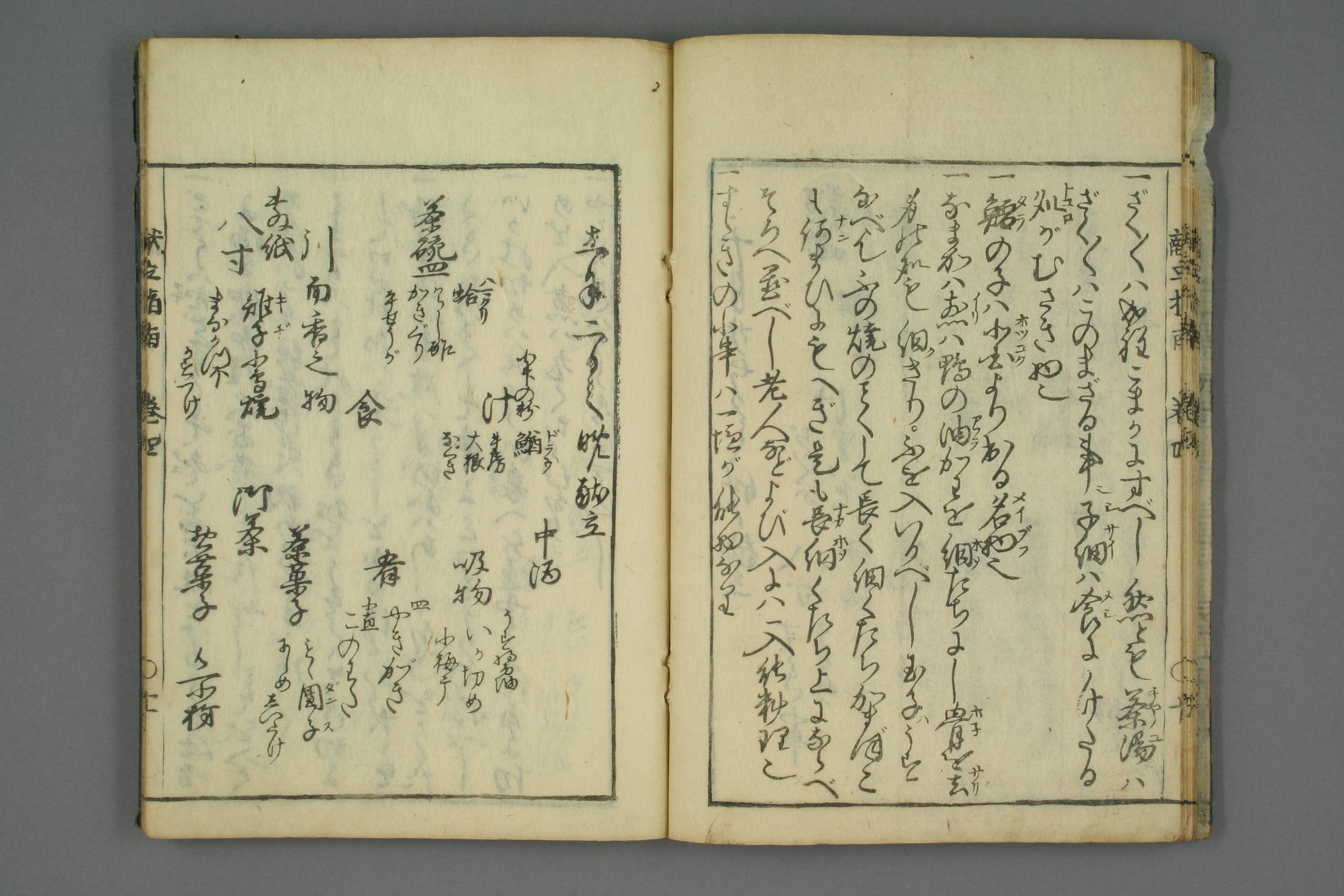
A 1696 Japanese book records the use of Alaska pollock's roe in Hokurikudō.[7]
The dish mentaiko originates from Korea, but after years of modification, most of the pollock roe consumed in Japan is Japanese mentaiko.[8] [9] [10][11][12][13][14] Script error: No such module "Nihongo"., who was born in the city of Busan, Korea during the Japanese occupation, founded the oldest mentaiko company in Japan called "Aji no Mentaiko Fukuya" (ja:ふくや) after World War II. He made several modifications to myeongnan-jeot to adapt to Japanese tastes and introduced it to Japan as "Karashi mentaiko" (ja:辛子明太子), its popular name is "mentaiko". The milder, less spicy version is called tarako (Script error: No such module "Lang".) in Japan.[8]
Consumption
Page Module:Infobox/styles.css has no content.
| Lua error in package.lua at line 80: module 'Module:InfoboxImage/data' not found. | |
| Alternative names | Myeongnan Myeongnan-jeot Tarako Mentaiko Ikra mintaya |
|---|---|
| Type | Jeotgal |
| Course | Banchan |
| Place of origin | Korea |
| Associated cuisine | Korean cuisine Japanese cuisine Russian cuisine |
| Main ingredients | Roe of Alaska pollock |
| Template:If first display both | |
Page Template:Plainlist/styles.css has no content.
| |
Script error: No such module "Check for conflicting parameters". Page Module:Infobox/styles.css has no content.
| Salted Alaska pollock roe |
|---|
Korea
Script error: No such module "Labelled list hatnote". Traditionally, myeongnan-jeot was made before dongji (winter solstice). Intact skeins of Alaska pollock roe are washed carefully with salt water, then salted in a sokuri (bamboo basket). The ratio of salt to roe ranges from less than 5:100 to more than 15:100. After 2–3 days, salted and drained roe is marinated for at least a day with fine gochutgaru (chilli powder) and finely minced garlic. myeongnan-jeot is usually served with sesame seeds or some drops of sesame oil.
Myeongnan-jeot, whether raw, dried, and/or cooked, is a common banchan (side dish) and anju (food served with alcoholic beverages). It is also used in a variety of dishes, such as gyeran-jjim (steamed egg), bokkeum-bap (fried rice), and recently in Korean-style Italian pasta dishes.
Myeongnan-jeot is a specialty of South Hamgyong Province of North Korea, and Gangwon Province and Busan of South Korea.
-
Myeongnan-jeot sold in a market
-
Vacuum-packed myeongnan-jeot
-
Heavily seasoned myeongnan-jeot
-
Myeongnan-jeot-muchim (salted pollock roe salad)
-
Myeongnan-jeot-gyeran-mari (rolled omelette with salted pollock roe)
-
Myeongnnan-jeot in jjigae (stew)
-
Myeongnan-jeot pizza
Japan
Mentaiko, adapted from Korean myeongnan-jeot,[9][10][11][12][13][14] hence the name mentai (derived from the Korean myeongtae, 명태, 明太, meaning pollack) + ko (Korean 알, 子, meaning baby/roe), is common in Japan. It is made in a variety of flavors and colors and is available at airports and main train stations. It is usually eaten with onigiri, but is also enjoyed by itself with sake. A common variety is Script error: No such module "Nihongo".. It is a product of the Hakata ward of Fukuoka City. Milder version is called tarako (Script error: No such module "Lang".),
Recently in Japan, mentaiko pasta has become common. Mentaiko is mixed with butter or mayonnaise and used as a sauce for spaghetti. Thin strips of nori (海苔) and shiso leaves are often sprinkled on top.
Pollack roe is dipped in a seasoning liquid. This method was invented in the grocery store "Fukuya(ふくや)" and became common in Japan.[15][16]
Mentaiko was nominated as Japan's number one side dish in the Japanese weekly magazine, Shūkan Bunshun.[17]
Tarako is served in a number of ways: plain (usually for breakfast),[18] as a filling for onigiri, and as a pasta sauce (usually with nori). Traditionally, tarako was dyed bright red, but recent concerns about the safety of food coloring have all but eliminated that custom.[18] In Kyūshū, tarako is commonly served with red chili pepper flakes.
-
Tarako
-
Mentaiko
-
Baked mentaiko
-
Mentaiko-chazuke
-
Mentaiko over rice, with nori strips
-
Tarako spaghetti
Russia
In Russia, pollock roe is consumed as a sandwich spread. The product, resembling liquid paste due to the small size of eggs and oil added, is sold as canned food.
As mentioned above, in Russian, the word for pollock roe is the same as for the caviar: "ikra". The same goes to a dish, known to the French as "caviar d'aubergine": "кабачковая икра", although it's a spread made of eggplants.
To make the pollock roe taste in a caviar-like way, one should make a butterbrot first e.g. to apply butter to the bread before adding the canned pollock roe. This will smoothen the excessive saltiness of the canned roe.
-
An open sandwich with canned roe
-
A piece of similar bread with less roe used since Ikra mintaya (canned roe) is rather salty.[19]
See also
Lua error in mw.title.lua at line 404: bad argument #2 to 'title.new' (unrecognized namespace name 'Portal').
Explanatory notes
Page Template:Reflist/styles.css has no content.
- ^ i.e., Script error: No such module "Nihongo". Script error: No such module "Nihongo"., however, since pollock bears the name suketōdara (Script error: No such module "Lang".) it is linguistically understood to be subtype of the tara or 'cod', so this is not exactly a misnomer in the Japanese language.
- ^ Whereas hontarako is usually sold raw, to be made into nitsuke (simmered or braise) or made into the soy sauce preserved tsukudani.[5]
- ^ That is to say, the sources treat mentaiko and karashi-mentaiko are synonyms, and thus interchangeable. Note that 'chili' is more formally tōgarashi[3] = tō 'foreign, Chinese' + karashi 'mustard'.[2][3]
References
Page Template:Reflist/styles.css has no content.
- ^ a b c Page Module:Citation/CS1/styles.css has no content.Sugimoto, Tsutomu [in 日本語] (2005). Gogenkai 語源海 (in 日本語). Tokyo Shoseki. p. 288. ISBN 4487797438.
- ^ a b c d Page Module:Citation/CS1/styles.css has no content.Uchida, Hirotsugu; Watanobe, Masamichi (2008). "Walleye pollack (Suketoudara) fishery management in the Hiyama region of Hokkaido, Japan". In Townsend, R.; Shotton, R.; Uchida, H. (eds.). Case Studies in Fisheries Self-governance. Food & Agriculture Org. p. 163. ISBN 9789251058978.
- ^ a b c d Page Module:Citation/CS1/styles.css has no content.Mouritsen, Ole G. [in dansk]; Styrbæk, Klavs (2023). Rogn: Meget mere end rogn. Gyldendal A/S. ISBN 9788702392029.
karashi-mentaiko (mentaiko) - krydret variant af tarako, som er saltet torskerogn.. med.. japansk chili (togarashi) [karashi-mentaiko (mentaiko) - spicy variant of tarako, which is salted cod roe...with.. Japanese chili (togarashi).]
- ^ a b Page Module:Citation/CS1/styles.css has no content.OECD: Organisation for Economic Co-operation and Development (2009). "Caviar substitutes". Multilingual Dictionary of Fish and Fish Products. John Wiley & Sons. p. 39. ISBN 9781444319422.
- ^ a b c d Page Module:Citation/CS1/styles.css has no content.Koizumi, Takeo [in 日本語] (2002). Shoku to nihonjin no chie 食と日本人の知恵 (in 日本語). Iwanami Shoten. pp. 401, 662. ISBN 9784006030520.
- ^ Page Module:Citation/CS1/styles.css has no content.Cha, Sang-eun (12 September 2015). "A hit abroad, pollock roe is rallying at home". Korea Joongang Daily. Retrieved 16 December 2016.
- ^ Page Module:Citation/CS1/styles.css has no content."遠藤元閑(1696年)『茶湯献立指南』、「鱈の子は北国より出る名物也」" (JPG). Archive.wul.waseda.ac.jp. Retrieved 15 May 2018.
- ^ a b Page Module:Citation/CS1/styles.css has no content."I asked store owner of Fukuya why the mentaiko is a local specialty of Hakata". dailyportalz. 2 April 2018.
- ^ a b Page Module:Citation/CS1/styles.css has no content."Mentaiko and the Japanese People". JACAR Newsletter. 4 February 2016. Archived from the original on 14 October 2017. Retrieved 14 October 2017.
- ^ a b Page Module:Citation/CS1/styles.css has no content."Busan, the City of Pollock Roe". Lotte Hotel Magazine. Archived from the original on 24 May 2022. Retrieved 24 May 2022.
- ^ a b Page Module:Citation/CS1/styles.css has no content."Fukuoka Food Guide". japan-guide.com. Archived from the original on 24 May 2022. Retrieved 24 May 2022.
- ^ a b Page Module:Citation/CS1/styles.css has no content.Preston Matt (27 October 2015). The Simple Secrets to Cooking Everything Better. Plum. ISBN 9781743547618. Archived from the original on 24 May 2022. Retrieved 24 May 2022.
- ^ a b Page Module:Citation/CS1/styles.css has no content.Yuto Omura (28 July 2021). "Japanese Mentaiko Pasta (Cod Roe Spaghetti)". Sudachi Recipes. Archived from the original on 24 May 2022. Retrieved 24 May 2022.
- ^ a b Page Module:Citation/CS1/styles.css has no content.Grace Keh (18 September 2014). "Mentaiko Spaghetti Recipe (明太子)". Sffood.net. Archived from the original on 24 May 2022. Retrieved 24 May 2022.
- ^ Page Module:Citation/CS1/styles.css has no content.産経新聞 (2016-10-05). "【九州の礎を築いた群像】辛子めんたいこ編(2)誕生". 産経新聞:産経ニュース (in 日本語). Retrieved 2025-03-03.
- ^ Page Module:Citation/CS1/styles.css has no content."Mentaiko for sale - Hakata Nakasu Aji no Mentaiko Fukuya". 味の明太子ふくや (in 日本語). Retrieved 2025-03-03.
- ^ Page Module:Citation/CS1/styles.css has no content.Ahn Min-jeong (6 May 2011). "일본인 좋아하는 밥반찬에 한국의 그것?". JPNews. Archived from the original on 22 November 2011. Retrieved 19 November 2016.
- ^ a b Page Module:Citation/CS1/styles.css has no content.Ashkenazi, Michael; Jacob, Jeanne (2003). Food Culture in Japan. Greenwood Publishing Group. pp. 58–9. ISBN 0-313-32438-7. Archived from the original on 24 May 2022. Retrieved 24 May 2022.
- ^ Page Module:Citation/CS1/styles.css has no content.Новейшая энциклопедия здорового питания. ОЛМА Медиа Групп. p. 124. ISBN 9785765435588.
External links
- Page Template:Sister-inline/styles.css has no content.Script error: No such module "Sister project logo". Media related to Script error: No such module "Commons link". at Wikimedia Commons
Template:Korean food and drink Template:Japanese food and drink Lua error in package.lua at line 80: module 'Module:Navbox/configuration' not found. Lua error in package.lua at line 80: module 'Module:Navbox/configuration' not found. Lua error in package.lua at line 80: module 'Module:Navbox/configuration' not found.



_in_a_market.jpg)
.jpg)
.jpg)


_in_jjigae.jpg)
.jpg)


.jpg)


![A piece of similar bread with less roe used since Ikra mintaya (canned roe) is rather salty.[19]](/index.php?title=Special:Upload&wpDestFile=Alaska_pollock_roe_Russia.jpg)