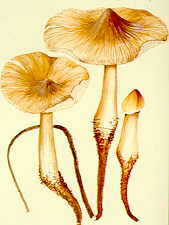
Termitomyces
Template:Short description Script error: No such module "Automated taxobox".
Termitomyces is a genus of basidiomycete fungi known as termite mushrooms in Lyophyllaceae family[3] farmed by fungus-growing termites.[note 1] The fungi and the termites interdepend to live,[4][5] as the termites house and culture the fungi, and the fungi in turn provide foods for the termites. Often after a raining,[6] the fungi grow mushrooms, which are edible and highly regarded for their flavor.[7]
Morphology
Termitomyces includes the largest edible mushroom in the world, Termitomyces titanicus of West Africa and Zambia, whose cap reaches 1 metre (3.28 ft) in diameter.[8] It also includes Termitomyces microcarpus that grows caps of a few centimeters in diameter.
Life as a Termitomyces fungus
Comb-associated saprotrophy
Some chamber(s) of the fungus-growing termite nest each contains an object, called comb or fungus garden, where the fungus dwells.[9] The comb is formed from the termites' excreta – the termites collect and chew up dead wood, leaf litter and other vegetable debris, depositing their primary faeces, which contain asexual Termitomyces spores the termites previously consumed, as new portions of the fungus garden.[10] The spores comes from another object the termites consumed – little balls that grow on the comb called spherules.[note 2] Thereafter, the Termitomyces fungus grows through the comb. Old combs are eaten by termites as well.[11]
Opportunist antagonist Pseudoxylaria
Fungi of Pseudoxylaria (termite-associated Xylaria, a subgenus of Xylaria) are found in fungus-growing termite combs.[12] Suppressed by fungus-growing termites,[13] they flourish at the price of the Termitomyces fungus when the termite nest is deteriorating or deserted.[14][12]
Reproduction
When a new termite colony is established, in most cases, the Termitomyces fungus is introduced through the activities of the termites collecting spores from the environment.[5] For spreading spores, the Termitomyces fungus forms mushrooms. For most species, the fungus grows rooting stipes (pseudorhizas) to the surface of the ground, where mushrooms are formed.[15] For Termitomyces microcarpus, the mushrooms grow from fungus garden fragments that are carried outside the nest by worker termites.[16] On the other hand, Termitomyces cryptogamus is not found to grow a mushroom in nature.[note 3][17]
Research history
Termitomyces was described by Roger Heim in 1942.[18]
From 1955 to 1969 Arthur French [19] worked in Uganda (as a hobby) on the subject of fungi and termites. Some scientific literature about these fungal species existed previously, but these texts failed to adequately discuss the relationship between termites and their fungal symbiotes, while the various edible varieties were merely termed "termite mushrooms." French conducted some investigations with the help of the elderly Baganda women who gathered termite mushrooms, and published his findings.
Culinary use
In the Philippines, they are highly-prized and are foraged regularly during the rainy season since ancient times, alongside other edible local mushroom species. They are associated with termite mounds (Script error: No such module "Lang".) and are known under various different names including Script error: No such module "Lang". (lit. "termite mound mushroom") and Script error: No such module "Lang". in Tagalog; Script error: No such module "Lang". or Script error: No such module "Lang". in Cebuano; and Script error: No such module "Lang". in various Cordilleran languages.[20][21][22]
They are foraged in Malaysia, known as cendawan busut ("mound mushroom"). Tamil rubber tappers in Selangor long time ago would find a lot of T. schimperi growing in estate environments not long after raining.[23]Template:Rp They are widely eaten across India.[24][25][26]
Lookalikes
Many cases of mushroom poisoning in Malaysia happen because Chlorophyllum molybdites look similar to Termitomyces fungi.[27]
Species
Species of Termitomyces included in Species Fungorum, 52 as of July 2023[update], are enumerated.[28]
Page Template:Div col/styles.css has no content.
- Termitomyces acriumbonatus Usman & Khalid (2020)
- Termitomyces albidus (Singer) L.D. Gómez (1995)
- Termitomyces aurantiacus (R. Heim) R. Heim (1977)
- Termitomyces biyi Otieno (1966)
- Termitomyces bulborhizus T.Z. Wei, Y.J. Yao, Bo Wang & Pegler (2004)
- Termitomyces citriophyllus R. Heim (1942)
- Termitomyces clypeatus R. Heim (1951)
- Termitomyces congolensis (Beeli) Singer (1948)
- Termitomyces dominicalensis L.D. Gómez (1995)
- Termitomyces entolomoides R. Heim (1951)
- Termitomyces epipolius (Singer) L.D. Gómez (1995)
- Termitomyces eurrhizus (Berk.) R. Heim (1942)
- Termitomyces floccosus S.M. Tang, Raspé & S.H. Li (2020)
- Termitomyces fragilis L. Ye, Karun, J.C. Xu, K.D. Hyde & Mortimer (2019)
- Termitomyces fuliginosus R. Heim (1942)
- Termitomyces gilvus C.S. Yee & J.S. Seelan (2020)
- Termitomyces globulus R. Heim & Gooss.-Font. (1951)
- Termitomyces griseiumbo Mossebo (2003)
- Termitomyces heimii Natarajan (1979)
- Termitomyces indicus Natarajan (1976)
- Termitomyces infundibuliformis Mossebo (2012)
- Termitomyces intermedius Har. Takah. & Taneyama (2016)
- Termitomyces lanatus R. Heim (1977)
- Termitomyces le-testui (Pat.) R. Heim (1942)
- Termitomyces magoyensis Otieno (1966)
- Termitomyces mammiformis R. Heim (1942)
- Termitomyces mboudaeinus Mossebo (2003)
- Termitomyces mbuzi Härkönen & Niemelä (2021)
- Termitomyces medius R. Heim & Grassé (1951)
- Termitomyces microcarpus (Berk. & Broome) R. Heim (1942)
- Termitomyces narobiensis Otieno (1966)
- Termitomyces perforans R. Heim (1977)
- Termitomyces poliomphax (Singer) L.D. Gómez (1995)
- Termitomyces rabuorii Otieno (1966)
- Termitomyces radicatus Natarajan (1977)
- Termitomyces reticulatus Van der Westh. & Eicker (1990)
- Termitomyces robustus (Beeli) R. Heim (1951)
- Termitomyces sagittiformis (Kalchbr. & Cooke) D.A. Reid (1975)
- Termitomyces schimperi (Pat.) R. Heim (1942)
- Termitomyces sheikhupurensis Izhar, Khalid & H. Bashir (2020)
- Termitomyces singidensis Saarim. & Härk. (1994)
- Termitomyces songolarum (Courtec.) Furneaux (2020)
- Termitomyces spiniformis R. Heim (1977)
- Termitomyces srilankensis Ediriweera, Voto, Karun. & Kularathne (2023)
- Termitomyces striatus (Beeli) R. Heim (1942)
- Termitomyces subclypeatus Mossebo (2003)
- Termitomyces subumkowaan Mossebo (2003)
- Termitomyces titanicus Pegler & Piearce (1980)
- Termitomyces tylerianus Otieno (1966)
- Termitomyces umkowaan (Cooke & Massee) D.A. Reid (1975)
- Termitomyces upsilocystidiatus S.M. Tang, Raspé & K.D. Hyde (2020)
Reidentified as external
- Macrolepiota albuminosa (Berk.) Pegler (1972) / Termitomyces albuminosus (Berk.) R.Heim (1941)
- — The original specimens were identified as termite mushrooms by Petch (1912).[29] However, this identification failed to take their microscopic morphology into account.[30] In a position outside the Termitomyces genus;[30] identified by Pegler (1986) as the same species as Leucocoprinus cepistipes.[31]
- Sinotermitomyces meipengianus M. Zang & D.Z. Zhang (2004) / Termitomyces meipengianus (M. Zang & D.Z. Zhang) P.M. Kirk (2014)
- — In a position outside the Termitomyces genus; likely in Xerula, Oudemansiella or a position nearby.[32]
Notes
Page Template:Reflist/styles.css has no content.
See also
References
Page Template:Reflist/styles.css has no content.
- ^ Page Module:Citation/CS1/styles.css has no content.Kirk PM, Cannon PF, Minter DW, Stalpers JA (2008). Dictionary of the Fungi (10th ed.). Wallingford, UK: CABI. p. 682. ISBN 978-0-85199-826-8.
- ^ Page Module:Citation/CS1/styles.css has no content."Termitomyces R. Heim 1942". MycoBank. International Mycological Association. Retrieved 2010-12-23.
- ^ Page Module:Citation/CS1/styles.css has no content.Bellanger JM, Moreau PA, Corriol G, et al. (2015). "Plunging hands into the mushroom jar: a phylogenetic framework for Lyophyllaceae (Agaricales, Basidiomycota)". Genetica. 143 (2): 169–94. doi:10.1007/s10709-015-9823-8. PMID 25652231. S2CID 254505216.
- ^ The Biggest Mushroom? — MykoWeb
- ^ a b Page Module:Citation/CS1/styles.css has no content.Nobre T, Aanen DK (2010). "Dispersion and colonisation by fungus-growing termites". Communicative & Integrative Biology. 3 (3): 248–250. doi:10.4161/cib.3.3.11415. PMC 2918769. PMID 20714406.
- ^ Page Module:Citation/CS1/styles.css has no content.Koné NA, Dosso K, Konaté S, Kouadio JY, Linsenmair KE (2011). "Environmental and biological determinants of Termitomyces species seasonal fructification in central and southern Côte d'Ivoire". Insectes Sociaux. 58 (3): 371–82. doi:10.1007/s00040-011-0154-1.
- ^ Page Module:Citation/CS1/styles.css has no content.Turnbull E, Watling R (1999). "Some Records of Termitomyces from Old World Rainforests". Kew Bulletin. 54 (3): 731–738. Bibcode:1999KewBu..54..731T. doi:10.2307/4110869. JSTOR 4110869.
- ^ Page Module:Citation/CS1/styles.css has no content.Pegler DN, Piearce GD (1980). "The edible mushrooms of Zambia". Kew Bulletin. 35 (3): 475–491. doi:10.2307/4110017.
- ^ Page Module:Citation/CS1/styles.css has no content.Luisa, Bozzano G. (2012). Insect-Fungus Interactions. Academic Press. p. 71. ISBN 978-0-08-098453-7.
- ^ Page Module:Citation/CS1/styles.css has no content.Rouland-Lefèvre C, Bignell DE (2006). "Cultivation of symbiotic fungi by termites of the subfamily Macrotermitinae". Symbiosis. Cellular Origin, Life in Extreme Habitats and Astrobiology. Vol. 4. p. 737. doi:10.1007/0-306-48173-1_46. ISBN 1-4020-0189-4.
- ^ Page Module:Citation/CS1/styles.css has no content.Batra, S.W.T. (1975). "Termites (Isoptera) Eat and Manipulate Symbiotic Fungi". Journal of the Kansas Entomological Society. 48 (1): 89–92. JSTOR 25082718.
- ^ a b Page Module:Citation/CS1/styles.css has no content.Fricke J, Schalk F, Kreuzenbeck NB, et al. (2023). "Adaptations of Pseudoxylaria towards a comb-associated lifestyle in fungus-farming termite colonies". The ISME Journal. 17 (5): 733–747. Bibcode:2023ISMEJ..17..733F. doi:10.1038/s41396-023-01374-4. PMC 10119272. PMID 36841903.
- ^ Page Module:Citation/CS1/styles.css has no content.Katariya L, Ramesh PB, Gopalappa T, et al. (2017). "Fungus-Farming Termites Selectively Bury Weedy Fungi that Smell Different from Crop Fungi". Journal of Chemical Ecology. 43 (10): 986–995. Bibcode:2017JCEco..43..986K. doi:10.1007/s10886-017-0902-4. PMID 29124530. S2CID 254656744.
- ^ Page Module:Citation/CS1/styles.css has no content.Visser AA, Kooij PW, Debets AJ, Kuyper TW, Aanen DK (2011). "Pseudoxylaria as stowaway of the fungus-growing termite nest: Interaction asymmetry between Pseudoxylaria, Termitomyces and free-living relatives". Fungal Ecology. 4 (5): 322–32. doi:10.1016/j.funeco.2011.05.003.
- ^ Page Module:Citation/CS1/styles.css has no content.Boddy L (2016). "Interactions with Humans and Other Animals". The Fungi. p. 332. doi:10.1016/b978-0-12-382034-1.00009-8. ISBN 9780123820341.
- ^ Page Module:Citation/CS1/styles.css has no content.Heim R (1977). Termites et Champignons. pp. 1–205. ISBN 2-85004-004-5.
- ^ Page Module:Citation/CS1/styles.css has no content.Van de Peppel LJ, De Beer ZW, Aanen DK, Auxier B (2022). "Termitomyces cryptogamus sp. nov. associated with Macrotermes natalensis in Africa". Mycotaxon. 137 (1): 41–50. doi:10.5248/137.41. hdl:2263/92420.
- ^ Page Module:Citation/CS1/styles.css has no content.Heim R. (1942). "Nouvelles études descriptives sur les agarics termitophiles d'Afrique tropicale". Archives du Muséum National d'Histoire Naturelle (in French). 18 (6): 107–66.
{{cite journal}}: CS1 maint: unrecognized language (link) - ^ Page Module:Citation/CS1/styles.css has no content.French A. (1993). "The Mushroom-Growing Termites of Uganda". Petits Propos Culinaires (44): 35–41.
- ^ Page Module:Citation/CS1/styles.css has no content.Corazon, D.; Licyayo, M. (2023). "Gathering practices and actual use of wild edible mushrooms among ethnic groups in the Cordilleras, Philippines". In Niehof, Anke; Gartaula, Hom N.; Quetulio-Navarra, Melissa (eds.). Diversity and Change in Food Wellbeing: Cases from Southeast Asia and Nepal. Brill. pp. 71–85. ISBN 9789086868643.
- ^ Page Module:Citation/CS1/styles.css has no content.Quimio, T.H. (1977). "Isolation and laboratory culture of Termitomyces cartilageneus". Philippine Agriculture. 61: 55–63.
- ^ Page Module:Citation/CS1/styles.css has no content."Termitomyces cartilaginous". Project Noah. Retrieved 12 August 2025.
- ^ Page Module:Citation/CS1/styles.css has no content.Hilton, Roger N.; Dhitaphichit, Pannee (1993). "Procedures in Thai Etnomycology". Natural History Bulletin of the Siam Society. 41 (2): 75–92.
- ^ Page Module:Citation/CS1/styles.css has no content.Karun N.C.; Sridhar K.R. (2013). "Occurrence and distribution of Termitomyces (Basidiomycota, Agaricales) in the Western Ghats and on the west coast of India" (PDF). Czech Mycol. 65 (2): 233–254. doi:10.33585/cmy.65207.
- ^ Page Module:Citation/CS1/styles.css has no content.Sharma, Roshi; Sharma, Yash Pal; Hashmi, Sayed Azhar Jawad; Kumar, Sanjeev; Manhas, Rajesh Kumar (2022). "Ethnomycological study of wild edible and medicinal mushrooms in district Jammu, J&K (UT), India". Journal of Ethnobiology and Ethnomedicine. 18 (1): 23. doi:10.1186/s13002-022-00521-z. ISSN 1746-4269. PMC 8953059. PMID 35331275.
- ^ Page Module:Citation/CS1/styles.css has no content.Karun, Namera C.; Sridhar, Kandikere R. (2017). "Edible wild mushrooms of the Western Ghats: Data on the ethnic knowledge". Data in Brief. 14: 320–328. doi:10.1016/j.dib.2017.07.067. PMC 5547233. PMID 28795109.
- ^ Page Module:Citation/CS1/styles.css has no content.Phan Chia Wei (17 December 2018). "Preventing fatal harvest of mushrooms". Asia Research News. Retrieved 14 July 2023.
- ^ Page Module:Citation/CS1/styles.css has no content."Species Fungorum - Termitomyces". www.speciesfungorum.org. Retrieved 2023-07-29.
- ^ Page Module:Citation/CS1/styles.css has no content.Petch T (1912). "Revisions of Ceylon Fungi (Part III.)". Annals of the Royal Botanic Gardens, Peradeniya. Vol. 5. pp. 265–301 (see pp. 266–68).
- ^ a b Page Module:Citation/CS1/styles.css has no content.Pegler DN, Rayner RW (1969). "A contribution to the Agaric flora of Kenya". Kew Bulletin. 23 (3): 347–412 (see pp. 373–74). doi:10.2307/4117177.
- ^ Page Module:Citation/CS1/styles.css has no content.Pegler DN (1986). Agaric Flora of Sri Lanka. Kew Bulletin Additional Series XII. pp. 1–519. ISBN 978-0112500049.
- ^ Page Module:Citation/CS1/styles.css has no content.Wei TZ, Tang BH, Yao YJ (2009). "Revision of Termitomyces in China". Mycotaxon. 108 (1): 281. doi:10.5248/108.257. ISSN 0093-4666.
External links
- Tobias Frøslev's Termitomyces page
- Patterns of interaction specificity of fungus-growing termites and Termitomyces symbionts in South Africa
- Image of a Termitomyces
- UN FAO report about Wild edible fungi
Script error: No such module "Taxonbar". Lua error in package.lua at line 80: module 'Module:Authority control/config' not found.